Man sentenced to nearly 13 years for conviction in 2017 rape of Lawrence teen

photo by: Mackenzie Clark
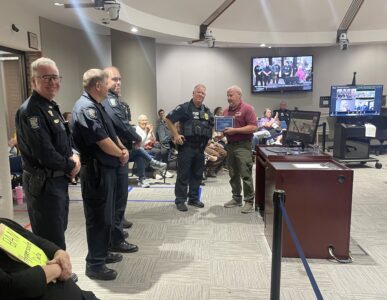
Jordan Ross, left, listens to the judge at Ross' sentencing hearing on Jan. 7, 2020, as his defense attorney, Cooper Overstreet, stands to speak.
A Topeka man was sentenced Tuesday to 155 months, or nearly 13 years, in prison for raping a Lawrence teen at a house party.
On Nov. 4, a jury found 22-year-old Jordan K. Ross guilty of raping a then-15-year-old girl at a Lawrence house party in August 2017. The girl testified that she blacked out and woke up to Ross taking off her pants and then raping her.
In a hearing on Dec. 20, Ross’ defense attorney, Cooper Overstreet, had requested that the judge consider a lesser sentence or probation for Ross.
Senior Assistant District Attorney Alice Walker on Tuesday proffered the testimony of another witness who reported a similar incident involving Ross to Topeka police in the summer of 2019. Chief Judge James McCabria ruled that he did not need to hear from that witness before making his decision.
Overstreet had brought in Gregory Nawalanic, clinical psychology director for the University of Kansas Health System’s Strawberry Hill Campus, to testify about cognitive and psychological assessments of Ross and his risks of recidivism, reoffending and other factors. Nawalanic previously suggested that Ross could be a good candidate for probation.
Walker cross-examined Nawalanic Tuesday. He testified that his assessments showed Ross’ IQ to be in the low-average range, as he’d said previously. Nawalanic agreed that Walker was accurate in saying it doesn’t require a high IQ to know that “no means no” and “stop means stop.”
She also asked whether he was aware of any similar allegations raised against Ross in the summer of 2019. Nawalanic was not, but he said if there were similar allegations, particularly after Ross was already charged in the Lawrence case, that could impact the assessments and his opinion.
Overstreet said in his final argument that Ross did not have the maturity level of most people his age. He said he wasn’t arguing that Ross was perfect — he has his flaws and issues, but they could be addressed by treatment, and a long prison sentence would negate the benefits of treatment, Overstreet said.
In her final argument, Walker said that Ross did have a great support system, which was a large factor Overstreet had touted in favor of probation. But she said that support system was already in place in August of 2017 when the offense occurred, and it didn’t prevent it from happening.
Walker read a letter from the victim, who was present but did not wish to speak. The victim wrote that she wanted to thank the prosecutor, the 12 people on the jury, her mother and several others for “seeing my truth.” She wrote that she is a rape survivor, but “one day I won’t have to just survive, because today justice was served.”
Overstreet read a letter that Ross had written, as his client was too overcome with emotion to read it himself. Ross wrote about how he grew up in a single-parent home and was raised in church — not on the street. He wrote that he was bullied starting in his freshman year for his weight and his voice, among other things. But he said he’s thankful for what he has, including his nephew and two nieces, and he said he wants to be able to take care of his mother as she ages. He also wrote that he wants to finish school to be a computer engineer.
McCabria ruled that he did not need to hear from the state’s rebuttal witness because he did not believe it would change how he was going to rule on the request for probation or a shortened sentence.
He told Ross that “frankly, I just didn’t believe” his statements at trial. Though the jury heard Ross’ initial interview with police, during which he said he’d had sex with the victim, Ross had testified at trial that they had not had intercourse but rather had other relations.
McCabria said Ross had a good family — several supporters have shown up to court appearances throughout the roughly 2 1/2-year-long case — and that he had several qualities that would serve him well in life. He said Ross was being sentenced for something he did, even though he had struggled to accept that. McCabria said people have to suffer certain consequences when they’ve done wrong, and if they accept them, they can move on as better people.
McCabria waived all court costs and fees, considering the length of Ross’ sentence. Ross will earn credit for 68 days served in custody, and he’s eligible for up to 15% good time credit. When he’s released from prison, he will have lifetime post-release supervision.
Overstreet declined to comment for this article.
Contact Mackenzie Clark
Have a story idea, news or information to share? Contact public safety reporter Mackenzie Clark:
Related coverage
• Dec. 20, 2019: Attorney seeks probation or reduced sentence for man facing 12-plus years for raping teen
• Nov. 4, 2019: Jury finds Topeka man guilty of raping 15-year-old at Lawrence house party
• Nov. 1, 2019: Defendant in Lawrence rape case testifies that he never had sex with teen girl
• Oct. 31, 2019: Expert says DNA of defendant in Lawrence rape case was found on teen’s underwear
• Oct. 30, 2019: In audio recording, defendant in Lawrence rape trial tells police he had sex with teen girl
• Oct. 29, 2019: In Lawrence rape trial, teen says defendant ‘wouldn’t let me’ leave, says she remembers crying, screaming
• Oct. 26, 2019: Rape case that made national news for Lawrence attorney’s ‘life begins at fertilization’ argument set for trial
• Nov. 27, 2018: Judge shoots down ‘life begins at fertilization’ argument disputing age of teen victim in Lawrence rape case
• June 4, 2018: Judge orders trial for man accused of rape of 15-year-old girl in Lawrence
• Jan. 25, 2018: Topeka man charged with rape of teen in Douglas County
Public Safety
In domestic violence case, Lawrence woman is acquitted of 5 of 6 charges; jury finds her guilty of one misdemeanor

Man ordered to stand trial after friend testifies that night of drinking ended with a rape

24-year-old ordered to stand trial in connection with Lawrence mother’s drug death
Former LHS teacher admitted having sex with a sophomore 26 years ago, but a lot turns on whether she was 15 or 16 at the time

23-year-old man charged with second-degree murder in downtown Lawrence homicide