At listening session on Lawrence police’s draft camera policy, Chief Rich Lockhart looks for understanding
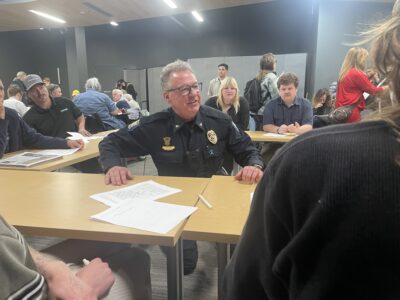
photo by: Sylas May/Journal-World
Lawrence Police Chief Rich Lockhart speaks with community members at a listening session on Wednesday, April 29, 2026, at the Lawrence Public Library.
“A dragnet of cameras,” “a new level of surveillance,” “Big Brother.” These are all things members of the community said on Wednesday night at a listening session about Lawrence police’s camera registry and aggregation program, and Chief Rich Lockhart is adamant that none of them is true.
He spent more than an hour at the Lawrence Public Library, trying to allay people’s concerns about the Connect Lawrence program; the technology called Fusus behind it; and the department’s associated camera policy, which is still in its draft stages. He said he understood the questions people might have, and that he just wanted to hear them and have a good-faith discussion about them.
“I think people want to feel understood, and they want to feel validated,” Lockhart told the Journal-World. “For me, it’s a chance for me to understand folks, and our community to understand us.”
Fusus is a system from body camera provider Axon that will make it easier for police to aggregate footage from a variety of sources to investigate crimes. It would also enable private home and business owners to register their cameras with police, and would let police send out requests for them to share their recordings if an incident took place nearby.
While Fusus can allow police departments to “integrate” cameras and stream footage live from them in certain circumstances, this requires the camera owner to have special hardware, and Lawrence police have said they have no interest in deploying it with people’s doorbell cameras and other home security devices. It might be possible for businesses to do this, but Lockhart said the department didn’t intend to let homeowners integrate with them. “We are not talking about doing that here,” he said.
“Our goal is not to have some infinite camera network,” Sgt. Drew Fennelly told the Journal-World. “In order for us to integrate cameras, it’s got to be mutually beneficial to the business or organization that we’re integrating.”
Participation in the camera registry is entirely voluntary, and people can unsubscribe from it at any time; you can find more details on connectlawrence.org.
Lockhart said Wednesday that camera footage from homes and businesses has been vital in many investigations; he mentioned the hit-and-run that killed KU student Elsa McGrain last year as a case where private cameras helped lead investigators to a suspect. He also said that Lawrence police weren’t interested in doing live “surveillance,” something the department has consistently said when discussing Fusus and cameras.
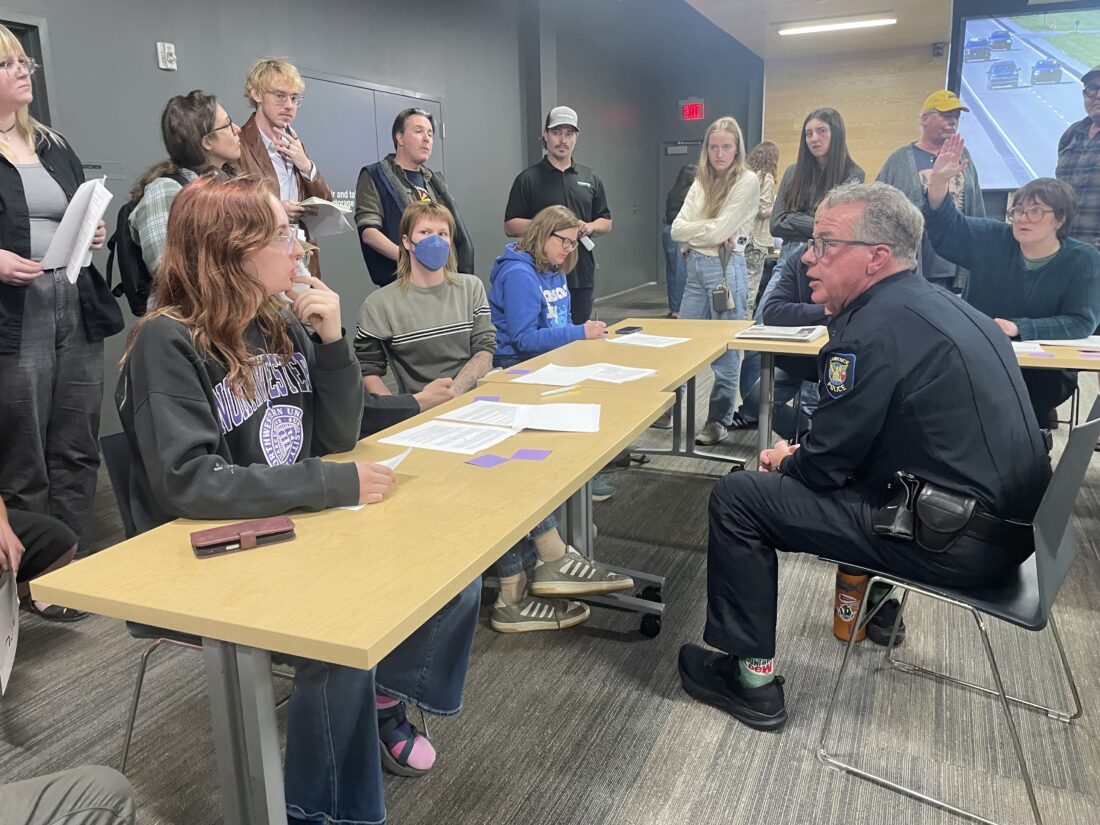
photo by: Sylas May/Journal-World
Lawrence Police Chief Rich Lockhart speaks with community members at a listening session on Wednesday, April 29, 2026, at the Lawrence Public Library.
When the meet-and-greet portion of the listening session began, Lockhart and other representatives of the department were sitting at three tables, taking questions and suggestions from a full room of attendees. The “Concerns” table where Lockhart sat was the busiest, with a couple dozen people crowding around it.
Many were worried about how Fusus would be used and whether it might make it easier for people outside the department to access sensitive data.
“No one can access our data from Fusus except us,” Lockhart said. He said security measures to protect police data were already in place now, and that wouldn’t change with Fusus or the new camera policy.
One attendee mentioned the possibility that the Trump administration could “force your hand” and ask for sensitive data. But Lockhart said that, if federal authorities wanted to do that, they would have to have a subpoena, and Fusus wouldn’t make it easier for people to subpoena records.
“If somebody wanted to issue a subpoena for footage, they can do it right now,” Lockhart said. “This doesn’t change that.”
Democratic state Rep. Brooklynne Mosley was among the attendees, and while she assumed “best intentions” from Lockhart, she was concerned about what might happen if the state pre-empted Lawrence’s policies. She worried that the state could do things like mandate that cities give their login credentials to the federal government. “We’re essentially setting the infrastructure” for that, she said.
“That’s my concern,” Mosley said. “… At the end of the day, the state can strip us of our local control, and now we have created this one-stop shop … now they know where all the cameras are.”
Other attendees had concerns that employees with access to integrated cameras might use them to stalk people, such as intimate partners. Lockhart said that if department employees were using cameras for that, that would be a “pretty serious violation” of department policy and the employee involved would be fired.
Lockhart said he was well aware that not everyone would like what the department was doing. Some people dislike the idea of cameras in public spaces at all, he said, regardless of whether they help solve crimes.
“What we’re trying to get to,” Lockhart said, “is how can we address your concerns in a way that, if we implement this, you’re maybe not loving it, but you can live with it?”
A man sitting across from Lockhart laughed.
“Look, there’s nothing, right?” Lockhart said. “There’s nothing I can say or do that’s going to make you say, ‘I can live with this.'”
Another attendee said they didn’t like the thought of the police “writing people off and saying there’s a whole group of people who will never listen.”
“I think it’s realistic, though,” Lockhart said. “There are some people who are never going to be in favor of this.”
There’s no timeline yet for when the feedback from Wednesday’s listening session might be integrated into the draft policy, Lockhart said, but he guessed that a new draft might be brought before the City Commission in a few months. He also said the department might hold more informational events for the public, as well.
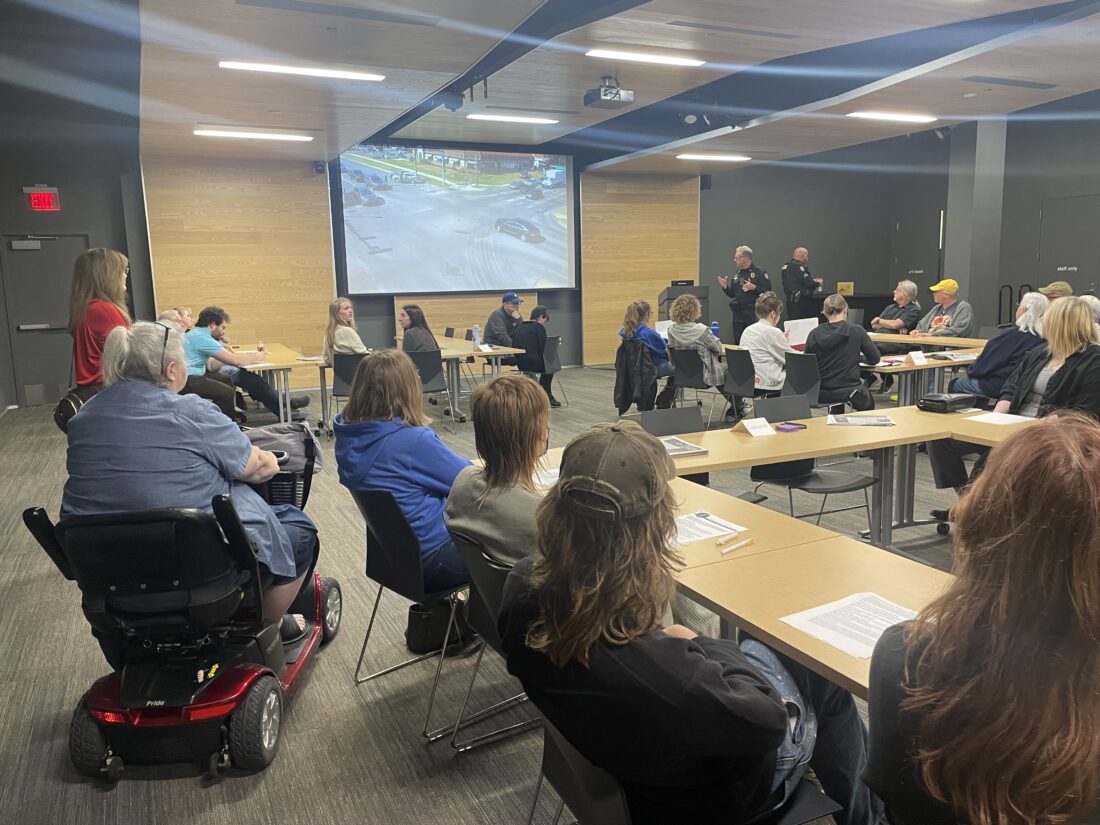
photo by: Sylas May/Journal-World
Attendees fill the Lawrence Public Library auditorium at a listening session on Wednesday, April 29, 2026, about cameras and policing.
City Government
The Granada announces two more watch parties in downtown Lawrence for U.S., Algeria matches
Mowing at Prairie Park’s remnant prairie is part of a strategy to control noxious weeds; city, restoration team say it’s the least damaging option
Share your feedback on North Lawrence study at open house next month
From styrofoam bans to ‘ecosystem personhood,’ Lawrence’s sustainability board has a lot of policy ideas to narrow down
Recent storms and North Lawrence tornado have kept the city’s forestry staff busy day and night