

City commissioners express interest in putting infrastructure sales tax renewal on ballot next year
Also: Public commenters call for lane reduction, bike lanes on Tennessee and Kentucky
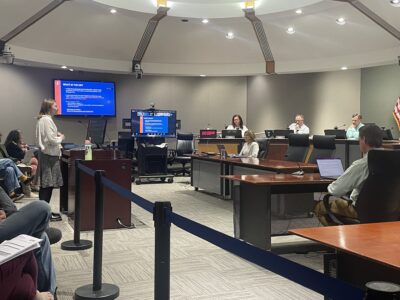
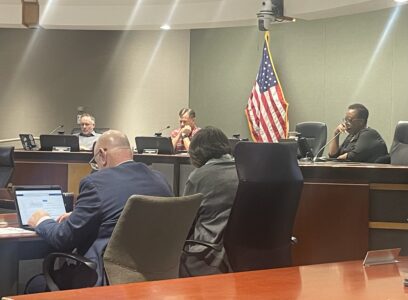
photo by: Sylas May/Journal-World
Mary Bisbee, a city budget analyst, goes over the 2027-2031 Capital Improvement Plan with the Lawrence City Commission on Tuesday, May 19, 2026.
Lawrence city commissioners are interested in asking voters to renew an infrastructure sales tax that is due to sunset in 2029, and some want to fund fewer infrastructure projects with debt and more with cash.
These were among the things the commission discussed on Tuesday during its first look at the Capital Improvement Plan for 2027 through 2031. It’s a long-term list of infrastructure priorities the city puts together each budget season, and this year it contains $407.7 million in projects, roughly $88.5 million of which would be in 2027.
Mayor Brad Finkeldei said this year’s CIP was “pretty lean,” because so much had been spent on infrastructure projects in the last few years. During their discussion on Tuesday, the commissioners didn’t want to significantly change the plan’s priorities, but there were some questions about how the city would pay for them.
The city has a special 0.3% sales tax for infrastructure projects that voters overwhelmingly renewed when it was last up for a vote in 2017. It is due to sunset in 2029, and a majority of commissioners said they’d want to put an extension on the ballot next year: Finkeldei, Vice Mayor Mike Courtney and Commissioner Kristine Polian all specifically said they’d be in favor.
“I love the idea of not debt funding right now,” Polian said after voicing her support for a sales tax question.
She and Courtney both had concerns about the amount of debt that would be taken on to fund projects. The CIP shows about $56 million in projects over the five years that would be funded by general obligation bonds, and $52 million that would be funded by the sales tax, assuming that it is renewed by voters. Finkeldei said that, if the commissioners wanted to fund fewer projects with debt, they could look at proposing an even larger sales tax.
“If we don’t like the idea of debt funding and we want to cash fund projects, a higher sales tax fund would allow you the cash flow,” he said.
City budget analyst Mary Bisbee told the commission that the CIP projects have many different funding sources other than sales taxes or debt. And Finkeldei said it’s important to note that some funding, such as from water and wastewater fees, is earmarked for specific uses and can’t be repurposed for just anything.
“Sometimes people will say, ‘well, why don’t you not do this wastewater project and instead do a waterpark?'” he said. “Well, you can’t use wastewater funds to build a waterpark.”
Among the high-profile projects on the 2027-2031 CIP are some things that the commission has discussed before: Lawrence-Douglas County Fire Medical’s Station 6 expansion in northwest Lawrence; phase two of the city’s Municipal Services and Operations campus; a reconfiguration of City Hall; and renovations to the Outdoor Aquatic Center.
The commission didn’t have many questions on these bigger items. But some projects that weren’t slated for funding did get some discussion.
Commissioner Amber Sellers wanted to look at extending 25th Street and add utility lines for an affordable housing project, and she also was interested in creating a new water spray park in western Lawrence. “We don’t have anything on the west side of town,” she said, and this would be “low-hanging fruit” that could add value for people living there.
A group of people who spoke to the commission also urged commissioners to add a reconfiguration of Tennessee and Kentucky streets to the plan. They wanted to add bike lanes on those streets and reduce motor vehicle traffic on each one to one lane.
Michael Almon, of the Sustainability Action Network, said this project was “highly time-sensitive,” because the city was planning repaving projects on those streets. He called Kentucky and Tennessee “two of the most dangerous streets in Lawrence – the Tennessee and Kentucky speedway.”
And state Sen. Marci Francisco also came out in support of this idea. “I think these changes to Kentucky and Tennessee would go a long way to restoring this as a great place for residents, for students, for families,” she told the commission.
Finkeldei said he would want to look at similar projects in the pipeline, such as on Massachusetts Street and Ninth Street, before moving forward with protected bike lanes on the one-ways. Once it’s clearer how these lane reductions are working, Commissioner Mike Dever suggested, the city could experiment with lane reductions using re-striping instead of more expensive physical barriers.
“I’d hate to spend a bunch of money on narrowing down those roads,” he said, and then see unintended consequences.
This is not the last discussion the commissioners will be having on the CIP. They will have another workshop on it in June and are scheduled to adopt it in September.
City Government
As they approve bikes plan, Lawrence city leaders ask about data collection, Kentucky and Tennessee streets
Lawrence city leaders want to toughen tobacco licensing rules ‘sooner than later’
Algerian government invites Mayor Brad Finkeldei, Lawrence delegation for a visit
Construction on Wakarusa Drive to resume; city manager says KDOT’s secretary has apologized for delay
Evacuation drill planned Tuesday at Lawrence City Hall
