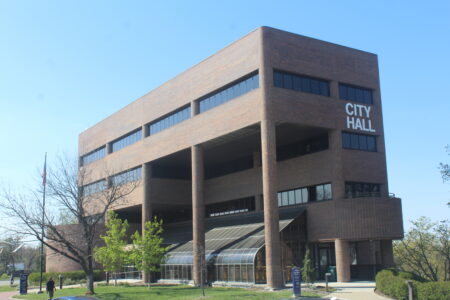
Lawrence’s four city manager candidates introduce themselves to the community
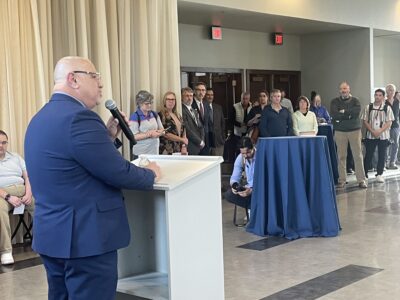
photo by: Sylas May/Journal-World
Members of the public listen to a short introduction from Lawrence city manager candidate Majed Al-Ghafry at a meet-and-greet event at the Carnegie Building on Wednesday, May 20, 2026. Standing just to the right of the curtain are the other three candidates, from left: Michael Kovacs, Joe Lessard and Joe Fivas.
In their first visit to Lawrence, the four men vying to be the next city manager already see a lot to like – and a lot of challenges and opportunities.
The four finalists – Majed Al-Ghafry, Joe Fivas, Michael Kovacs and Joe Lessard – got to introduce themselves to the public at a meet-and-greet at the Carnegie Building on Wednesday, after a long day of meetings and tours around the city. A crowd of people stopped by the noisy building, moving from table to table and asking the finalists questions about how they’d approach Lawrence’s challenges.
“We think it’s an important step for both the community to get to know these candidates and get to know a little more about them, as much as the candidates to know about the community,” said Doug Thomas with Strategic Government Relations, the firm that helped the city do its search.
Which one will succeed the last city manager, Craig Owens, will be decided by the Lawrence City Commission later this week. The commission will meet on Friday morning to make its decision.
Here’s some of what the finalists had to say on Wednesday.
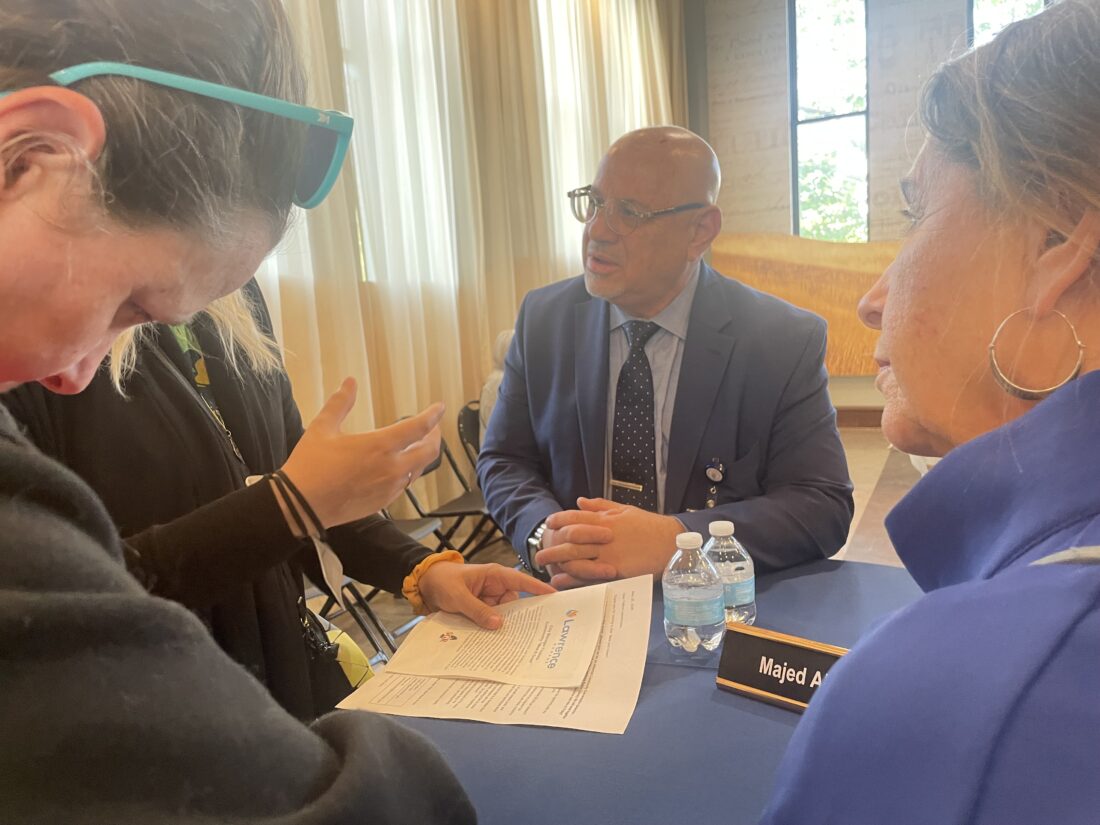
photo by: Sylas May/Journal-World
Lawrence city manager candidate Majed Al-Ghafry speaks with members of the public on Wednesday, May 20, 2026, at the Carnegie Building.
Al-Ghafry
Al-Ghafry, who is from DeSoto, Texas, a Dallas suburb of about 50,000, said Lawrence was “definitely a unique city” with lots of stakeholders who work together.
“It’s a beautiful city,” he said. “Obviously any town-gown city is an amazing city, because you have the support of KU and other institutions.”
He says that cities can turn their challenges into opportunities, and in Lawrence, “the opportunities are about housing diversity, are about economic development diversity. And a lot of people don’t really focus on the economic development diversity.”
Some of the missing pieces in Lawrence’s economy, Al-Ghafry said, might be biotech companies, smaller corporations and more research-oriented jobs. Higher-paying employers would also support the city’s finances, which would help make progress on another priority he identified, deferred infrastructure maintenance.
He also said the community’s buy-in would be important for whatever the city did. “Community participation is a big deal,” he said. “Obviously we have a very involved -” and he gestured to the crowd – “Look at how many people are here! An involved and informed community. We need to engage them front and center.”
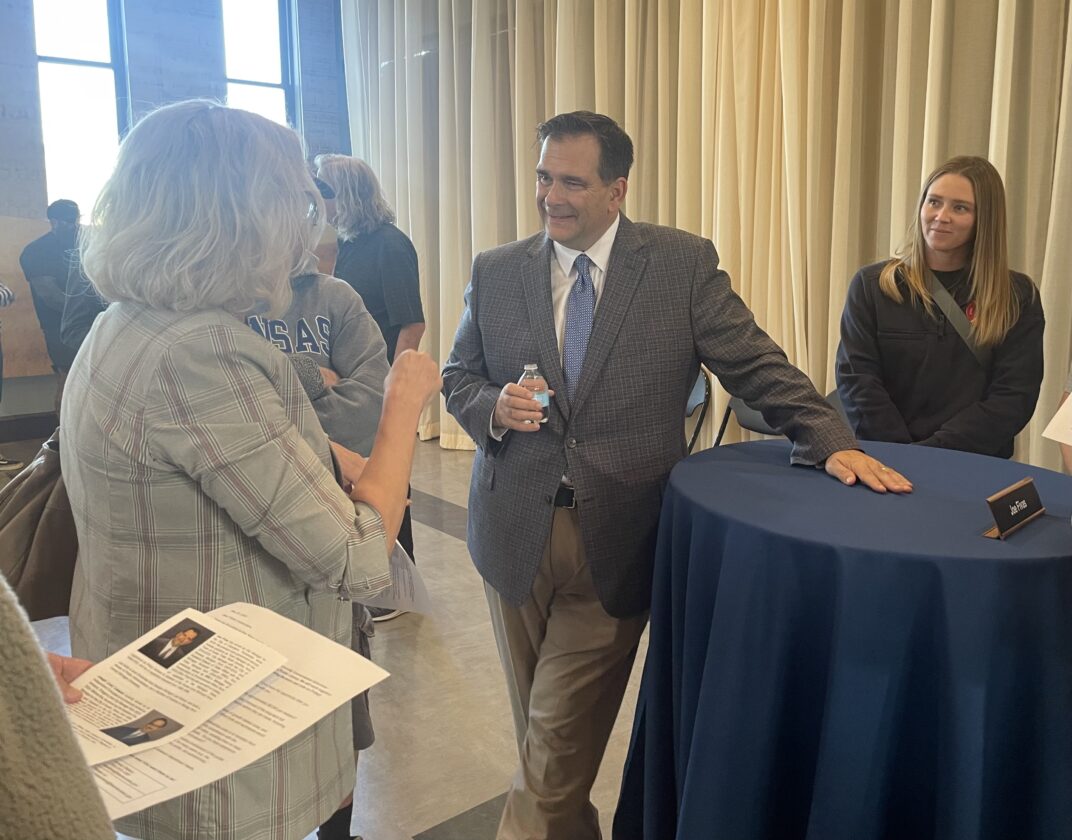
photo by: Sylas May/Journal-World
Lawrence city manager candidate Joe Fivas, center, speaks with members of the public on Wednesday, May 20, 2026, at the Carnegie Building.
Fivas
Fivas, who currently manages Cleveland, Tennessee, said he sees Lawrence as a community with a lot of possibilities ahead. “I think there are unbelievable opportunities in Lawrence,” he said.
He told people at his table that he wants to bring in more quality employers and jobs; his current community has more than a dozen manufacturing sites for Fortune 500 companies. “Good-paying jobs are at a premium,” he said, and he suggested the city could look at ways to bring activity from the Kansas City area into Lawrence.
“You see a lot of the development in Johnson County,” Fivas said. “… I think we should go and try to get some of those jobs.”
He thinks Lawrence will have to navigate financial challenges going forward, but will also have to improve its relationship with its people. “Obviously there’s always budget challenges, and there’s issues with communications with the community,” Fivas said.
One of his takeaways, he told those at his table, is that there are opportunities for more dialogue between the city and the public, and that it’s a two-way street.
“Engagement requires equal and opposite engagement from the public,” Fivas said.
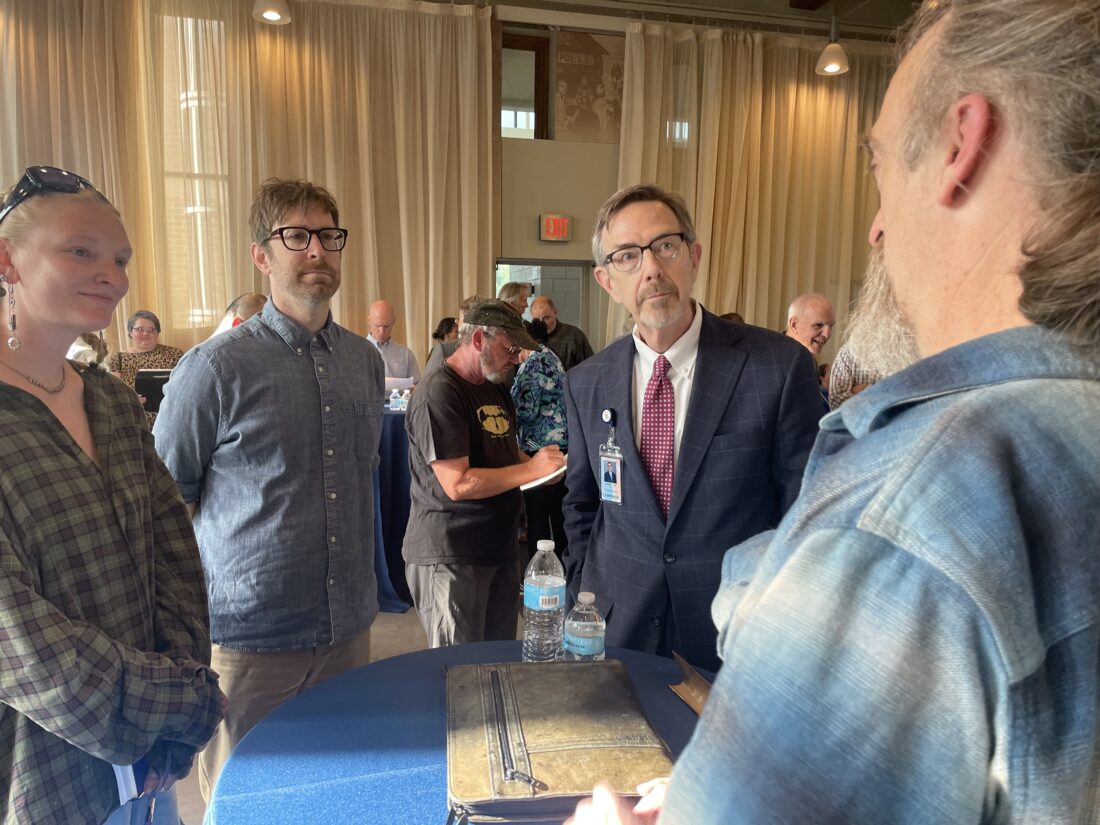
photo by: Sylas May/Journal-World
Lawrence city manager candidate Joe Lessard speaks with members of the public on Wednesday, May 20, 2026, at the Carnegie Building.
Lessard
Lessard, who currently works as an independent consultant, had his last city manager job in Ashland, Oregon, a town that was in transition to a council-manager form of government. He said Lawrence looked to him like a proactive city.
“It’s a leaning-forward city,” Lessard said. “It wants to take on issues it needs to address and proactively work toward solutions.”
At his table, he was fielding questions about economic development and what role businesses should play. “Cities are in the real-estate business,” he told the people gathered around. “… Your financial sustainability is dependent on real estate.”
He said one of the biggest tasks for Lawrence’s city government would be balancing the many different interests and voices. “How do you meet the community’s expectations in an age of affordability and inflation,” he asked, and how do you work with your partners to achieve that?
“How do you balance all the demands the community wants in terms of service, and how do you maintain quality, particularly in public safety and infrastructure?” he said.
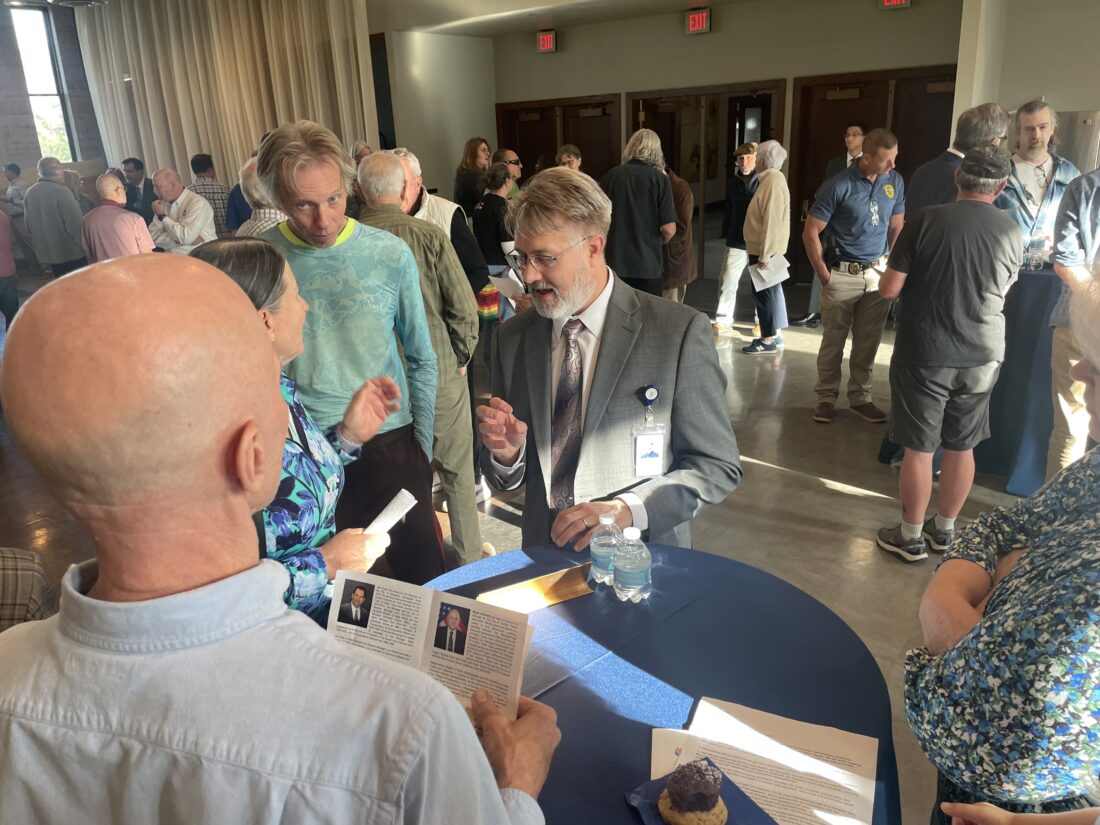
photo by: Sylas May/Journal-World
Lawrence city manager candidate Michael Kovacs, center, speaks with members of the public on Wednesday, May 20, 2026, at the Carnegie Building.
Kovacs
Kovacs – currently city manager of Fate, Texas, a town of 23,000 people – said he did his research before coming to Lawrence. But “physically being here” is different. “It’s a happening place,” he said.
“Downtown is fantastic, the community’s active, there’s a lot of good stuff going here,” Kovacs said. “You see movement, you see construction … everything from the Costco to historic preservation taking place downtown.”
He’s impressed by Lawrence’s “community spirit” and political engagement, including the city’s high voter turnout. But he also said the city needs to focus on its practical concerns, like economic development, and do “fiscally resilient, smart planning.”
“Like many cities, it’s going to be financial,” he said of the challenges in Lawrence, and infrastructure will play a role. Typically, he said cities have a lot of infrastructure but not necessarily the tax base to maintain it. “After you run that through a couple life cycles, you realize, ‘Oh, man, all this stuff costs so much money just to keep it going.'”
Maintenance may not be glamorous, he said, but it’s something cities need to focus on.
“Everyone’s kind of like, ‘Improve the city, improve the city, improve the city,'” Kovacs said. “But a lot of times, you get to a point where you still have all of your regular job to do, which is the grinding and the maintenance and the street replacement and the drainage work. So that’s the stuff that starts to really eat you alive over time.”
City Government
Lawrence City Commission to weigh whether Costco should be included in STAR bond district
As they approve bikes plan, Lawrence city leaders ask about data collection, Kentucky and Tennessee streets
Lawrence city leaders want to toughen tobacco licensing rules ‘sooner than later’
Algerian government invites Mayor Brad Finkeldei, Lawrence delegation for a visit
Construction on Wakarusa Drive to resume; city manager says KDOT’s secretary has apologized for delay