For Lawrence city staff, 2027’s budget is a ‘full-circle moment’ in more ways than one
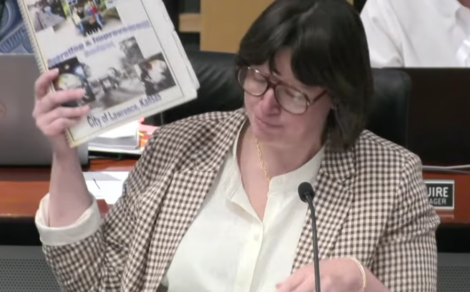
photo by: City of Lawrence screenshot
Acting City Manager Casey Toomay holds up a 2001 budget book at the Lawrence City Commission's meeting on July 7, 2026.
Just how long has Lawrence’s city staff been working toward its 2027 budget proposal?
The answer to that question might be a year, a few years – or even, in Acting City Manager Casey Toomay’s case, a whole career.
“More than 25 years ago, as I mentioned, I was a graduate student interning in the city manager’s office, and I worked on the city’s budget for the year 2001” Toomay told the Lawrence City Commission on Tuesday night, holding up a spiral-bound budget book from that year. “I’ve been here for almost every budget year since, and the significance of tonight as a full-circle moment for me does not go unnoticed.”
Beyond her personal story, it was also a culmination of several things the city had been trying to do for years, she and other city officials involved in the budget process said.
These include staffing a new fire station on the northwest side of town, something Lawrence-Douglas County Fire Medical had been seeking for years; making staff pay more competitive, which the city has been working on since at least 2019; and keeping the city’s fund balance healthy, which was an issue in 2024 when city commissioners voted to spend down more than a million dollars in savings rather than raise taxes in 2025.
“This is the culmination of so many people’s work, and for years,” budget strategy and performance director Alley Porter told the Journal-World. “We’ve been talking about fire expansion for years. We’ve been talking about our commitment to pay for years.”
Commissioners had a lot of questions and requests for information on the roughly $415 million budget proposal, which features a nearly 2-mill property tax rate increase and keeps service levels for many departments outside of LDCFM relatively flat. The details will be figured out over the coming weeks, and the first big vote is on Tuesday, July 14, when commissioners will decide what the maximum property tax rate for 2027 will be.
The day after Toomay presented her recommended budget to the commission, the Journal-World sat down with her, Porter and a few other officials who worked for about a year to craft it. Here’s what they had to say about the work that went into it.
What could be cut?
With the mill levy increase, the recommended budget keeps services in most departments fairly stable, and that was a priority, Toomay and Porter both said.
“Our direction to our departments was, we’re trying to minimize the need for additional resources, so if we have the ability to operate within our existing expenditure levels, we should do that,” Toomay said.
And Porter added: “I think by and large, you saw a relatively flat budget outside of personnel increases and contractual obligations – changes here and there, but generally that’s where the increases were. And the levels of service that we identified last year would be our expectations.”
As the Journal-World reported, the budget includes a net increase of 21 positions, 17 of which are related to the expansion of LDCFM’s services for the new Station 6. The only position that the budget would cut would be a court clerk position that is currently unfilled.
There were questions on the commission on Tuesday about what the city could do to keep the mill levy flat. “I think we owe it to the community to do everything that we possibly can to avoid this mill levy increase,” Commissioner Kristine Polian told staff.
But Toomay said that would come with tradeoffs. “If we don’t want to have a mill levy increase and we want fire expansion, we would have to make cuts in other areas to accomplish that,” she said.
Earlier this year, the commission saw a list of proposed cuts that departments compiled, including position cuts in certain departments, severe reductions in sustainability and equity efforts and cutting certain policing roles like school resource officers and downtown foot patrol, among dozens of other possibilities.
“We provided what some of those cuts would be in one of our budget presentations,” Toomay said. “And so we have any number of different opportunities to look at any number of our programs and make those cuts. We have time to have that conversation in the coming weeks.”
They will be working to answer the commission’s questions, too – some take more resources and time than others, but Toomay said the discussions can keep going through Sept. 15, when the budget is slated to be adopted.
“We have until Sept. 15 to make sure that they have all the information they need to make this ultimate decision of adopting the budget,” she said.
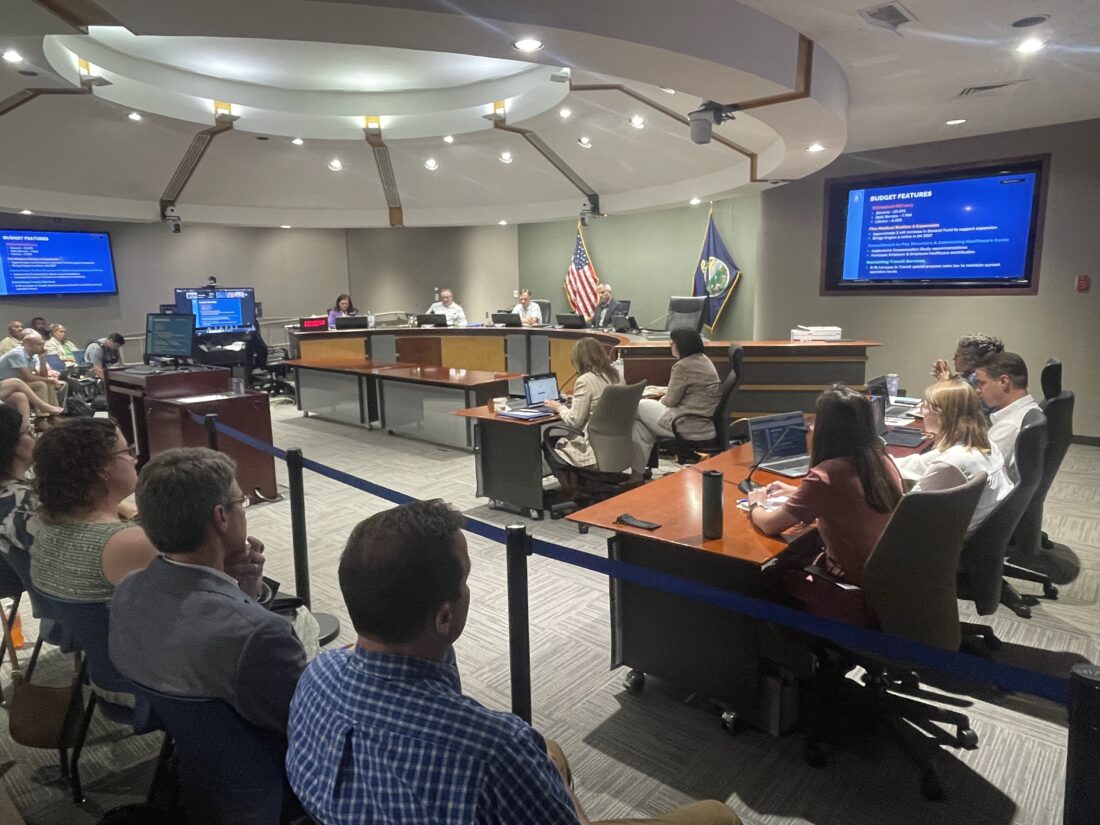
photo by: Sylas May/Journal-World
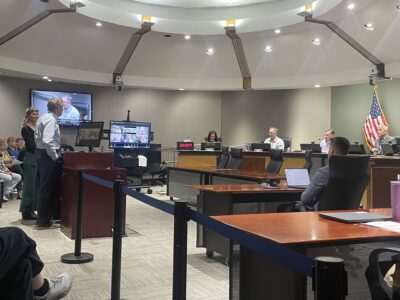
The Lawrence City Commission hears a presentation on the 2027 budget proposal on Tuesday, July 7, 2026.
‘It’s not sustainable’
LDCFM expansion is about improving a city service, but other parts of the budget are about making things more sustainable, staff said.
One of those is the roughly $15 million in new spending on compensation and benefits, about half of which would go toward the city’s contribution to the employee healthcare fund.
Toomay said the healthcare fund wasn’t in an emergency situation – there was no danger that claims wouldn’t be paid. But she also said that the city had been spending down fund balance for years, and that recent claims data wasn’t “going in the direction we were hoping.”
“It’s not sustainable, just like we’ve had other conversations, to continue to spend down your fund balance,” she said. “So we have to align our revenue coming in with our expenses going out.”
The city also wants to make the fund balance in its general fund more sustainable. That balance “relates to our credit rating, obviously being able to utilize those dollars in economic downturns like we saw with COVID, and things like that,” Porter said.
The city has a goal of enough reserves to cover 90 days of operations, and a report provided to the commission ahead of Tuesday’s meeting said the fund balance in the general fund was approaching that level “for the first time in several years.”
Porter said the city still hadn’t hit the goal, and that she didn’t know “if we have an active plan” to hit it. The more important thing, she said, was that it stayed above 60 days, which is the minimum in the city’s policy.
Sales tax revenues are also “projected conservatively,” the budget report said, but the city does anticipate “growth tied to ongoing development, resulting in an approximately 4% increase (in collections) over the 2026 Revised Budget.”
Sales tax revenues are one of the city’s biggest funding sources, but they haven’t always turned out the way budget-makers wanted. In 2022 and 2023, as the Journal-World reported, the city made more aggressive estimates of its sales tax collections, only to have the real collections come in below what was projected. That was a driving factor in the millions of dollars of budget reductions the city was wrestling with in 2025.
In light of these past years, the Journal-World asked Toomay on Wednesday whether she considered the 2027 projection conservative.
“I think that’s a subjective word, but yes, I would say it’s conservative,” Toomay said. “We hope it’s conservative.”
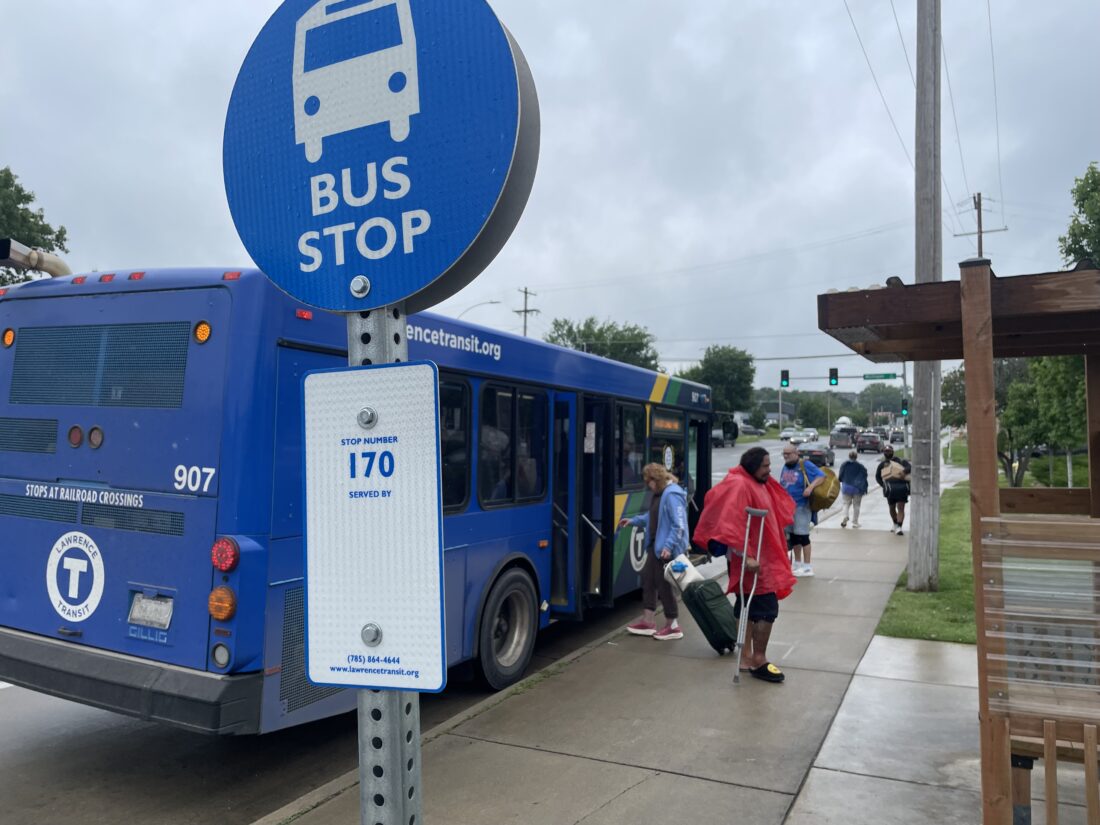
photo by: Sylas May/Journal-World
A Lawrence Transit bus picks up and drops off passengers at Sixth and Michigan streets on Friday, May 22, 2026.
Transit sales tax
The budget also assumes that voters will raise the city’s transit sales tax from 0.2% to 0.3%, and the commission had some things to say about that on Tuesday.
“I’m all about fees,” Commissioner Mike Dever said. He wanted to have conversations about whether fares could be part of the solution for the currently free-to-ride bus system’s problems.
But transit director Felice Lavergne said Wednesday that the issue wasn’t about whether buses would stay free. “The conversation is about, does Lawrence want to have a transit system?”
“If this were a problem fares could fix, we would be having a really different conversation,” Lavergne said.
As the Journal-World has reported, the idea of the sales tax vote is to give the transit system a chance to build its savings in preparation for future years when expenses will grow faster than revenues. Lavergne and Toomay said Wednesday that the big problem for Lawrence Transit starts in 2029, when the city’s contract with its current bus service provider ends.
The city will be able to fulfill its contractual obligations through 2028 at the current sales tax level, Toomay said, but when the new contract is negotiated, if the sales tax isn’t raised, “we’d have to renegotiate a new contract for a lesser amount of service.”
Transit budgets are set up to use federal matching funds, and Lawrence doesn’t have to use sales tax to fund the match. But Toomay said not using sales tax would require the city to find money elsewhere, and fares wouldn’t generate enough revenue on their own.
“If we wanted to maintain our existing service levels, we would have to make that up from some other source,” she said.
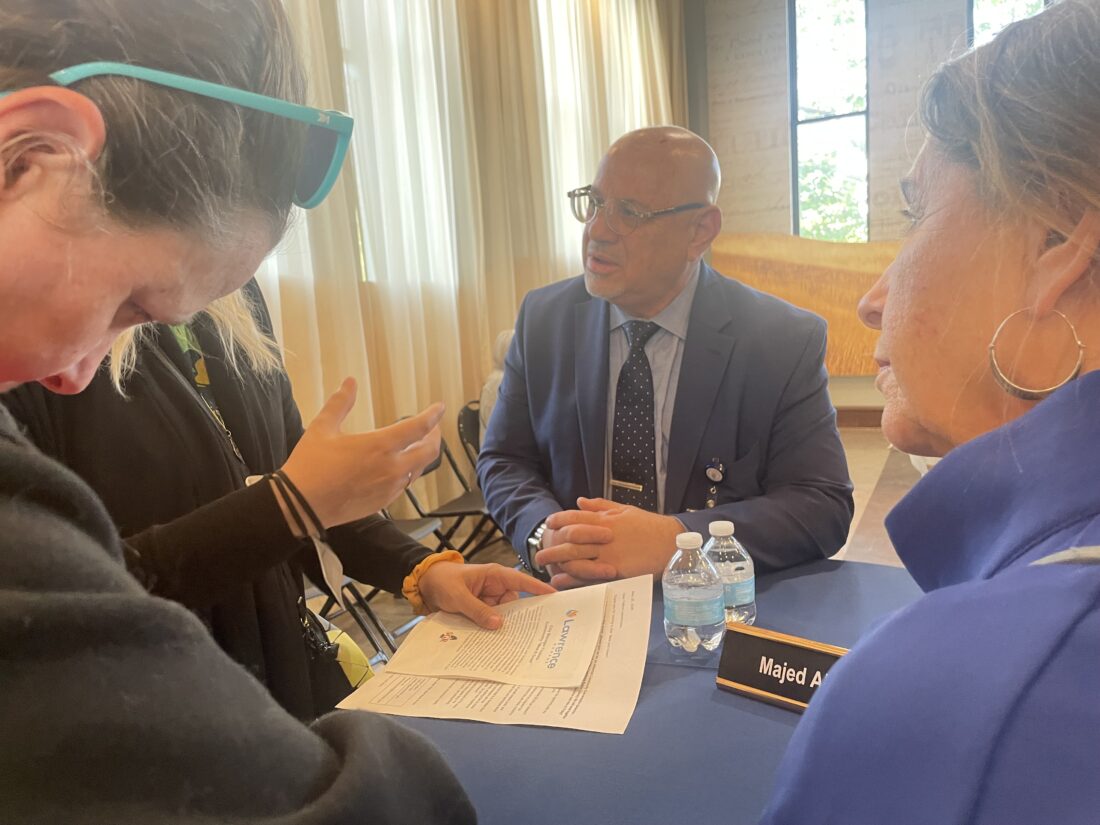
photo by: Sylas May/Journal-World
Lawrence city manager candidate Majed Al-Ghafry speaks with members of the public on Wednesday, May 20, 2026, at the Carnegie Building.
Al-Ghafry’s arrival
There’s one more factor to take into account in this year’s budget process: Lawrence’s new, incoming city manager.
Midway through the budget process, Majed Al-Ghafry is expected to arrive and take over from Toomay. His contract specifies that he must start work within 60 days of his June 9 hiring date, which would put his arrival in early August at the latest.
“That transition will happen kind of right in the middle of this, so we will have to work through that,” Toomay said. “I anticipate he’s obviously going to be sitting in the chair answering these questions, but I’ll go back to the chair I was sitting in, Brandon (McGuire, assistant city manager) and I and Alley and Mary (Bisbee, budget analyst) will go back to answering questions if he wants us to do that.”
When asked about preparing the budget while in an interim role, Toomay said that she had confidence in the result, and that the budget process involves much more than just the city manager.
“There are organizational changes that I think the new city manager should make,” Toomay said. “Obviously, the new city manager is an important part of that organization, but so are the other 900 folks that show up to work every day.
“And so I think that there are management decisions that happen on a day-to-day basis that I’m absolutely willing to make and have made, and that the recommended budget came under my signature, and that’s an example of that. Those were recommendations I was willing to put my name on and put forward.”
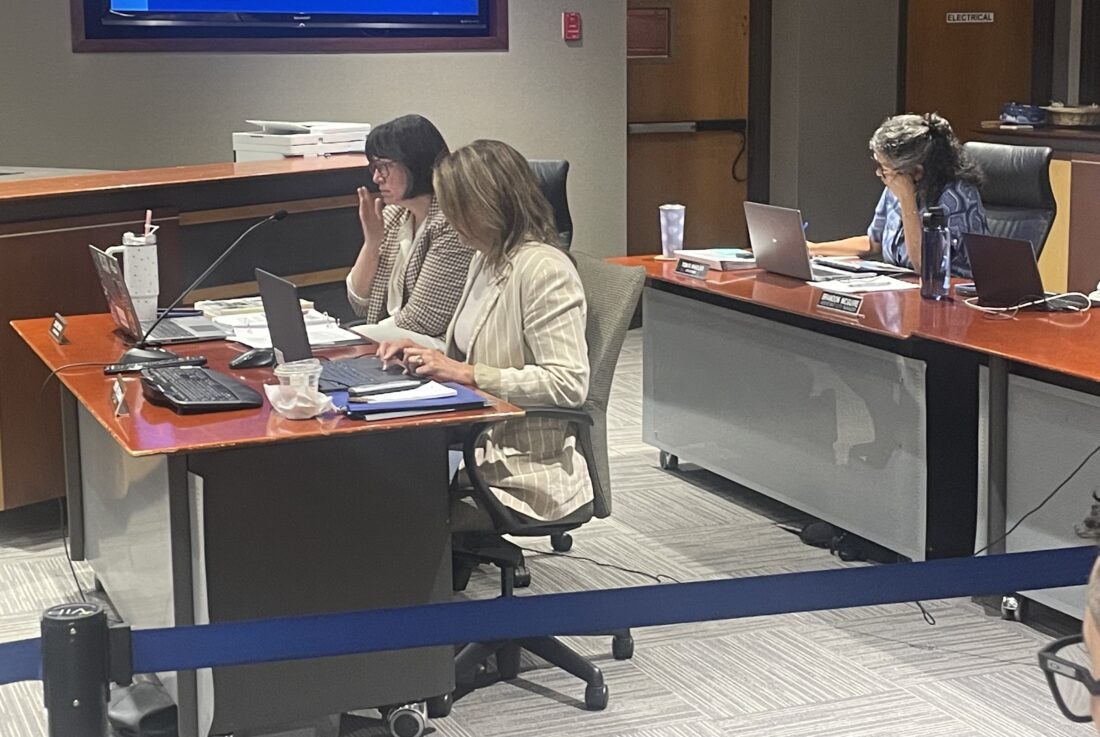
photo by: Sylas May/Journal-World
Acting City Manager Casey Toomay, left, and other city staff members take part in the budget discussion at the City Commission’s meeting on July 7, 2026.
‘I wish it were that simple’
Some members of the community have asked about whether the city can make cuts around the margins, instead of to its core services – cuts to things like coffee for staff, for instance. And Toomay said there is, in fact, low-hanging fruit in any budget.
The question is how much of a difference cutting it will make.
“There is always room for us to save money,” Toomay said. “Do we want to tell employees that they have to bring their own coffee from home? We can do that.”
But she also said, “I am confident that we would not be recommending a mill levy increase if we still thought we could get there by just attacking the low-hanging fruit.”
Much of that idea, she said, comes from someone looking at city finance the way they look at their personal finance.
“So many of us have our household budget,” she said. “So many of us are part of an organization, you might be the treasurer of your church or whatever, where you have a budget and you follow that budget, and if you don’t have enough you make cuts.
“I wish it were that simple,” she said.
If a household budget were like the city budget, McGuire said, it would look strange, like one person’s income going into an account that by law could only be used for groceries, or their partner’s income being only for mortgage payments.
“All of those things, I think, create a barrier that makes it more challenging for the public to understand the budget and to trust us,” Toomay said.
But city communications director Cori Wallace said she’d been pleased with the feedback from members of the public so far. At Tuesday’s meeting, she said, “I think for the first time, I heard a budget conversation from the community’s side that was reasonable.”
On Tuesday, Toomay called the mill levy increase a “last resort,” and on Wednesday she said she meant that. She hopes the community understands that city staff weighed the alternatives and came up with what it really believed was best.
“I’ve been doing this in some version for so many years, and it really is an honor for me to do it in this community, because I live in this community, so I feel the impact of these decisions, as well,” Toomay said. “And I take that responsibility really seriously.
“And I mean it when I say that recommending a mill levy increase – last resort is what I said, but that is what I really think. We’re to the point that if we want to provide this expansion of service level, we need a revenue stream to support that. And we also want all of the other services we provide in this community, because that’s what makes Lawrence Lawrence.
“I’m probably still struggling a little bit to find the right words,” she added. “But it is a responsibility I hold dear and take seriously, and I hope the community does understand that.”
City Government
Opinion: An $80 million Hail Mary that combines Costco and Lawrence’s love of trails
Lawrence Police Department receives KDOT’s top traffic safety award for second straight year
Lawrence City Commission approves extra layers of oversight for data centers, asks for patience on further regulations
Lawrence to participate in program that helps nonprofits rehabilitate abandoned properties as affordable housing
Lawrence’s first bike lanes with physical barriers are installed on Ninth Street