

Lawrence Transit’s sales tax is ‘critical,’ its director says, and an increase could be on the ballot in November
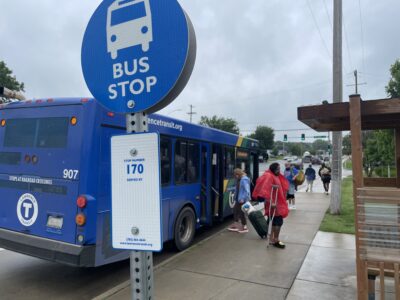
photo by: Sylas May/Journal-World
A Lawrence Transit bus picks up and drops off passengers at Sixth and Michigan streets on Friday, May 22, 2026.
If Lawrence Transit’s finances were a bus, it would be approaching a few important stops right now.
First up is 2027, when its Biden-era infrastructure funding gets off, and a new and likely scaled-back Trump-era plan gets on. Next is 2029, when its contract with its current service provider will get off, too.
And, depending on what happens in the next two years, there could be one more departure at that stop: the 0.2% sales tax that funds its operations. Unless the City Commission puts an extension on the ballot and voters approve it, the tax is on track to sunset in 2029.
And that could be the end of the line for Lawrence Transit’s services as they are today.
“The sales tax is critical, I would say,” Felice Lavergne, the city’s transit director, told the Journal-World this past week. “… We could look at other revenue streams, but (losing the sales tax) would significantly decrease the amount of service we could put on the street.”
There’s still a lot to do before a sales tax vote can happen. The Lawrence City Commission would have to approve language for a ballot question this summer, and it would have to be submitted to the county clerk’s office by Sept. 1 to get on the November ballot.
But the city will have two chances to hold such an election, in 2026 and in 2027. And, for the first attempt, Lawrence Transit wants to not just maintain the 0.2% tax, but increase it to 0.3%.
Lavergne said the idea was to give the transit system a chance to build up its savings in preparation for a series of years further out when expenses will grow faster than revenues. If it continues the tax at 0.2%, there may still be difficult choices ahead – including whether to continue the city’s downtown bus station project and whether to change the frequency of certain routes.
Whatever happens, Lavergne said, the community will be involved in these discussions, even after the votes are in.
“My team keeps our service hours top of mind,” Lavergne said. “That’s never the first thing we go to when we’re looking to cut costs, because it’s just hugely important to getting people to work, school, medical. So we’ll look other places rather than service as needed.
“If these dire scenarios come to pass, we’re committed to a transparent process, and I think we can have hard conversations together.”
• • •
In past City Commission meetings, Lavergne has explained the department’s financial picture to the commission with a couple of charts showing its revenue and expenses minus grant-funded projects. One shows the sales tax continuing at 0.2%, and the other shows what happens if it grows to 0.3%.
Both charts show a slight surplus of just over $41,000 for 2026, and a fund balance, or savings, of roughly $8.3 million. But after that, the charts look very different.
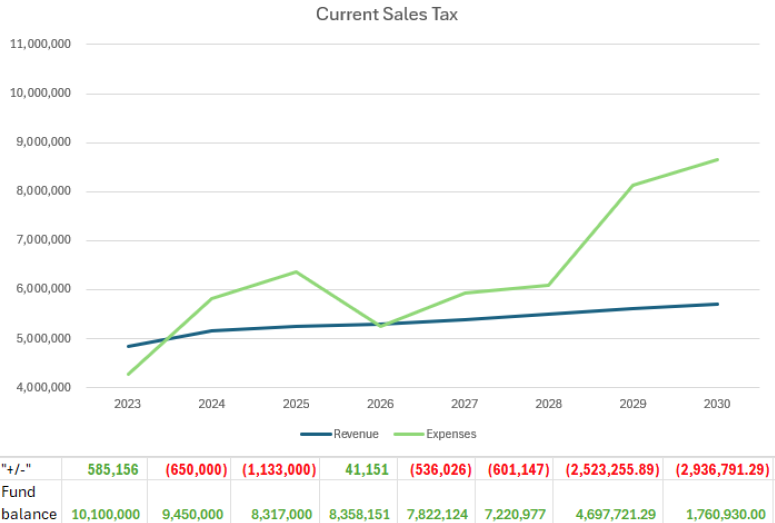
photo by: Screenshot
A chart shows Lawrence Transit’s revenue projections through 2030 if its sales tax rate were to remain at 0.2%.
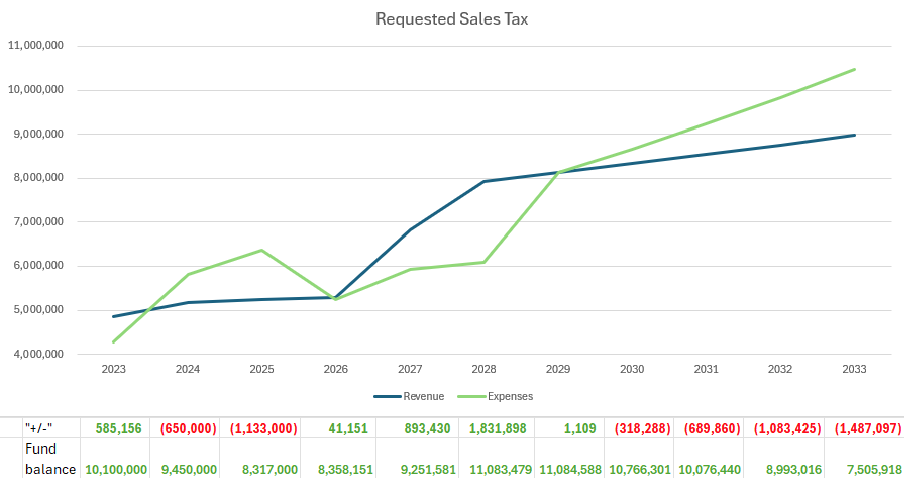
photo by: Screenshot
A chart shows Lawrence Transit’s revenue projections through 2033 if its sales tax rate were increased to 0.3%.
Lavergne has told the commission that due to inflation, transit systems around the country are seeing their expenses grow faster than their funding sources. The 0.2% chart shows the fund balance being spent down year after year as the tax revenue stays relatively flat and expenses rise by millions of dollars. In 2027, the department would spend $536,000 of its fund balance; in 2028, $601,000; in 2029, $2.5 million; and in 2030, $2.9 million.
But the 0.3% chart shows revenues significantly outpacing expenses for two years, 2027 and 2028, and being roughly even with them in 2029. That would let the department grow its fund balance by $2.7 million, to about $11 million.
Then, from 2030 to 2033, expenses would overtake revenues again. Lavergne said the department was projecting this partly due to the lower federal funding expected under the future infrastructure bill. But the department would spend down a lot less of its savings here than in the 0.2% scenario. In none of those years would it spend down more than $1.5 million of fund balance, and in 2033 it would still have $7.5 million of savings left.
What happens in the 0.2% chart after 2030? That part of the chart doesn’t exist, Lavergne said, because past that point Lawrence Transit wouldn’t be able to operate as it does now.
“We’ve projected until 2030, because that’s when we dip below the required fund balance amount and would likely cease transit operations,” she told the commission on May 5.
• • •
If that scenario comes to pass – or if the tax isn’t renewed at all — what are the implications?
First of all, it might have an impact on how much federal aid Lawrence Transit could receive. Lavergne said that the federal funds the city gets for transit are matching funds, where every dollar of federal funding has to have a dollar of local funds to match it. The transit sales tax is currently used to pay the city’s share of the matching funds, she said.
“People bring in that local match in a variety of ways (in other transit systems); a sales tax is a really stable way to do it,” she said.
If the department didn’t have the tax, it would have to find another way to match. That could be done through bus advertisements or sponsorships, Lavergne said, and some of it could come from reimplementing fares, which the department hasn’t had since 2022.
But she also cautioned that bringing back fares wouldn’t be enough to solve the problem on its own.
“This system has historically not taken in a high amount of fares,” Lavergne said. When the department had fares, it would take in a few hundred thousand dollars a year from them – “$400,000 in fares is a number we’ve done in the past.”
The transit system provides about 2.5 million rides a year, but many of those users are students at the University of Kansas. Lavergne said that while Lawrence Transit does have agreements with KU and while students do pay for bus service through their student fees, they haven’t had to pay fares on a per-trip basis.
“This system is never one that if we have 3 million rides, we get $3 million,” Lavergne said.
• • •
The fact that Lawrence Transit hasn’t historically relied on fares, however, also means that drops in ridership don’t hurt as much.
In the 2010s, annual ridership on Lawrence Transit reached around 3 million, and the system was recognized for multiple years in a row for the highest ridership in the state. But when COVID hit in 2020, ridership figures dropped by about 50%, according to statistics Lavergne shared with the commission earlier this month. The system has regained some ground from there; in 2022, as the Journal-World reported, the system gave 1.9 million rides, and by 2024 it was nearly at 2.5 million.
Lavergne said factors other than COVID have hurt ridership. At the national level, she said, more people are working from home, and “nationally folks are driving more.” And at the local level, a set of route redesigns in 2024 and 2025 affected ridership in those years.
As the Journal-World reported, those changes were meant to bring several major bus routes together at the newly opened Central Station on Bob Billings Parkway. Lavergne, who was not the transit manager when this process began, said that any time you change bus routes significantly, you can expect ridership to temporarily suffer as some riders struggle to adjust their habits.
She said part of the reason Lawrence Transit went fare-free in 2023 was to “create that ridership boost when we knew the route changes were coming.”
Though route changes are still going on in Lawrence, including adding stops at the new Dillons store on Iowa Street, Lavergne said the statistics for this year show ridership is recovering.
“Ridership is trending upward this year with the data we have already, because we didn’t do a big set of changes,” she said. “When people understand the routes, they get back to using them.”
• • •
If Lawrence Transit has to make some cuts, Lavergne said the public would be involved in the process from the start.
“Our public participation plan, which is adopted every couple of years, says if there’s more than a 5% cut in service hours, we go to the public,” she said. “And so this is something we have a public conversation about, probably some scenarios.”
There would likely be impacts to the city’s downtown bus station project; Lawrence Transit has said that the sales tax increase is necessary for that to continue. But there could also be reductions in service frequency, or more days when the buses don’t run.
“There’s coverage, there’s frequency, there’s schedules,” Lavergne said. “We could add more holiday days when there’s no service, and that could be a good way to lower impact. We could look at summer schedules on certain routes … So there’s a lot of ways we could do it, and we have a lot of data to help us understand where the ridership is coming from, when is the ridership highest, even down to the stop level.”
The first step before any changes would be an intensive survey of the system’s routes. After that, Lavergne said, there would be public outreach just like in the previous route redesigns. The most recent round of route changes, for instance, included an online survey people could fill out and “on-route surveys” where transit staff were at stops or on the buses to ask for people’s opinions in person.
“What the public’s been seeing from us in terms of process and transparency would be the same,” Lavergne said. “We read every comment that we get, and we respond to all of them, too, through our route change and report process. So it would be the same format.”
There’s also the possibility that, if the commission puts a sales tax on the ballot this year and it fails, the department can try again in 2027. Lavergne said this would probably just be asking for the sales tax to continue at its current level, but it would help avoid the most painful outcomes for the transit service.
“There are two options for the vote: this year and next,” she said. “And if it doesn’t go forward at the higher rate this year, we will likely see continuance at the same level next year, so a little bit of contingency planning there.”
Lavergne feels good about the chances of approval for a sales tax, if commissioners decide to put the issue up for a vote. The last referendum on the transit sales tax was in 2017, when it passed with around 70% of the vote.
While she acknowledges that “past doesn’t always speak to present,” she said that “Transit has historically been well supported in our two previous sales tax endeavors.”
“I’m optimistic,” she said. “We strive to provide a really good service for folks, and we are looking forward to the democratic process of the sales tax vote and having Lawrence tell us directly how much they’d like to see invested in the transit system.”
City Government
As they approve bikes plan, Lawrence city leaders ask about data collection, Kentucky and Tennessee streets
Lawrence city leaders want to toughen tobacco licensing rules ‘sooner than later’
Algerian government invites Mayor Brad Finkeldei, Lawrence delegation for a visit
Construction on Wakarusa Drive to resume; city manager says KDOT’s secretary has apologized for delay
Evacuation drill planned Tuesday at Lawrence City Hall
