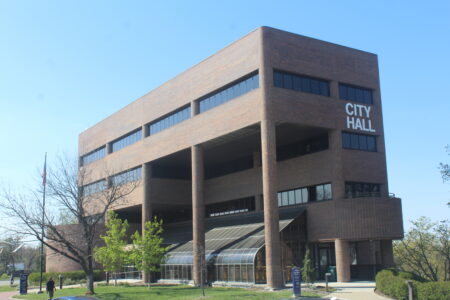
Potential ballot question on directly elected mayor needs much more discussion, Lawrence city commissioners say
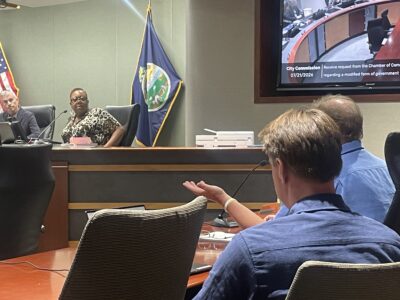
photo by: Sylas May/Journal-World
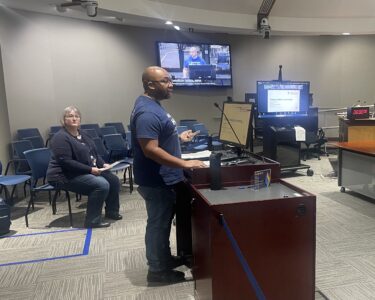
City staff answer a question from Lawrence City Commissioner Amber Sellers on Tuesday, July 21, 2026, at City Hall.
While their opinions differ on how Lawrence should choose its mayor, city commissioners think there should be much more discussion before they ask voters about it.
On Tuesday, commissioners discussed the idea of a future ballot question on whether Lawrence residents should directly elect the mayor. Under the current system, voters don’t choose the mayor directly; instead, the five-member City Commission chooses one of its members each year to serve as mayor and another one to serve as vice mayor, normally using a set of unwritten rules based on the results of the most recent City Commission elections.
The Lawrence Chamber of commerce brought the issue before the commission, and Chamber staffer Evie Lazzarino said they weren’t asking for a vote yet, but just looking at how the discussion could move ahead.
“Clearly we’re not there right now,” she said of putting the question before voters.
Commissioner Amber Sellers said much the same: “This conversation, yes, we need more time. I wouldn’t vote on this, I wouldn’t ask us to consider this, because right now is not the time or the place.”
Voters have recently spoken about how the mayor should be chosen. Back in 2024, a ballot question asked not just about electing the mayor, but also about a new structure for the commission in which there would be six members and some would represent specific geographic districts. Voters narrowly rejected that proposed government structure, with 50.86% voting against it and 49.14% voting for it.
The Chamber isn’t proposing the districts idea, but it has been doing research on the idea of an elected mayor, and its leaders say they’ve seen support for it in the community.
Lazzarino told the commission that 72% of municipalities in the country have a directly elected mayor, including DeSoto, Texas, where new City Manager Majed Al-Ghafry is coming from. A directly elected mayor, she said, would have “time to enact a vision, rather than passing the gavel when someone’s just getting started in one year.”
“We really believe this is something that has possibilities,” Lazzarino said.
Mayor Brad Finkeldei said he supported the last ballot measure, but that the city needed to have a longer conversation before putting the question before voters again. If the commission wanted to put this on the November ballot, it would have to decide on that before the start of September.
“I do agree that I don’t think we have time to put that together before September,” Finkeldei said.
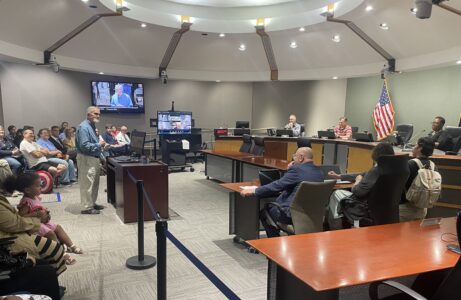
During public comments, several people spoke about the proposed change, and most of them were opposed to it. Some of them thought it would increase the influence of money on Lawrence’s local politics. Others said a directly elected mayor wouldn’t be more representative than the current system.
“You were democratically elected. You got the most votes, after Commissioner, former Mayor (Mike) Dever,” Courtney Shipley, who was mayor in 2022, told Finkeldei. She said that if continuity were really an issue, the commission, if it wanted to, could elect one person to be mayor for more than just one year.
Multiple commenters also said they wanted to change back to the uneven terms the commission had before. Before the 2023 election, commissioners were elected to either a four-year term or a two-year term – the top two vote-getters got four years, and the third got two, meaning that three commission seats were up for election every two years. But starting in the 2023 election, that changed so that all commission terms were four years, with two up for election in some years and three up for election in others.
“As we consider our form of government, I think the idea of having a majority up for election every two years ought to be a part of whatever system we adopt,” said state Sen. Marci Francisco, herself a former city commissioner and Lawrence mayor.
The commission’s opinions on this, too, were mixed. Sellers and Vice Mayor Mike Courtney both said they opposed the idea of bringing the two-year term back.
Sellers, who was elected in 2021 and again in 2023, spoke passionately about her own history on the commission. She was the third-highest vote-getter in both those elections, but in 2021, that meant she got the two-year term. “To do that work, and to say that you’re only good enough to serve for two years,” she said, was an equity problem. “It makes no sense,” she said.
She also mentioned how she had nominated herself for the commission’s leadership roles multiple times, but the commission always chose based on its traditional rules.
“If we want to talk about a form of government,” Sellers said, “… I want us not to have a surface-level conversation about it.”
Courtney, meanwhile, said four-year terms for everyone led to a more effective commission.
“Having four years gives somebody the ability to get much better at this job,” he said.
Dever, on the other hand, said that when the terms changed, “the commission broke a system that was working for 70 years.”
“We used to have a majority elected every two years, and now we don’t do that anymore,” he said.
He thought the commission should acknowledge that. But he also said that Lawrence should have conversations about how its government should grow and change, just as the community grows and changes. Douglas County, he said, had already made a change to its government by adding two more seats to the County Commission.
He also noted that the last referendum on the mayor and election by districts was almost an even split.
“This is a 50-50 issue,” he said. “This community thought seriously about it once, and they’re going to do it again.”
City Government
Lawrence City Commission to weigh whether Costco should be included in STAR bond district
As they approve bikes plan, Lawrence city leaders ask about data collection, Kentucky and Tennessee streets
Lawrence city leaders want to toughen tobacco licensing rules ‘sooner than later’
Algerian government invites Mayor Brad Finkeldei, Lawrence delegation for a visit
Construction on Wakarusa Drive to resume; city manager says KDOT’s secretary has apologized for delay