‘How do we use that most effectively?’ New study and incentive policy will help city make its affordable housing decisions
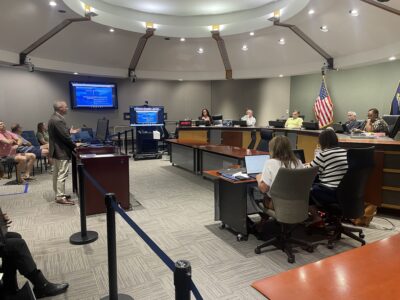
photo by: Sylas May/Journal-World
On a night full of facts and figures about the future of affordable housing in Lawrence, Mayor Brad Finkeldei mentioned a specific one leaders will soon be thinking about: $4 million.
That’s how much assistance the University of Kansas has pledged to the city for future affordable housing projects. And two things the commission discussed on Tuesday night – a new incentive policy and a housing study – could be key to deciding how this and the city’s other housing resources are used.
As the Journal-World reported, the $4 million commitment was part of KU’s agreement with the city for its Gateway project near the football stadium. The Journal-World reported at the time that KU would be providing the city with land worth at least that much for affordable housing, but Finkeldei told the Journal-World on Tuesday that talks were ongoing about whether some of that assistance would come in cash instead.
“It might come more in cash than in property,” Finkeldei said, adding that no final decision has been made yet.
It would be a significant sum for affordable housing in the city – for comparison, the Affordable Housing Trust Fund had about $1.2 million available to distribute for 2026. And Finkeldei said the question will soon be “how do we use that most effectively?”
The commission hopes the affordable housing study will help answer that question. It’s intended to be a sort of 10-year plan with strategies for meeting the city’s housing goals.
Before they voted 5-0 to adopt the study report, which was funded by a COVID-era grant, commissioners heard more about it from Justin Carney, a principal from consultant Development Strategies. Vice Mayor Mike Courtney asked Carney whether there was anything high-level that the city should be focusing on, other than adding more housing stock.
“There’s not a silver bullet right now from that perspective,” Carney said. “I wish there was; we’d be selling it.”
One area where Carney saw opportunities was what he called NOAH, short for “naturally occurring affordable housing.” He said these were older homes, built from just after World War II to around the 1970s, that had stayed with the same owner for a long time and hadn’t turned over frequently in the market.
He used his own starter home as an example. It was a small brick ranch that he bought in 2002 for $115,000. He lived in it until about five years ago, he said, and then, “when I moved, now somebody bought that house, that 1950s brick ranch. They didn’t buy it as cheaply as I did, but it was still cheaper than buying a new house.”
“Your older housing, your smaller housing, with one or two owners over the lifespan, may not have seen prices increase much,” Carney said.
The study includes suggestions for how to protect NOAH homes. One that Finkeldei asked about was a right of first refusal policy that would allow certain housing stock to be preserved as affordable before it could be sold at market rates.
Carney said these types of programs were sometimes seen with tax foreclosure sales. But Finkeldei said that might not work in Lawrence. He said the city had explored it before, after Wyandotte County implemented a similar program, “but it didn’t really work here, because we didn’t really have that many tax foreclosure sales.”
The study suggests that there could be a right of first refusal for housing supported by city incentives, such as repair programs. Finkeldei said he’d heard from people who were interested in keeping their homes affordable after they left them, and that the city might help them maintain that affordable stock in exchange for that promise: “We’ll help you now in exchange for you to do that.”
Courtney also asked about whether short-term rentals such as Airbnbs were threatening this older affordable housing stock, and Carney said they were just one of the threats that NOAH housing faced. He mentioned “tear-down, rebuild” activity in older neighborhoods and corporations buying older homes as investment properties as two of those issues.
But Carney also said that properties in the core of the city weren’t the whole solution.
In recent years, the city has prioritized infill development – building in areas already within the city limits, rather than annexing more land. But Carney said that infill was often more expensive than “green-field” development. There were several reasons for that, he said, from economies of scale for large developments to stormwater restrictions and other issues that could limit what could be built on infill lots. “A lot of times it’s very specific,” he said.
Still, commissioner Kristine Polian said the city should “start exploring the vacant land that we have” – whether the city has land that could be donated for housing.
And Courtney said there was one other incentive that developers might appreciate – streamlining the overall approval process.
“If we’re able to shorten that, that should make us more developer-friendly as a community,” he said.
That’s part of the other affordable housing piece the commission approved on Tuesday: the incentive policy. It aims to establish clear requirements and guidelines that affordable housing developers must follow to receive incentives from the city. Commissioners voted 5-0 to adopt it.
Among other things, the policy requires certain percentages of dwelling units in a project to be affordable at certain income levels. It requires all units to be affordable to households earning 120% of area median income, at least 80% affordable at or below 80% of area median income, and at least 40% available at or below 60% of area median income.
It also includes a menu of additional requirements, at least one of which must be met for at least 20% of units. These include being affordable at or below 30% of area median income; being accessible for people with disabilities; or having three or more bedrooms.
And it specifies that certain incentives, such as Affordable Housing Trust Fund development grants, would be limited to projects that would stay affordable for 99 years. Others, such as industrial revenue bonds or loans from the trust fund, would be open to projects that would stay affordable for 50 years.
Finkeldei said years of affordability and building units quickly were both important, and he asked about how the policy struck a balance “between 99 years and speed.”
“I think that the balance is that the most valuable incentives are reserved for the projects that are going to be the most valuable to the community,” Affordable Housing Administrator Lea Roselyn replied.
Commissioners said they supported the policy, but that even with it, there would still be big decisions and tradeoffs for the city to make.
“If there was a magic wand,” Finkeldei said, “we’d all be using it.”
City Government
Opinion: Environmentally conscious Lawrence is not focused on the biggest problem with electric vehicles
Locust Street apartments, Holcom housing development among this year’s applicants for $700K in Affordable Housing Trust Fund money

Business owners hurting from Wakarusa Drive closure say they’re getting no answers, no signs, no accountability
Planning Commission recommends adding more layers to approval process for data centers in Lawrence
Lawrence Loop trail may go along busy downtown street; city wants to steer clear of Riverfront for development reasons