Planning Commission recommends adding more layers to approval process for data centers in Lawrence
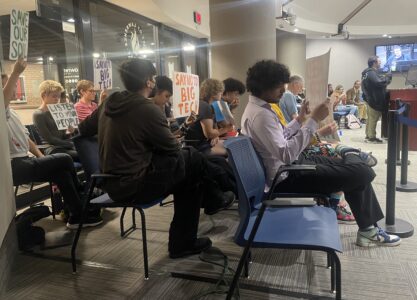
photo by: Sylas May/Journal-World
Commenters hold signs opposing hyperscale data centers at the Lawrence-Douglas County Planning Commission meeting on Sept. 21, 2026.
More layers of approvals, including multiple public hearings, would be required for data center developments in Lawrence under a proposed change to the city’s land use code that the Lawrence-Douglas County Planning Commission recommended on Monday.
The Planning Commission voted 6-1, with Commissioner Gary Rexroad opposed, to recommend a text amendment to the code that would require any future data center development in Lawrence to get a special use permit. It’s not finalized yet; the City Commission will still need to vote on it at a future meeting. But if it’s approved then, it will mean that any data center development will have to go through public hearings where the Planning Commission and City Commission can both impose conditions on it.
The City Commission started the process on this text amendment in July, at the same time that it imposed a two-year moratorium on data center development in Lawrence. The moratorium doesn’t block data center uses entirely, because developers can still ask the City Commission for an exemption.
Planner Drew Bealby said the text amendment wouldn’t change anything about the moratorium. What it would do, he said, is add more steps to the process and allow the public and elected officials more chances to weigh in.
“Just more layers of public engagement is what this text amendment really is seeking,” Bealby said.
In a memo to the Planning Commission, staff described how those extra steps would work.
First, if the City Commission allowed an exemption, city staff would study the project and develop conditions for it to adhere to. Then, the project would go through two separate public hearings – one before the Planning Commission and another before the City Commission – where residents would be allowed to comment and commissioners would take public votes on it. The commissioners could also add or remove conditions during this process.
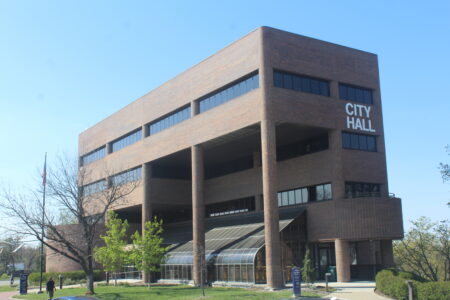
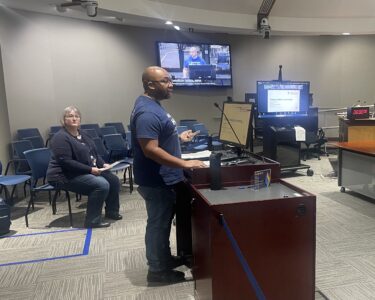
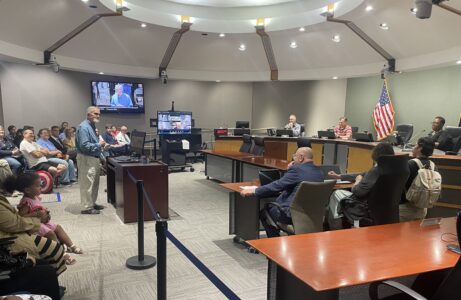
A couple dozen people showed up at City Hall to share their opinions on data center development, and they were overwhelmingly in favor of the amendment. Some of them brought signs with messages like “SAY NO TO BIG TECH,” “LISTEN TO YOUR PEOPLE” and “WE NEED WATER.” They had concerns about utility rates, environmental issues and the potential risks posed by artificial intelligence agents that are powered by data centers.
Many of them said the special use permit requirement wasn’t enough, and they called for a total ban on data centers in Lawrence.
One commenter, Iris Craver, sent the commissioners a letter ahead of their meeting with more than 300 names of other residents who opposed data centers. “The moratorium is not sufficient, obviously,” she told the commissioners. “… It doesn’t protect us. What we need is an absolute ban.”
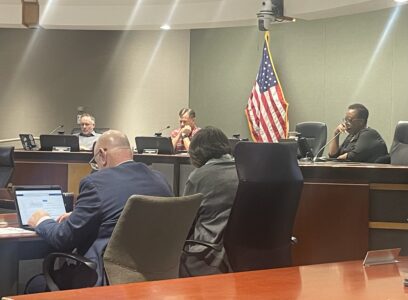
The commissioners said they understood those concerns about hyperscale developments. But Rexroad had his own worries about whether other businesses might suffer unintended consequences.
Not all data centers are hyperscale data centers, he said, and not all of them are used for AI. He gave the example of a biotech company and asked whether it would need a special use permit for the servers it stored its data on.
“That’s a seismic shift that I don’t think we’ve contemplated,” he said of the potential consequences to users other than hyperscalers. He said he wouldn’t be comfortable voting for the text amendment as it stood now, before the city had clearly defined what data center uses were: “What we’re talking about now is putting something in place before the definitions are done.”
Planning and Development Services Director Jeff Crick and other staffers said much would depend on what the primary purpose of a development would be, and whether the data center would be that primary use or just an “ancillary” use. If an engineering firm or other business has a large server facility, Crick said, that facility is in support of the business, but a hyperscale data center is a business in itself.
Staff and other commissioners also said they expected more clarity in the coming months. That’s because city commissioners have asked planning staff to research a number of concerns about data centers, including water and environmental issues, energy requirements, the potential impact on residents’ utility costs, noise and light pollution, mandatory setbacks and more. The moratorium is intended to give them time to do that research, and they’ll come back with new policy recommendations.
“I’m a 35-year IT person,” Commission Chair Mike Kelso said. He used to operate a data center in Kansas City, and he said that you could probably find data centers at the University of Kansas, LMH Health and local schools. “We have to take all those into account, and that’s what the next 24 months is about,” he said.
The issue of definitions reminded Commissioner Charlie Thomas of the famous comment about obscenity by Supreme Court Justice Potter Stewart in the 1960s: “I know it when I see it.” Thomas said he had faith in the planners and the City Commission to clarify things, and that inaction could leave the door open to unintended consequences, too.
“I will certainly live with and support 100% voting for this text amendment,” he said, “rather than waiting and leaving that door ajar for longer.”
City Government
Lawrence City Commission to weigh whether Costco should be included in STAR bond district
As they approve bikes plan, Lawrence city leaders ask about data collection, Kentucky and Tennessee streets
Lawrence city leaders want to toughen tobacco licensing rules ‘sooner than later’
Algerian government invites Mayor Brad Finkeldei, Lawrence delegation for a visit
Construction on Wakarusa Drive to resume; city manager says KDOT’s secretary has apologized for delay