Lawrence City Commission starts process of developing data center rules, imposes 24-month moratorium
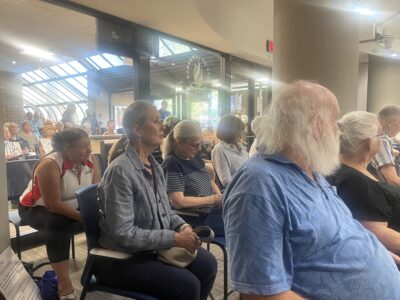
photo by: Sylas May/Journal-World
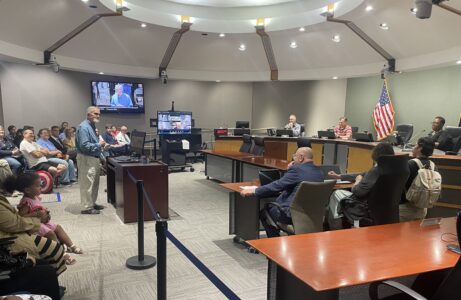
Data center opponents fill the City Commission meeting room and the lobby of City Hall on Tuesday, July 14, 2026.
Over the coming months, City of Lawrence planning staff will be studying what new rules for data centers should be in the city’s code – and data center development will be on hold while they do that work.
The City Commission on Tuesday, after hearing from a crowd of advocates, voted unanimously to initiate two text amendments on data centers in the city’s Land Development Code and to impose a 24-month moratorium on data center uses within the city limits. The current version of the code allows data centers in industrial areas by right, meaning no special approval by the City Commission would be required, but the commission intends to change that through the text amendments.
“The teeth are in the text amendment,” Vice Mayor Mike Courtney said.
For one of the text amendments, commissioners directed city planning staff to study a number of potential issues related to data centers, including water and environmental issues, energy requirements, the potential impact on residents’ utility costs, noise and light pollution, mandatory setbacks and more.
Courtney brought the list of issues to study, and he said that many other states and cities had acted to restrict data centers. That includes 18 of 50 U.S. states and many municipalities and counties, such as Sedgwick County, home of Wichita, he said.
The second text amendment would require a special use permit for data center developments, so landowners would have to get a special approval rather than being allowed to develop them by right.
Researching and drawing up new rules for data centers won’t happen overnight. Jeff Crick, director of planning and development services, said it was difficult to say how long the text amendment process would take. “I can see 12 months being possible, I can see 24 months being possible,” he said.
The moratorium is intended to allow them time to do that work. It will last for 24 months or until the city repeals it, whichever comes first. The commission had originally been asked to consider a 12-month moratorium that could be extended, but decided on a 24-month one instead to ensure planning staff had more time.
Crick said that currently, he was not aware of any proposals to develop a data center in Lawrence.
A crowd of commenters who mostly opposed data center development spilled out of the commission room. Before hearing their comments, Mayor Brad Finkeldei noted that the moratorium was originally on the commission’s consent agenda – a sign that the commission considered it routine and had consensus on it.
“We originally put it on the consent agenda because we all support the moratorium,” he said. “… You don’t have to convince us of that.”
Still, residents addressed the commission for about an hour, and the crowd of attendees frequently applauded in between speakers. One North Lawrence resident said she’d sent the commission a letter with more than 180 signatures that were gathered in just a couple of days. She urged the commission to work together with the county on “a total ban on hyperscale data centers.”
“It’s not going to happen in Douglas County,” she said. “It’s not going to happen here.”
Some of them also wanted the city to remove a provision in the moratorium that would allow property owners to request an exception from the City Commission.
The exception language, Deputy City Attorney Randy Larkin said, was intended to protect the city from liability. Finkeldei, himself an attorney, explained that the provision meant a developer would have to have a project and actually apply for an exception in order to have standing to sue the city over the moratorium. If they’re not given the right to apply for an exception, a developer “could sue us tomorrow,” Finkeldei said.
The commission did decide to change this language a bit to specify the criteria by which the commission would evaluate exception requests. They would be considering whether the application was “consistent with the intent of the text amendment” that was being developed, Finkeldei said.
Larkin also noted that if the moratorium were longer, such as five years or even indefinite, it probably would not withstand legal scrutiny.
“Moratoriums are not favored in the law, so we have to walk a fine line here,” Larkin said.
As staff begins its research, how to define and classify data centers could be one of the big issues they address. Steve Kelly, of the Lawrence chamber of commerce, said during the public comment period that it would be important to have clear language and definitions going forward.
“People are all over the place in terms of definitions,” Kelly said. He said there were likely already data centers all over Lawrence of various sizes, but that opponents of data center development were generally thinking of hyperscale data centers used for AI.
“That’s probably the crux of the text amendment itself,” Crick said.
Crick said codes normally classified things based on their principal land use, so a server room that’s used by “a school, a hospital, a city government” would be different from a facility used primarily as a data center and not as an accessory to some other use.
Commissioners also expressed interest in working with the University of Kansas and Haskell Indian Nations University to see if they would join in the moratorium. “While we cannot mandate a moratorium (for them), we can as good-faith partners give them the opportunity to participate in this moratorium with us,” Commissioner Amber Sellers said.
And Finkeldei said he wanted to ensure that Lawrence had more robust restrictions than Douglas County, which has been having its own data center conversations recently.
“Whatever the county adopts,” Finkeldei said, “I want to be more restrictive than the county.”
City Government
Lawrence City Commission to weigh whether Costco should be included in STAR bond district
As they approve bikes plan, Lawrence city leaders ask about data collection, Kentucky and Tennessee streets
Lawrence city leaders want to toughen tobacco licensing rules ‘sooner than later’
Algerian government invites Mayor Brad Finkeldei, Lawrence delegation for a visit
Construction on Wakarusa Drive to resume; city manager says KDOT’s secretary has apologized for delay