

Lawrence could be a landing spot for data centers as city code already allows them
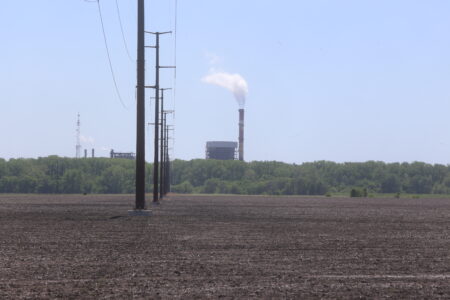
photo by: Chad Lawhorn/Journal-World
A row of high voltage power lines leading into Lawrence is pictured on April 24, 2026. The Lawrence Energy Center, a coal fired power plant operated by Evergy, is pictured in the background.
The artificial intelligence boom has driven companies to search nationwide for space to build “hyperscale” data centers – and it turns out, Lawrence is actually a place they could go.
Not only that, the large energy-using structures wouldn’t need much in the way of special approvals from city officials to build on certain parcels of Lawrence land, a Journal-World review of city codes found.
The city’s Land Development Code lists data centers as a permitted use in industrial zoning districts, meaning they are allowed by right – no special vote from the City Commission is required – as long as they meet district standards such as setbacks, building size and infrastructure requirements.
Several other zoning districts in the city – a mixed corridor district and commercial center districts, among them – would allow data centers with a special use permit, which would require a vote by city commissioners.
The Big Data Debate:
A three-part series from the Journal-World on whether big data centers are likely to become a big part of our local communities.
• Sunday: Douglas County’s “de facto pause” on data centers and crypto mines
• Today: What the City of Lawrence already has decided about data centers
• Tuesday: Big ideas for big data centers in nearby De Soto and Tonganoxie
Even though data centers are listed as an allowed use, Lawrence’s code does not include use-specific standards for them, leaving staff to review applications under existing permitting requirements. That means a data center would need to meet the same general requirements as a distribution center, for example, even though the two projects may differ significantly in terms of energy use, water use, noise and other such issues.
Douglas County is handling data centers and similar developments differently, as officials have spent nearly two years considering whether and how to regulate data centers, cryptocurrency mining and battery energy storage facilities, though no formal rules or timeline for adoption have been set, as the Journal-World reported.
Aaron Bilyeu, chief development officer of Cloverleaf Infrastructure — which is proposing a large data center development near rural Tonganoxie — said Kansas Senate Bill 98, which was passed last year, has been a major reason companies are looking at Kansas. The law created a 20-year sales and use tax exemption for data centers that invest at least $250 million and create at least 20 jobs within five years. With some data center construction easily topping $100 million, the state incentive means companies are saving millions of dollars by not having to pay sales taxes on the construction materials needed to build the centers.
The incentive covers construction materials, equipment and maintenance labor.
“That is really what started a lot of the projects that you’re seeing come up across the state,” Bilyeu said. “The hyperscalers really don’t very often go to states that don’t have sales and use tax exemptions because it’s such a valuable economic tool to them.”
Lawrence Mayor Brad Finkeldei said he would be concerned with any large data center that would consume significant acreage and use large amounts of energy and water, but he said he believes a company would likely be more interested in Douglas County land than property inside city limits because of limited available acreage.
“Because of our limited acreage in the city, I believe any such project would likely seek to be located in the County or seek to be annexed into the city,” Finkeldei said via email. “As such, I believe we would have significant processes that would allow us to determine if a particular project was a good fit for our community or not.”
The idea that a data center could seek to annex land into the city to build upon is an important one. City officials do have broad discretion to approve or deny annexation requests. Thus, if a company announced it wanted to locate a data center in Lawrence and filed annexation and rezoning requests to build it, city commissioners would be in a position to fully debate the project.
However, not all annexation and rezoning requests are so clear cut. In the past, the city has annexed land into the city limits with the idea that it would house industrial users, but didn’t know what specific businesses ultimately would build on the land. For example, the city annexed and rezoned the land that now is Lawrence VenturePark without knowing any specific users for the industrial park.
City officials may be asked to repeat that process for new industrial parks in the near future. Economic development leaders in the city have acknowledged that they are looking at hundreds of acres of land to serve as the city’s next industrial park.
Once the land becomes zoned industrial, city officials would face difficulties in denying a data center project, if the project met the basic technical site plan requirements of the city.
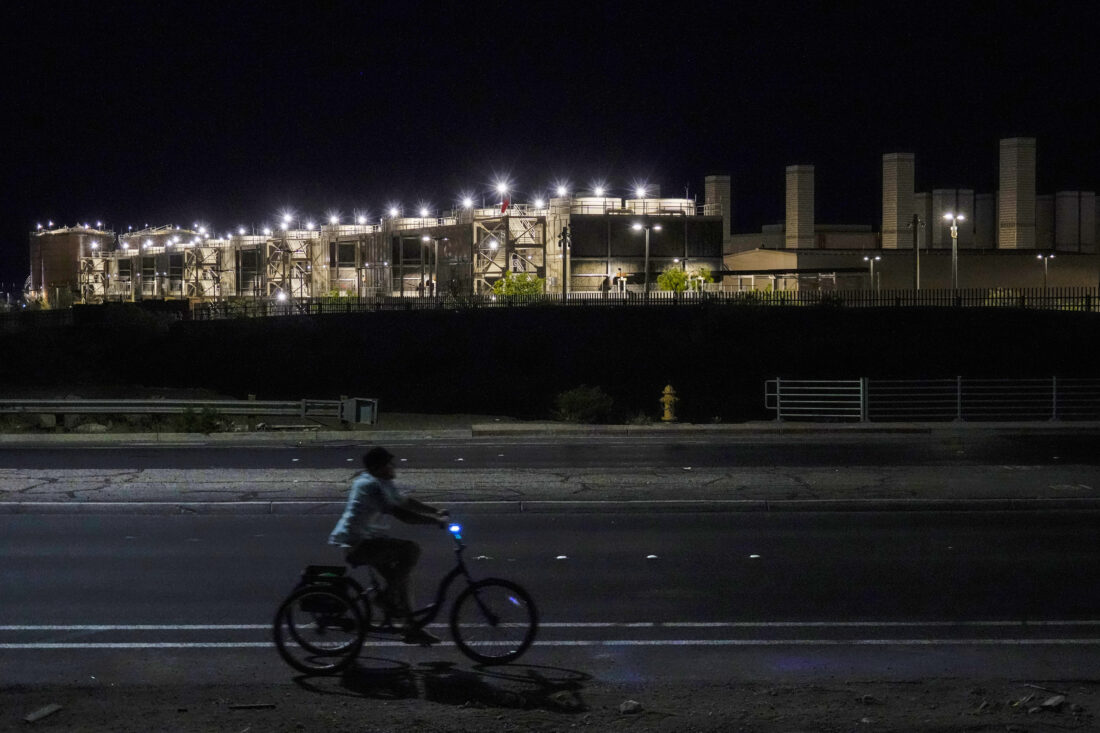
The exterior of a Google Data Center is shown on Thursday, April 2, 2026, in Henderson, Nev. (AP Photo/Ty ONeil)
Could a data center come to Lawrence?
There are many factors companies consider when choosing where to build a data center. These facilities use large amounts of power to run servers that store and process digital information, along with cooling systems, backup power equipment and networking infrastructure that must operate continuously.
Lawrence has major electrical infrastructure already in place due to being one of the few cities in the state that is home to a major power plant. Evergy’s coal-fired Lawrence Energy Center is located just northwest of the Lawrence city limits, resulting in a multitude of high-voltage power lines in the area. The city could also see additional electrical generation come online from the proposed Kansas Sky Energy Center solar project in northern Douglas County. That project is the subject of a lawsuit, which has stopped construction from beginning.
Just over the Douglas County line, large-scale data center projects are already being explored in Leavenworth County and the city of De Soto. Bilyeu said companies deciding where to locate a data center are not simply looking for enough land, but for how much electricity a utility can provide to the site.
“Because what ends up happening is, when you’re working with the utility, they’re telling you how much energy can be provided at the site, and then from how much energy you have, you then work backwards and design your facility to be able to consume all of the electricity,” Bilyeu said.
The addition of the Kansas Sky Energy Center, if it eventually is allowed to be constructed, likely will make significant amounts of new energy available to the area. The solar facility is projected to provide enough energy to power 30,000 homes, although the energy doesn’t have to be used for homes. A data center customer for the solar facility might be advantageous for Evergy because it would provide a constant user for the power. Unlike many other solar facilities, the Kansas Sky Energy Center does not plan to have a battery storage facility that will allow the solar farm to store the energy it produces to be used for a later time.
Water use can also be a consideration, though Bilyeu said an increasing number of modern data centers use cooling systems that do not require large amounts of water. He said Cloverleaf does not necessarily build projects that require large amounts of water. However, that is not the case with all data center projects. The proposed De Soto data center is a heavy water user, and the city’s willingness to build new water and sewer systems has been a reason for the data center interest in that community.
If water is a key consideration for a data center project, Lawrence has a statistic that may catch the attention of data center developers. The city already has two water treatment plants. As the Journal-World recently reported, the city has enough water treatment capacity to produce 41 million gallons of water per day, but it usually sells only 10 million to 11 million gallons per day.
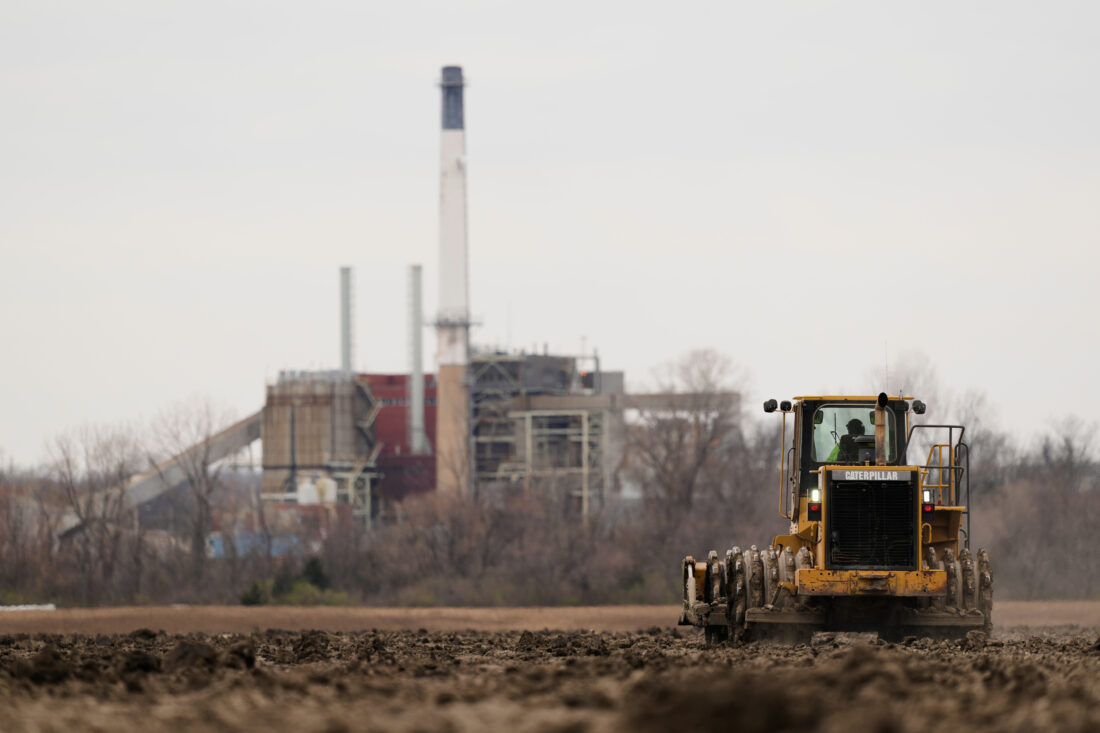
photo by: AP Photo/Charlie Riedel
A worker prepares a plot of land for an AI data center while a retired power plant being refurbished to provide electricity for the facility rises in the distance Tuesday, March 24, 2026, in Independence, Mo.
City’s rules for other developments
Data centers are sometimes grouped with similar developments, such as “cryptocurrency mining” – also known as digital asset retrieval – or battery energy storage facilities due to their high energy intensity and demands on the electric grid.
Cryptocurrency mining facilities are not mentioned or explicitly defined as a land use in the city’s code. For uses not listed, an applicant may request that planning staff decide if a proposed development fits into existing zoning rules or a text amendment to the Land Development Code may be needed, Jeff Crick, the city’s planning and development services director, said.
“The Land Development Code does not attempt to define every possible land use that may arise,” Crick said via email. “Instead, it takes a broader approach, providing ways to address new or emerging types of development as they are proposed.”
If there are no specific regulations tied to crypto mines, it leaves decisions up to planning staff on whether it fits into existing code, and if it is allowed in the zoning of where the property is proposed.
Meanwhile, it is a very different situation for battery energy storage systems, where the city allows them in any of its zoning districts with a special use permit. These projects are primarily used to store excess energy generated from renewable sources like solar and wind.
Battery energy storage systems in industrial areas must follow safety and maintenance standards to reduce risks and limit impacts on nearby properties. For larger systems over 600 kilowatt-hours, the area within 10 feet must be kept clear of vegetation and other combustible materials to reduce fire risk. Larger battery systems must also have a decommissioning plan for when the facility is abandoned or removed.
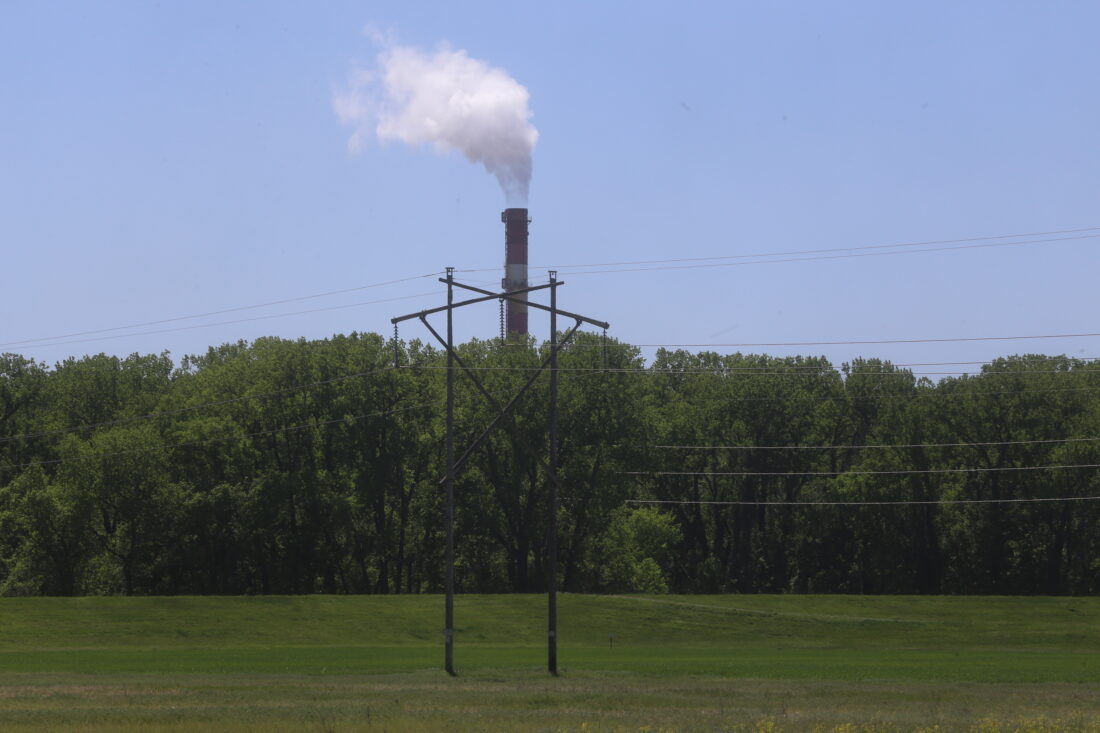
photo by: Chad Lawhorn/Journal-World
A high voltage power line and a the coal-fired power plant, the Lawrence Energy Center, are pictured north of Lawrence on April 24, 2026.
City’s not looking to change its code
Even though the city allows data centers and has no regulations specific to them, Susie Carson, the city’s director of economic development, said the city is continuing to stay informed and evaluate information as it becomes available.
If city staff was to look at potentially adding specific regulations to these uses, it would have to be directed by the City Commission.
“The City regularly evaluates whether its policies and processes continue to reflect community needs, infrastructure capacity, and long-term land use goals. That applies to all types of development,” the city told the Journal-World via email. “If any code changes are needed in the future, they would go through the City’s processes, including review by the Planning Commission, as applicable, as well as the City Commission.”
And there may be good reason that the city officials don’t want to automatically discourage data center companies from considering Lawrence. While the centers aren’t traditionally large employers, they can be very large taxpayers. If a $200 million data center were willing to locate in Lawrence without a local property tax abatement, it would pay nearly $4 million a year in combined property taxes to the city and the county.
Carson said the city regularly receives inquiries about available land, buildings and infrastructure as part of normal economic activity.
“No formal development application or zoning request has been submitted for a data center, battery storage facility, or cryptocurrency mining operation,” Carson said via email.
Despite thinking that the city’s regulations would give “sufficient oversight on any such project,” Finkeldei said that doesn’t mean the city would never consider making changes to its code for data centers.
“Of course, as technology changes, data centers may take on different shapes and sizes, at which point additional regulations may be required,” Finkeldei said via email.
City Government
As they approve bikes plan, Lawrence city leaders ask about data collection, Kentucky and Tennessee streets
Lawrence city leaders want to toughen tobacco licensing rules ‘sooner than later’
Algerian government invites Mayor Brad Finkeldei, Lawrence delegation for a visit
Construction on Wakarusa Drive to resume; city manager says KDOT’s secretary has apologized for delay
Evacuation drill planned Tuesday at Lawrence City Hall
