Lawrence city commissioner calls video on homelessness plan ‘grossly dishonest,’ urges others to denounce it
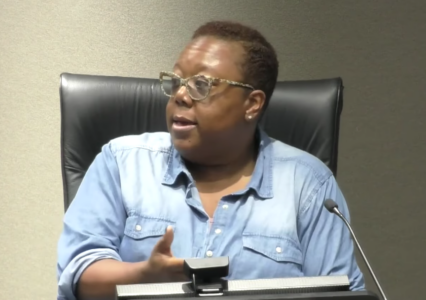
photo by: Screenshot/City of Lawrence
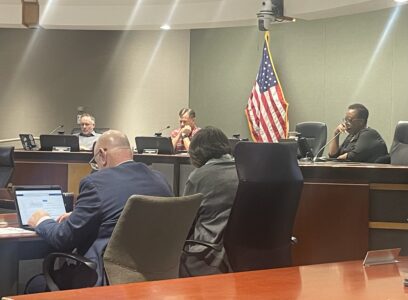
City Commissioner Amber Sellers speaks with the other members of the commission on Tuesday, Aug. 4, 2026.
Last week, an anonymous YouTube video about Lawrence’s and Douglas County’s homeless plan sparked a tense conversation at a community meeting. And this week, it sparked another one at City Hall, with one city commissioner calling it “a grossly dishonest narrative” and urging her peers to denounce it.
The video, called “Douglas County Fails Homeless Accountability,” was shown at the start of a gathering last week about the homeless plan, which City Commissioner Kristine Polian and two Douglas County commissioners attended. Among other things, the video briefly criticizes the homeless response in another U.S. city, Baltimore, and says that it “failed to ensure accountability for results.”
At Tuesday’s Lawrence City Commission meeting, Commissioner Amber Sellers denounced the video and its reference to Baltimore as racially charged, embarrassing and a piece of “propaganda,” and she asked Polian to denounce it, too.
“What I want to know is, do you denounce the video and call for it to be pulled off of social media?” she asked Polian.
And when Polian began to answer – “I 100%, never, ever want to criticize another –” Sellers cut her off:
“My question to you is, do you denounce the video?”
“I will denounce that portion of it,” Polian said of the Baltimore reference, “100%, and would ask that any criticism to any other local government be removed, and focus just on us.”
The video caused some controversy at the meeting where it was shown, too. The meeting was organized by community members to discuss the effectiveness of the homeless plan, A Place for Everyone, and it followed a report on that topic that County Commissioner Erica Anderson and Lawrence resident John Ims compiled.
The video summarizes the report’s findings, as the Journal-World reported, but some attendees said the video made it seem like the meeting’s organizers wanted to scrap A Place for Everyone entirely. All of the local elected officials in attendance then – Anderson, Polian and County Commissioner Gene Dorsey – said they didn’t want to do that.
Polian on Tuesday reiterated that her intent wasn’t to get rid of the homelessness plan. “There were some concerns of folks in attendance that there was this approach of trying to scrap the plan … and say that this plan is a poor plan,” she said. “That is absolutely not the case.”
But Sellers had a problem with how the meeting as a whole was organized and conducted.
She said people who actually provided homeless services in the community felt “caught off guard by the tone and texture of it.” And she also seemed to respond to comments made by Anderson and Dorsey, who both said that they requested to meet with county and city commissioners multiple times, but felt those requests were not moving forward.
“I’ve never been asked to come to a conversation in regard to this, and neither were service providers,” Sellers said. “They didn’t know anything about the meeting.”
The video
“Douglas County Fails Homeless Accountability” is the only upload on a YouTube channel called “LawrenceDouglasCo” that was created on July 15. This channel has no description and provides no information about its ownership.
The video itself consists of a voiceover about homelessness in Douglas County on top of still images and video clips, many of them taken from news outlets.
Some of the clips are related to homelessness and are of sites in Lawrence, including shots of unhoused people on Massachusetts Street and The Village of Pallet cabins on North Michigan Street. Others seem to be unrelated to Lawrence, Douglas County or homelessness.
A few clips are from communities elsewhere in the U.S. named “Lawrence” and “Douglas County”; there are clips of an ambulance service in Lawrence County, Alabama, and a clip from a government meeting in Douglas County, Colorado. At one point, the narrator says that police calls had been made to supportive housing sites for “assaults, weapons, welfare checks on children,” and the video shows a photo of Lawrence Thai Massage taken by the Journal-World and an image of Joshua Salazar, a Lawrence resident accused of raping a client while he was employed as a massage therapist at that business.
Polian and Sellers both said they didn’t know where the video came from. Sellers said it “just happened to have popped up on YouTube,” and that “no one knows who created it, no one knows who paid for it.”
But Sellers also insinuated that there might be some connection between the video and the meeting’s participants: “I think it’s interesting, the timing of the meeting and the timing of the video, and that the subject of the meeting was included in the subject of the video, yet nobody knows anything about it.”
She also suggested that Polian knew how to contact the video’s creator, which Polian emphatically denied.
“It sounds like you know who has access to making the video,” Sellers said. “I certainly don’t,” Polian responded.
‘A deplorable narrative’
One of Sellers’ biggest problems with the video was the comment about Baltimore, which she said was part of a racially charged narrative and was “punching down” at another city.
The video includes clips from a CBS News report on Baltimore’s homeless services, over which the narrator speaks: “Baltimore invested heavily in buildings and housing, but failed to ensure accountability for results. Despite significant public spending, many of the problems those investments were intended to address persisted.”
Anderson’s report, which the video is based on, also mentions Baltimore, calling it “the documented end-state of investment without accountability.”
Sellers pointed to her own position as a leader with the National League of Cities, an organization of U.S. municipal governments that was founded in Lawrence in 1924. This year, she holds the title of first vice president of the NLC’s National Black Caucus of Local Elected Officials, or NBC-LEO, and she said that she was “deeply embarrassed and ashamed” that the video spoke about another NLC member in this way.
“I refuse to see our community use a fellow NLC member city – mind you, we are the birthplace of NLC – to create a bogeyman lore, to perpetuate a deplorable narrative that is not the sum of this city or the people who call it home,” Sellers said. “My eyes are not able to weep, because the fire inside me burns and reminds me that the work to teach must continue.”
She said that Baltimore, with more than 500,000 people, is more than five times the size of Lawrence, and that their governments are structured differently. In addition, she pushed back on the idea that Baltimore’s homeless programs had failed, saying the city had “housed over 1,443 households experiencing homelessness and placed over 2,500 affordable units in (the) development pipeline.”
And she said that Baltimore’s mayor, Brandon M. Scott, is Black, and that Baltimore is a majority-Black city. (The U.S. Census Bureau reports that more than 58% of the city’s residents are Black.) She said it was problematic to use “specific, highly visible, predominantly Black urban centers to illustrate failed government spending or crime.”
“These actions were malicious, intentional and use racial undertones tucked behind plausible deniability to discredit the leadership of a Black mayor,” Sellers said.
Commissioners heard similar sentiments from a different Mayor Scott on Tuesday: Bobby Scott, the top elected leader of Center Point, Alabama. Scott also is the president of NBC-LEO, and he spoke to the commission via Zoom during the public comment period at the end of the meeting.
He said his work with NLC focused on bringing elected officials together “to help resolve each other’s issues in a civil manner.”
“That video discredits the work that we do as Black mayors, as mayors in general, for our cities,” he said. He called on the commission to formally denounce it as a group and to apologize to Baltimore’s Mayor Scott.
“You don’t have to destroy another person’s reputation to make your point,” Bobby Scott said.
What’s next?
The commission didn’t take any formal action like that, but it does intend to discuss A Place for Everyone in the future.
And all four commissioners present Tuesday (Mayor Brad Finkeldei was absent) spoke a bit about what they wanted that to look like.
“What, specifically, are we wanting to talk about in regard to A Place for Everyone?” Sellers asked. “Because I’m not interested in relitigating anything.”
Commissioner Mike Dever echoed that.
“I don’t want to relitigate this, because we have so much relitigating going on,” he said. “We spent a lot of time relitigating for the last nine months; I’d like to really focus on our future.”
Polian, meanwhile, said her goal was to discuss “the effectiveness of the plan.” She said that she’d “done the work” of talking to homeless service providers and recipients, and that “I haven’t met a person that hasn’t said that there is room for improvement there.”
“Congratulations both to Lawrence and to Baltimore for the successes that we’ve both had, because we’ve had a lot,” Polian said. “But, again, there, I think, are some gaps, and I was told to do the work many months ago.”
Dever said he’d like to clarify what “effectiveness” means. And Polian added as well that it might be productive to have another community meeting similar to the one that was held last week, but with a panel of service providers who could educate the community about the work they do.
Vice Mayor Mike Courtney wanted to involve Anderson in the discussion, too. He said both he and Anderson were on the steering committee for the Douglas County Community Health Improvement Plan, or CHIP, and that might be a chance for discussions, as well.
And he suggested that the commission could put a more thorough discussion about A Place for Everyone on its calendar in October, after the 2027 budget process is complete.
City Government
Lawrence City Commission to weigh whether Costco should be included in STAR bond district
As they approve bikes plan, Lawrence city leaders ask about data collection, Kentucky and Tennessee streets
Lawrence city leaders want to toughen tobacco licensing rules ‘sooner than later’
Algerian government invites Mayor Brad Finkeldei, Lawrence delegation for a visit
Construction on Wakarusa Drive to resume; city manager says KDOT’s secretary has apologized for delay