Douglas County commissioner raises concerns about the city and county’s progress toward ‘functional zero’ homelessness goal
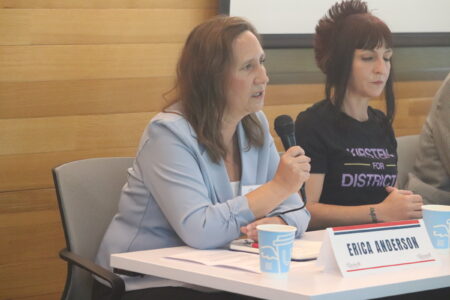
photo by: Josie Heimsoth/Journal-World
Current County Commissioner Erica Anderson, a Democrat representing District 5, speaks at a candidate forum on Tuesday, June 23, 2026.
A new analysis written by a Douglas County commissioner argues that the city and county are not on track to meet the goal of reaching “functional zero” homelessness by 2028.
The review was put together by County Commissioner Erica Anderson alongside John Ims, a Lawrence resident and frequent public commenter at city and county meetings. The 25-page document evaluated the city and county’s five-year plan to end chronic homelessness in Douglas County – ‘A Place for Everyone.’
The five-year plan – which was originally finalized in 2024 – is approaching its milestone of 2028. The end goal is to achieve functional zero, where the number of people experiencing homelessness is lower or equal to the number of people moving into permanent housing each month. And Anderson wasn’t the only commissioner who thought the county may not meet that goal.
“‘A Place for Everyone’ needs a thorough review,” Commissioner Gene Dorsey said at the County Commission’s June 24 meeting. ” … The overall objective was to be met by 2028. I don’t think that’s going to happen in any sense of the word.”
Anderson initially brought up her review of “A Place for Everyone” during the June 24 meeting, in hopes to schedule a conversation with the city and county about where the plan was at in achieving its goals. However, since it was two weeks before next year’s budget discussions were scheduled to start, county staff suggested scheduling the conversation sometime after the budget cycle and once the new city manager was on board.
Anderson argues that “A Place for Everyone” is unlikely to achieve its goal by 2028 because the plan measures activity – such as housing placements, services provided and dollars spent – rather than whether those efforts lead to long-term stability.
The report says the city and county do not track outcomes such as whether people remain housed after utilizing services, reduce their use of emergency services or have fewer interactions with law enforcement after being placed in housing. It also argues the data used to measure homelessness is incomplete and understates the homeless population, while shelter trends indicate the number of people experiencing homelessness is increasing rather than declining.
Anderson also said she thinks Douglas County is the partner that will bear significant financial and public safety costs in the long-term, making the 2028 goal difficult to achieve under the current approach.
According to the report, city and federal dollars often pay for capital projects such as housing development, but the county is responsible for recurring costs tied to behavioral health services, emergency medical response, the jail, courts, housing stabilization efforts and other public services if residents continue to experience instability.
New affordable housing developments can increase demand for housing vouchers and supportive services funded through the Lawrence-Douglas County Housing Authority, the report said, while Douglas County also incurs costs serving some nonresidents without reimbursement. The report argues the county lacks data tracking whether these long-term costs decline after people are housed, making it difficult to determine whether “A Place for Everyone” is reducing the county’s fiscal exposure over time.
Anderson said the county is already funding gaps in “lanes” of the “A Place for Everyone” plan she thought was the city’s responsibility.
City and county staff say they each have their roles in implementing the different strategies in APFE. An example is the affordable housing pillar of the plan, and many projects contributing to those efforts are funded with the city’s Affordable Housing Trust Fund – a local sales-tax-backed funding pool designed to improve housing availability, quality, and affordability.
“We really have lanes,” County Administrator Sarah Plinsky said at the June 24 meeting. “There are things the city funds that we don’t fund that much, and there are things that we fund that the city doesn’t fund very much.”
However, Anderson told the Journal-World she thought the county was shifting lanes, specifically for the emergency shelter area of the plan. The city has primarily led those efforts, and Anderson said when a majority of commissioners during most recent budget deliberations decided to fund multiple additional funding requests for Family Promise, that was the county not staying in its lane.
The bulk of additional funding allocated to Family Promise was $327,095 in one-time funding to pay off a loan for a temporary family shelter.
“We did not stay in our own lanes,” Anderson told the Journal-World.
On Monday afternoon, the Journal-World shared a list of questions with city and county staff. One of those questions was whether the report’s estimates that “A Place for Everyone” has cost about $50 million to date and is projected to cost $267.77 million over five years are accurate. The five-year projection was included in the plan when it was adopted by both the city and county in 2024.
The Journal-World also asked whether staff agreed with the report’s claim that Douglas County is shouldering much of the long-term costs associated with the plan, including behavioral health services, EMS, the jail and other public services.
A Douglas County staff member told the Journal-World via email on Tuesday that those questions “involve (a) broader financial and policy analysis related to the jointly adopted plan, and we don’t have additional information to provide on those at this time.”
There were also questions about whether existing data provides a complete picture of homelessness in Douglas County. Last year, the city and county launched the Douglas County Active Homeless Dashboard, but Anderson said it may not represent the actual number of unhoused individuals or the full population being served with taxpayer resources.
The dashboard only counts individuals who are connected to certain homelessness services or who have recently exited those services to non-permanent housing, meaning people experiencing homelessness outside the service system are not included, the report said. In addition, the report said the data may not capture people served in Douglas County who do not identify the county as their prior region, leaving uncertainty about the number of individuals receiving local services but not appearing in the dashboard.
“(The dashboard) provides an ongoing picture of people engaged in the homeless response system during the previous 90 days,” Kristen Egan, housing and human services program manager for Douglas County, said via email. “The methodology follows the Built for Zero model and uses information primarily from the Homeless Management Information System (HMIS) and Coordinated Entry System (CES) to track people entering and exiting homelessness and changes over time.”
“Like any service-based data system, it cannot guarantee every person experiencing homelessness is represented,” Egan added.
If someone has never been identified by or interacted with the homeless response system, the county would not have individual-level information about that person in HMIS, Egan said. “However, someone does not have to be enrolled in a housing program or receive ongoing services to be included in the community’s data,” Egan said via email.
In regards to what happens to people after using services and temporary housing, Egan said the county tracks some outcomes, including housing placements and whether someone later returns to the homelessness response system.
“Employment is not routinely tracked through the Built for Zero dashboard, and emergency-service utilization is not currently part of the dashboard,” Egan said via email. “We continue to look at ways other available data can help provide a better understanding of longer-term outcomes.”
Beyond the data collected in the Homelessness Dashboard, Anderson raised concerns about whether the agencies involved in the plan are working together effectively. She said many community partners involved in the plan were “all working in silos” and not communicating with each other to achieve collective goals.
“We have to work better together as teams,” Anderson said. “We have to come together and have really hard conversations about how we create better workflows, and just stop working around each other. Because right now, people are just working around each other. They’re not truly coming together to sit down and figure out how we better figure out these situations instead of just funding the problem.”
“We have to just stop funding the problem,” Anderson said.
The report states that Kansas law mandates counties to provide core functions such as jail operations, court-related support and certain administrative services, but homelessness programs and behavioral health investments are authorized rather than required expenditures. Because the county voluntarily created and funded these systems, the report argues that commissioners have both the authority and responsibility to demand stronger cost transparency, outcome measurements and accountability.
“It really comes down to policy,” Anderson said. “We really need to partner with our state agencies and our policymakers at the state level and advocate for better policies … and get them to change how they are affecting the local level.”
The Journal-World also reached out to the City of Lawrence for comment on Monday afternoon. The city did not provide comments on the review by Anderson, and the city said the document was not shared with any of the subcommittees involved with the “A Place for Everyone”.
“We should take the time to explore what you’ve provided to us,” Cori Wallace, the city’s spokesperson, said via email. “It’s what this work warrants … we need to take a look as a group to answer with discernment and respect.”
Anderson initially told the other county commissioners during the June 24 business meeting that she would be interested in having a conversation about the city-county plan with city commissioners and staff, especially since there have been multiple changes in leadership in both local governments.
Meanwhile, in response to Anderson asking for a larger conversation about the plan with city commissioners, Kelly said his experience with the plan was not with both the city and county sitting down together.
“It was a very broad process that involved lots of public input, and discussion, and meeting with community partners,” Kelly said at the meeting.
While Kelly admitted the process has felt “clunky,” he wasn’t sure it made sense for city and county leaders to revisit the plan following every election of new commissioners.
“If we wanted to revisit every time they had someone new, we’d be revisiting the plan every single year,” Kelly said. ” … I think it’s important for us to reference the document, and I bet I could find things in there that we’re not funding that we’ve aspirationally put out there.”
Reid said she didn’t think it was a plan put together by just the two government entities, also emphasizing that the fundamentals of many strategic plans in the county are “aspirational in nature.”
“It’s important to aspire to things that we may not be able to achieve because we want the whole community working in that direction,” Reid said at the meeting. “And ‘A Place for Everyone’ was a community-wide generated plan. It was not two government entities putting it together.”
Kelly said he never thought the plan was “set in stone” when the city and county would have to achieve its goals. He added that maybe county staff could explore what the review process of the plan might look like and what it could entail, especially when putting together a strategic plan is oftentimes years in the making.
“How do we honor what happened there and continue to strengthen the plan going forward in a way that continually reviews it?” Kelly said.
Anderson told the Journal-World if the plan continues in the direction it is going right now, she worries the county will continue to spend more and more money.
“I just hope that it truly becomes a place for everyone, and that we don’t leave people behind, including our middle class, including our kids, that they can live here,” Anderson said.
Dorsey told the Journal-World that there will be a conversation surrounding the “A Place for Everyone” plan with a few city and county leaders from 6 p.m. to 7:30 p.m. on Wednesday at the Lawrence Public Library, 707 Vermont St.
Other News

Student-run coffee shop opens at Community Connections at Pinckney, teacher receives surprise $1,000 award
‘This is for all of us’: Midco Prairie, an oasis of native plants in downtown Lawrence, opens to the public
Douglas County commissioners express interest in fireworks sales dates that include a weekend

Douglas County commissioners to discuss whether to increase the number of days fireworks can be sold in the county
Lawrence’s first bike lanes with physical barriers are installed on Ninth Street