

Lawrence’s 2025 audit reveals issues related to airport grants, accounting software error
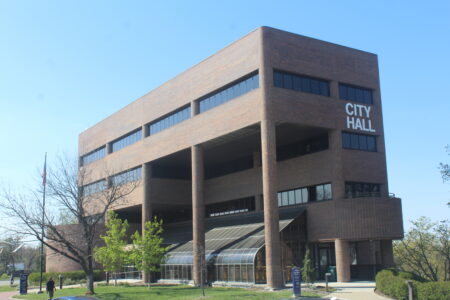
photo by: Bremen Keasey/Journal-World
Lawrence's City Hall, 6 E. Sixth St., as seen on Monday, April 6, 2026.
Lawrence’s audit and financials for 2025 are in, and this time, auditors flagged problems related to grants at Lawrence Regional Airport and to the city’s accounting software.
The audit, prepared by auditing firm RSM, was released to the public this week and is scheduled to be discussed at the City Commission meeting next Tuesday.
Unlike the 2024 audit, the 2025 audit found what auditors call “material weaknesses” in the city’s financials.
The report spells out the difference between a material weakness and another type of deficiency called a “significant deficiency.” A material weakness is a deficiency that’s associated with a “reasonable possibility that a material misstatement of the City’s financial statements will not be prevented, or detected and corrected, on a timely basis.” A significant deficiency is one that is “important enough to merit attention” by city leaders, but it’s less severe than a material weakness. In 2024, the auditors found one significant deficiency and no material weaknesses. In 2025, the auditors found two of each.
One of the weaknesses in the 2025 financials has to do with debt refunding and how the city keeps track of it. Debt refunding is basically how municipal governments refinance their debt – issuing new bonds in order to retire outstanding bonds. The audit findings say that the city failed to properly account for one of these transactions in the water and sewer fund, and that resulted in the deferred gain from refunding being overstated by about $7.7 million, which the city had to correct.
“The lack of established procedures and controls for transactions of this nature, which have historically occurred infrequently for the City, could potentially result in material misstatements of the financial statements and material departures from generally accepted accounting principles,” the auditors wrote.
The city, in its corrective action plan attached to the report, said that this error was caused by a third-party accounting software system that it uses, which had been incorrectly configured. “As a result of the audit process, City finance staff collaborated directly with the software vendor to identify and correct the configuration issue,” the plan states.
The plan also says that, in the future, “all software-generated bond and debt-related accounting entries” will undergo an “offline calculation verification by both a City Accountant and the Finance Director.”
The airport weakness, meanwhile, is related to the allegations from the FAA in 2025 that the city violated grant provisions.
In April 2025, as the Journal-World reported, the FAA alleged, among other things, that the private company that Lawrence partners with to operate the airport was charging aircraft owners to park their aircraft on the airport’s apron. These “tie-down fees” for use of the apron were not allowed, the FAA said, because work on the apron was funded with FAA grant money, and maintaining broad access to the aviation public was a requirement of the grant.
Noncompliance with the grant’s provisions could put the airport at risk of losing all access to federal grants, federal officials warned at the time.
The auditors wrote that “all revenues generated by a public airport must be expended for the capital or operating costs of the airport, the local airport system, or other local facilities that are owned or operated by the owner or operator of the airport and are directly and substantially related to the actual air transportation of passengers or property.” In response to the FAA allegation, they said, the city was investigating whether there was “revenue that was not remitted to the airport as required per revenue diversion criteria.”
In the corrective plan, the city says it “has and continues to perform a legal and management review,” and that the airport manager and other executive staff will work to improve compliance and oversight. However, it also says that its review thus far shows that “revenue diversion may not have occurred, or not to the extent originally asserted.”
The two significant deficiencies are also related to airport grants. These had to do with federal reporting requirements.
One of these findings involves a report called a Schedule of Expenditures of Federal Awards, or SEFA – basically a report of how much grant funding was spent in the fiscal year. The city included expenditures on the SEFA for 2025 that actually happened in other fiscal years. The other says that the city submitted some of the reports required in grant agreements several months after the deadline of Dec. 31, 2025.
Here are a few other takeaways from the city’s audit and financials for 2025:
The net position
The financials show that the city has a “net position” of $468.7 million. That means assets and deferred outflows exceeded liabilities and deferred inflows by that amount.
In an analysis and discussion of the results attached to the agenda, city management said this was an indicator that the city’s financial health was improving.
“Over time, increases or decreases in net position may serve as a useful indicator of whether the financial position of the City is improving or deteriorating,” the report from city management said. “Based on (these) criteria, the City’s financial position continues to improve.”
Of the $468.7 million net position, about $350 million reflected its capital investments such as land, infrastructure and machinery. Another $74.6 million was subject to external restrictions on how it could be used. Among other things, that portion includes money set aside for debt service ($36.2 million), capital improvement projects ($16.9 million), transit ($8 million), road and highway projects ($4.3 million) and remediation of environmental pollutants at the former Farmland Industries fertilizer plant ($1.7 million). That left $43.9 million unrestricted, or not assigned for specific purposes.
Revenues outpace expenses
Revenues were up 7.1%, or about $19.1 million, in 2025. Among the revenue sources that rose were property tax collections, which went up by $4.1 million, and other tax collections, which rose by $8.3 million.
In 2025, the city held its mill levy flat, but property tax revenues still increased because of rising property values. The increase in “other tax collections” was because of the 0.05% sales tax increase that voters approved in 2024 to fund affordable housing programs.
These gains were offset by decreases in investment income and in operating grants and contributions, such as the end of COVID-era American Rescue Plan Act funding.
Expenses were up 1.21%, or about $3.3 million, so revenue growth significantly outpaced them.
More debt
The city’s total debt increased by $86.6 million to $516 million. That’s a greater increase than from 2023 to 2024, when it rose by $30.96 million.
City leaders have attributed Lawrence’s increasing debt to major capital projects such as the $130 million Municipal Services and Operations campus and infrastructure overhauls. This March, when the City Commission discussed normally routine resolutions to issue debt, Mayor Brad Finkeldei and then-City Manager Craig Owens both said that the city had reached a “peak” after years of projects that were on the backlog.
“We’ve been ramping up, and we’re going to ramp down,” Owens said at the time.
The city’s general obligation debt and revenue bonds both maintained the same ratings from credit rating agency Moody’s as in the previous year. General obligation debt was rated Aa1, the second-highest rating that Moody’s assigns, and revenue bonds were Aa2, the third-highest rating.
Payment in lieu of franchise fee
The 2025 financials show that the city’s water and sewer fund again transferred millions of dollars of ratepayer funds into the general operating fund, a de facto tax called a “payment in lieu of franchise fee.”
In April of this year, the Journal-World reported on a $6.8 million transfer from the water and sewer fund into the general fund in the city’s 2024 financials. The newly released 2025 financials include another transfer, this time $4.6 million, out of the water and sewer fund, which is also described as a payment in lieu of franchise fee.
When the Journal-World reported the 2024 transfer, the city first disputed the figure, then, days later, told the Journal-World that the statement about the transfer in the 2024 financial report was inaccurate.
The report had contained a straightforward statement that the city’s water and sewer fund took $6.8 million of ratepayer funds and transferred them “to the general fund in lieu of franchise fees for various utilities.” But upon review, the city determined that $4.224 million of the amount was a payment in lieu of franchise fee that went to the city’s general operating fund. The remaining $2.6 million was a transfer to a capital improvement fund, and the city said it should not be counted as a payment in lieu of franchise fee.
The 2025 financials have a statement about the transfer worded in the exact same way as the 2024 financials: a transfer “to the general fund in lieu of franchise fees for various utilities.”
The 2024 financials did show a $2.6 million transfer into the water and sewer fund, and the 2025 financials show another transfer in, but a smaller one at just over $1 million.
• • •
The audit is listed as a work session item on the commission’s agenda, meaning that the commissioners will discuss it but are not expected to take any binding action related to it. The commission meets at 5 p.m. Tuesday at City Hall, 6 E. Sixth St.
City Government
As they approve bikes plan, Lawrence city leaders ask about data collection, Kentucky and Tennessee streets
Lawrence city leaders want to toughen tobacco licensing rules ‘sooner than later’
Algerian government invites Mayor Brad Finkeldei, Lawrence delegation for a visit
Construction on Wakarusa Drive to resume; city manager says KDOT’s secretary has apologized for delay
Evacuation drill planned Tuesday at Lawrence City Hall
