Lawrence city leaders want to toughen tobacco licensing rules ‘sooner than later’
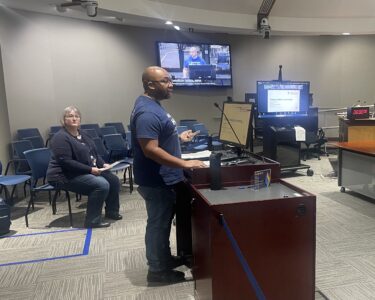
photo by: Sylas May/Journal-World
Vicki Collie-Akers, left, and Jonathan Smith of Lawrence-Douglas County Public Health address the Lawrence City Commission on Tuesday, Oct. 6, 2026, about tobacco licensing.
Eighty-nine licensed retailers in the city, eight within 5 miles of New York Elementary School alone – the local health department had plenty of tobacco stats for city commissioners on Tuesday night.
But there was one that Vice Mayor Mike Courtney just had to double-check:
“You said that Lawrence has more vape density than Las Vegas?”
Vicki Collie-Akers of Lawrence-Douglas County Public Health said that for tobacco retailers overall, not just vapes, that was true. “The stores per person count, Las Vegas is doing better than us.”
“Lord,” Courtney said later in the meeting, just recalling that stat.
“I don’t know what a crisis would look like, but this is super concerning,” he told his fellow commissioners. He said he wanted to strengthen the city’s tobacco licensing ordinance “sooner than later,” limiting where these businesses can locate and cracking down on sales to minors, and the other commissioners agreed.
The first step could be a temporary moratorium on new licenses, which the Journal-World has reported on before and which could come back to the City Commission in a matter of weeks. But commissioners are also interested in substantive changes to the licensing ordinance, which was passed in 2023 and is enforced by LDCPH through compliance checks where underage shoppers attempt to buy tobacco products.
Jonathan Smith, executive director of LDCPH, told the commission that the original ordinance was like a boat, and that the commission’s job now was to plug the holes in that boat. In their presentation, he and Collie-Akers shared that Lawrence had a higher density of tobacco retailers than of primary care providers or dentists, and that noncompliance rates had been between 15% and 18% each year.
The moratorium on new tobacco licenses, he said, would provide more time to develop stronger policies. “If you all would consider that, we would spend that year working with you all to figure out, ‘How do we amend this ordinance to fill up some of those holes?'”
The commission did ask city legal staff to bring that idea back for consideration at a future meeting. City Attorney Toni Wheeler said a yearlong moratorium would probably be the longest the legal staff was comfortable with.
But multiple commissioners also said that if there were ways to rapidly strengthen the ordinance and stop sales to minors – such as by using ideas that had succeeded in other communities – it might be worth skipping directly to that without the moratorium as a stopgap.
“I’m a little worried that it might take us two or three months to come up with good moratorium language when you could just be spending that two or three months to come up with a fix on some of these holes,” Mayor Brad Finkeldei said.
And Commissioner Mike Dever added, “If we can get it done quicker and have some preexisting rules that we could apply rather than put a moratorium in place, I’d be in favor of that.”
Some of the policy suggestions that LDCPH offered would limit where new retailers could locate. Smith noted that this had been done elsewhere in the Kansas City metro area, such as in Shawnee, where he said new stores can’t open within a mile of existing stores or within 200 feet of a school, daycare or park.
The density was important, Collie-Akers said, because there are “patterns of investment” by tobacco retailers, who concentrate in “low-income and minoritized areas of the community.” She said ZIP code 66046, which is mostly east of Iowa Street and south of 19th Street, has the greatest density of tobacco retailers, with one for every 663 people, while 66049, which is mostly west of Iowa and north of Bob Billings Parkway, has the lowest density at one per 1,607 people.
“66046, where I live, that’s the highest density in town,” Courtney said.
The officials also proposed raising the fees for tobacco licenses and making it more difficult for a store at the same location to reopen under new ownership and a new name if its license is suspended for noncompliance, something LDCPH has observed before.
Smith said he’s often asked why Lawrence has so many vape shops, and the answer he gives is, “All you need is $260 and a location.”
Some of the requests might be tricky to accomplish from a legal standpoint, Finkeldei said. But he thought the top priority should be stopping stores that the city knows are selling to underage customers.
“I’m interested in proximity and density, but my first hole we need to fill is, when we know somebody is selling to minors, we need to be able to enforce that in ways that are useful,” he said.
Along with the LDCPH leaders, Dr. Vance Burns of Lawrence Pulmonology Specialists told the commission on Tuesday night about the stakes. He said that just that day, he’d had to diagnose three people with lung cancer.
Many of the patients he sees for smoking-related illnesses are older adults, but he said that grown men and women don’t just decide to start smoking one day.
“If there were no children, the vape industry and tobacco industry would have nobody starting,” Burns said. “I don’t meet people in my clinic who, at age 30, say, ‘After considering all the logical prospects, I’ve decided that smoking, vaping is something I want to start doing.’ Grown-ups don’t start smoking. They don’t.”
He said the health leaders were justified in their concerns.
“I wouldn’t be doing a good job as a physician, and I wouldn’t be giving you a physician’s perspective, if I didn’t tell you I was a little worried about Lawrence, Kansas,” Burns said.
City Government
Lawrence city leaders want to toughen tobacco licensing rules ‘sooner than later’
Algerian government invites Mayor Brad Finkeldei, Lawrence delegation for a visit
Construction on Wakarusa Drive to resume; city manager says KDOT’s secretary has apologized for delay
Evacuation drill planned Tuesday at Lawrence City Hall

Bond issue for water and sewer projects, bike plan, Wakarusa Drive update on Lawrence City Commission’s agenda