
Lawrence city leaders signal support for Aldi incentive; final vote postponed because of public notice error
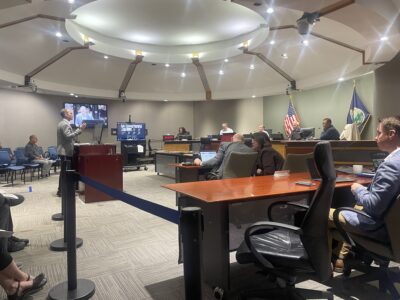
photo by: Sylas May/Journal-World
The Lawrence City Commission hears from representatives of Catalyst Property Group about the proposed Aldi grocery store in northwest Lawrence on Tuesday, Nov. 17, 2026.
It will take a little longer than expected for a new Aldi store’s incentive request to get a proper hearing, but Lawrence city commissioners on Tuesday night signaled that they were on board with the development.
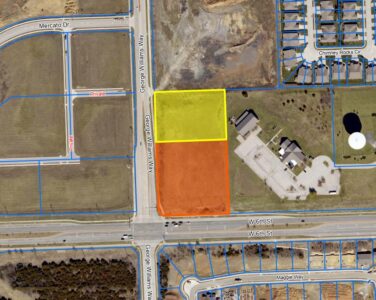
The 20,000-square-foot grocery store is being proposed for the northeast corner of the intersection of Sixth Street and George Williams Way, and it won two key approvals from the Planning Commission on Monday. But the developers have said that it won’t be financially viable without an incentive called a Community Improvement District, or CID, that would create a new 1% sales tax in the project area to reimburse the developer for some costs.
City commissioners were originally scheduled to hold a public hearing and vote on that incentive district on Tuesday, but they had to postpone that because the published notice of the hearing accidentally had the wrong date. However, they could still vote on a development agreement, which establishes the terms of the CID, such as its length and the cap on reimbursable expenses, and which would take effect if the CID is approved at a future meeting.
The commission voted 5-0 to approve that agreement.
“I think it’s a way to get a good user to make a pretty unviable piece of property viable at a very important intersection,” Mayor Brad Finkeldei said before the vote. That intersection is in a part of town where the city is counting on growth, near the new Costco store that opened last month.
The developer, Catalyst Property Group, was requesting the CID because of the extra cost of working with this specific piece of land. Assistant City Manager Brandon McGuire told the commission about two issues: the fact that there’s no sewer infrastructure serving the property, and the steep slopes that will require extra excavation and drilling.
“I’ve run that hill many times,” McGuire said. “It’s a great hill for doing hill repeats, but not so great for construction.”
Catalyst has been working on the proposed development for more than a year. But its founding partner, Jeff Berg, said the company would have to walk away from the project if it couldn’t get the incentive.
“If you were to put me under oath, I would tell you that,” Berg told Commissioner Kristine Polian when she asked whether the project would be viable without the CID. “And I’ve got a lot of money already spent on it.”
McGuire said that while it’s not normally his role to advocate for developments, he thought the Aldi was a great project that the city should try to help. He noted that the current property tax bill for the undeveloped site was just $22. “It is currently zoned as agricultural land, and it is very, very unproductive for our tax rolls,” he said.
Some public commenters told the commission they were worried about whether it was fair to existing grocery stores to give the Aldi an incentive. Others said they were worried about Lawrence’s existing Aldi location near 31st and Iowa streets closing if this store were built.
The developers said that Aldi had told them it had no plans to close the South Iowa Street store, and Finkeldei said that CIDs weren’t about favoring one project over another. He used the Q39 barbecue restaurant on New Hampshire Street as an example, and said that the reason for its incentive was the cost of redeveloping the former Journal-World printing plant building after a larger project there fell through. It wasn’t, he said, about the city preferring Q39 over barbecue restaurants like Bigg’s that were already in Lawrence.
Finkeldei and Commissioner Mike Dever also said that they didn’t really think of a CID as an incentive – it can actually be a detriment to a business, they said, because the business’ customers will be paying the extra 1% sales tax, while its competitors’ customers won’t.
“They’re asking their customers for more money,” Dever said. “So I want to make sure we couch this in the right terminology.”
The city also would not be taking on any debt or pledging any money from its general fund. Catalyst would be paying the costs up front, and the revenues generated by the CID would reimburse some of that on a pay-as-you-go basis. City staff is recommending that the developer be reimbursed for just over $1.4 million of eligible principal costs plus interest, for a maximum total reimbursement of about $2.9 million over a maximum time of 22 years.
It’s not known when the CID request will come back to the commission for a vote. But the developers said that if it gets the necessary approvals, they plan to be “full steam ahead” soon afterward.
City Government
Lawrence city leaders signal support for Aldi incentive; final vote postponed because of public notice error
Lawrence city staff says a 6-month tobacco license pause will be enough to craft new rules, and commissioners approve it
Proposed Aldi store in northwest Lawrence receives approvals from Planning Commission; City Commission to vote on incentive soon
In Algeria, Lawrence cops who helped out during the World Cup get the celebrity treatment

Lawrence City Commission to consider 12-month moratorium on new tobacco retail licenses