Lawrence City Commission approves nearly $1M contract for fire station design, has questions about stormwater
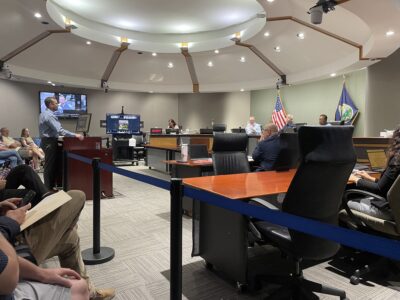
photo by: Sylas May/Journal-World
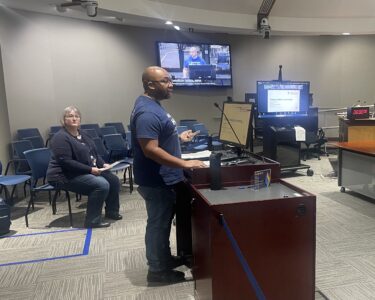
MSO Project Manager Steven Hallstrom speaks to the Lawrence City Commission about Fire Station 6 on Tuesday, Aug. 4, 2026.
Lawrence city leaders on Tuesday approved a nearly $1 million final design contract for the city’s new fire station, and they’re interested in hearing more about how the project might affect stormwater drainage nearby.
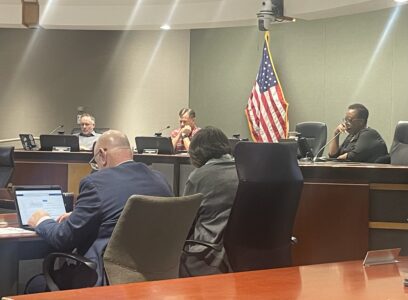
The commission voted 4-0, with Mayor Brad Finkeldei absent, in favor of the $951,502 agreement with SFS Architecture Inc. for the final design of Fire Station 6 in northwest Lawrence. Steven Hallstrom, a project manager with the city’s Municipal Services and Operations division, said the project was nearly done with its schematic design process, and that the last design phase would finalize all the fine details in preparation for construction.
Station 6, whose construction cost is estimated at $11.1 million, will be at 555 Stoneridge Drive. It’s meant to reduce response times in the western parts of the city, where Lawrence is expected to grow through annexations and new developments in the coming years.
“The community is growing,” new City Manager Majed Al-Ghafry said, and noted that the station had been on the city’s list of priorities for a long time. “… Some things should have been done much earlier than that, and we’re catching up right now.”
Commissioners and staff both noted that a fire station was more complex than many other types of buildings the city uses. Hallstrom said it was “a whole different animal than a standard building,” a facility that houses complex equipment and where firefighters have to live 24/7.
City Commissioner Kristine Polian said she wanted to reassure the public that, for a project like this, the design cost was reasonable.
“This is a large expenditure, and I want to make sure that our public understands,” she said.
The special requirements of a fire station were also part of why the commission voted in April to authorize a method called “construction manager at risk” for the project. This is a method in which the construction manager for the project isn’t chosen just based on the lowest bid, but based on qualifications and expertise, too. It often allows the construction contractor and the architect to collaborate more closely than they could in a “design-bid-build” process.
“Really, if it’s done right, it saves us a lot of money and time,” Al-Ghafry said of the construction manager at risk method.
Polian also said that the station should be considered a long-term investment in the community.
“Where it might feel a little abundant, we can explain that this is going to last a very long time,” she said.
The concept plans for the station so far say it would be about 13,000 square feet, with three vehicle bays, 10 bunk rooms for LDCFM responders, a day room, a kitchen and a fitness area. A preferred site plan also shows electric vehicle charging infrastructure; potential locations for geothermal infrastructure and ground-mounted solar panels; and landscaping designed to “serve as a buffer between the station and neighbors to create additional privacy.”
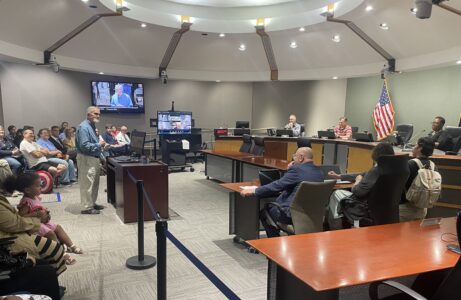
Some members of the public were concerned about the station’s potential impact on the neighborhood, including stormwater and flooding issues downstream of the project. There will be a drainage study done to identify challenges and how they can be mitigated, and Polian and Vice Mayor Mike Courtney were both interested in further discussion of those issues.
Al-Ghafry, who has an engineering background, cautioned that it was important to wait for the study to come back before considering how to mitigate things. “Is it more about velocity or capacity? Is it about runoff? Is it about intensity?” he asked. Engineers can’t speculate now on what the problems might be, but once they know, they’ll have a better idea on how to lessen the impact.
One public commenter, Debbie Filkins, also had questions about whether there would really be an effective buffer between the building and the neighborhood, and was worried about traffic when the nearby Costco store was completed.
Once the drainage study is complete, the community will have the chance to weigh in at an open house in late 2026. And the project will come back before the commission again. The timeline calls for a preconstruction services contract with a construction manager by this fall, and a guaranteed maximum price for the station will be developed by sometime in 2027 or early 2028, Assistant City Manager Casey Toomay said.
Then, after that, “We hope that in early 2029, our Station 6 will be open and operational,” she said.
As the Journal-World has reported, staffing Station 6 will require 15 full-time equivalent positions. When to fund these positions – either in 2027 or across 2027 and 2028 — has been one of the major issues of the city’s 2027 budget conversations.
City Government
Lawrence City Commission to weigh whether Costco should be included in STAR bond district
As they approve bikes plan, Lawrence city leaders ask about data collection, Kentucky and Tennessee streets
Lawrence city leaders want to toughen tobacco licensing rules ‘sooner than later’
Algerian government invites Mayor Brad Finkeldei, Lawrence delegation for a visit
Construction on Wakarusa Drive to resume; city manager says KDOT’s secretary has apologized for delay