When to hire for Fire Station 6? How big a raise for staff? Exploring the variables in Lawrence’s budget ‘math problem’
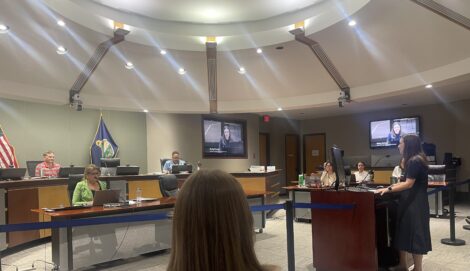
photo by: Sylas May/Journal-World
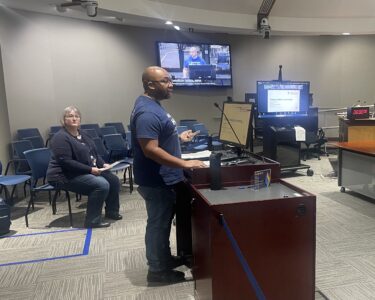
Alley Porter, the City of Lawrence's budget strategy director, at lectern, addresses the Lawrence City Commission on Tuesday, June 2, 2026.
When the City of Lawrence’s recommended 2027 budget officially arrives, look for a two-mill property tax rate increase, a 2.5% raise for staff, and too many fine details to list here.
That’s what city leaders signaled on Tuesday about the upcoming budget proposal, which Acting City Manager Casey Toomay said would be in front of commissioners later this month.
“We’re two weeks out from having the recommended budget in front of you all,” Toomay told the commission near the end of its meeting, which stretched until midnight. “Unless I hear otherwise, … what Alley (Porter, city budget strategy director,) put on this discussion slide is likely what’s going to be in my recommendation to you all.”
The slide had three points: a roughly two-mill property tax rate increase to fund staffing for Lawrence-Douglas County Fire Medical’s Station 6 expansion; a 2.5% general wage increase for city staff and a “step” increase on their pay scale; and retaining the recreation center fees that were implemented this year.
But commissioners will also have to examine a menu of potential budget cuts that city departments have identified, as well as some other ways to lessen the impact of Station 6, such as by splitting the staffing costs over multiple years. And some on the commission wanted to dive even deeper into the minutiae of city finance than that.
“I’ve asked for all the contracts to see what’s going on there,” Commissioner Kristine Polian said, just as an example of what she wants to examine. She said there’s “a litany of things” that she would be asking staff to produce as she makes her decisions in the coming months.
Toomay said that the city used to present its budget in a more granular way, but that it shifted to higher-level “priority-based” budgeting presentations that were more about showing the public the impact on departments and their services. Polian said that, in her opinion, having budget talks in this way required a lot of community trust, and she wanted much more detail because she thought that trust was lacking.
“We need to explain ourselves a little better,” Polian said. “… I do believe the community is struggling with trust, which is why I’m asking the questions.”
Budget conversations aren’t easy, Toomay said, but at the end of the day, “it is kind of a math problem.”
Here are some of the variables in that problem that city leaders will soon have to balance.
When to hire for Station 6
How the Station 6 expansion will be funded is one of the biggest questions in the budget. That’s what the mill increase or cuts would largely be for, and the city previously was talking about an even larger increase of about 3 mills.
But none of that conversation is about funding the physical building itself in northwest Lawrence, which isn’t expected to be open until 2029. It’s about how to hire the staff for it.
Part of the issue is that 12 positions in LDCFM are already being temporarily funded by Douglas County for this year only. During last year’s budget process, Mayor Brad Finkeldei noted, the city decided to eliminate staffing for one truck, but the county provided a one-time bump in funding for LDCFM to move those employees to an ambulance crew instead. Now, the city will have to find a way to pay for those existing employees.
“The county gave us a bump last year,” said Commissioner Amber Sellers. “… Now we have to keep moving forward.”
Beyond that, the city has discussed needing to hire 15 full-time equivalent staff and two internal positions in 2027 to bring staffing up to the levels Fire Station 6 will need. In the meantime, before the station is operational, the idea would be to put the other engine back in service using that extra staff, based out of a different station.
Commissioners had asked if the hiring could be split over multiple years instead of just in 2027. The city did compile an estimate of that, which said it could be split between 2027 and 2028, requiring a 1.4-mill increase in 2027 and a 0.6-mill increase in 2028. The engine wouldn’t be fully staffed until mid-2028 with this idea, though, while the 2027-only plan would fully staff it by the fourth quarter of next year.
Vice Mayor Mike Courtney asked, “What if we just did this all in 2028?” McKenzi Ezell of LDCFM answered, “As far as the time frame of those recruit classes … we could move that to 2028 if that was the direction (from the commission).”
Toomay noted that there was also the possibility of building the station but not staffing it. But Commissioner Mike Dever balked at that idea.
“We have to bundle the construction of the fire station and the funding of the operation thereof together,” he said. “I don’t want to do this piecemeal.”
Raising pay
Before hearing the budget update, the commission heard about a compensation study the city recently did, and about a proposal to raise staff pay for 2027.
The raise would be a 2.5% general wage increase, which would cost an estimated $2.4 million, and a step up for employees on the city’s pay scale, which would cost around $2.7 million. These had been factored into the budget conversation already, but commissioners said they might be open to a smaller increase.
“I could see myself supporting something like a 2%, not 2.5%” wage increase, Finkeldei said. He said that could work together with spreading out the LDCFM hiring to reduce the budget impact of these things next year.
Dever said he was also open to the idea of a “smaller percentage increase.”
“We need to take a hard look at the costs of our employee, labor pool,” he said, noting that changes there could make a substantial impact given how much of the city’s budget goes to payroll.
Courtney, though, was undecided on this issue. “I don’t know where I am on that,” he said.
Departments’ cut lists
Previously, city departments prepared lists of potential budget cuts, but the slides for the commission didn’t show how much they expected those cuts would save. This time around, though, staff did have those numbers in the presentation.
Some of the departments’ suggested cuts to services would amount to a couple hundred thousand dollars or less. Homeless Solutions’ cuts would total about $100,000, the planning department’s would be about $200,000, and the economic development department’s would be around $50,000.
Other departments’ suggested cuts would total a lot more. The largest would be the Lawrence Police Department, which identified about $1 million in cuts. Those would include cuts to downtown patrol and school resource officers and cutting six sworn and four non-sworn positions.
Courtney had a question about whether police could save money by cuts to the drone program, but department staff told him the program had already seen decreases in past years and was functional, but not funded – that is, if a drone went down or otherwise couldn’t be used, it couldn’t be replaced.
And Sellers wanted to know about reductions to “internal services,” which would include things like the city’s diversity and sustainability staff. She wanted to know if those would just go away if forced to make cuts, and Porter said that because these are such small departments, “potentially yes.”
Polian noted that some in the public were “losing their minds over what these lists are comprised of.” She wanted the public to know that these were ultimately just recommendations, and it would be up to the commission to make the final decision on how the budget looked.
“We can create something completely different here,” Polian said.
Why not sales tax?
Courtney had a “philosophical question” for staff: “Could we offset a mill by a 0.1% sales tax increase?”
The idea, he said, was to switch to a funding source that came more from people outside the city and not just residents. But other commissioners said there were limits that made this idea impractical.
Finkeldei noted that the city had already maxed out the amount of sales tax it can collect for general expenses under state law. Any other sales taxes would have to be approved by voters for a specific thing, and they could last for 10 years at most.
That would create problems, he said, if the city tried to fund something like police with a sales tax. If voters approved such a tax and then rejected it 10 years later, job cuts would likely follow.
Sellers also noted that sales taxes were regressive, meaning they have a bigger impact on lower-income people.
Finding savings
Courtney also wanted to know about whether employees could be incentivized to find money-saving opportunities on their own. He wondered if there could be a competition between departments, like “MSO (Municipal Services and Operations) vs. police, who can save the most amount of money?”
Toomay said that encouraging employees to find ways to save money was a good idea, but she wasn’t sure how much of an impact that would have. “The number of large cost-saving items like that, I’m not sure how many of those are in the organization,” she said.
She also said that, in her experience, employees were already doing these small things, even if they didn’t highlight it.
She gave the example of one employee who had decided to bring their own coffee creamer from home instead of buying it with city money. The employee’s justification was, “I don’t want to spend city tax dollars on that.”
“A lot of my folks say, ‘That’s just my job,'” Toomay said.
City Government
Lawrence City Commission to weigh whether Costco should be included in STAR bond district
As they approve bikes plan, Lawrence city leaders ask about data collection, Kentucky and Tennessee streets
Lawrence city leaders want to toughen tobacco licensing rules ‘sooner than later’
Algerian government invites Mayor Brad Finkeldei, Lawrence delegation for a visit
Construction on Wakarusa Drive to resume; city manager says KDOT’s secretary has apologized for delay