‘A bright future ahead for bikeability in Lawrence’: Committee puts its final touches on new bike infrastructure plan
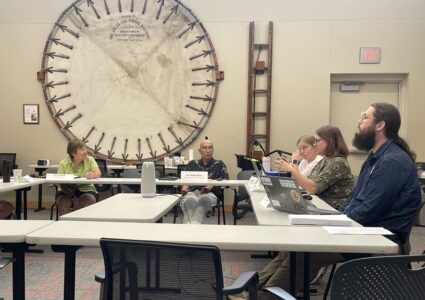
photo by: Sylas May/Journal-World
Transportation Planning Manager Jessica Mortinger, second from right, speaks with the Lawrence Bikes Plan Update Steering Committee on Wednesday, July 15, 2026, at Fire Station 5.
After more than a year of work, surveys and public outreach, Lawrence’s new “vision” for bicycle infrastructure and safety is nearly ready for city leaders to review.
It’s the updated Lawrence Bikes Plan, and Transportation Planning Manager Jessica Mortinger said it’s going to “help guide the future of investments that our community is making in relation to cycling.” The steering committee that’s been crafting it since February 2025 had its last meeting on Wednesday, and soon the plan will be going before several other local boards and commissions for their feedback and approval.
“We feel grateful to have community members who have engaged with us in this process on the steering committee, to share their diverse perspectives about cycling and what it means to them and how they use the bicycle in their life – to get to the grocery store, to take their kids to school, to go on a ride with friends,” Mortinger said.
The plan isn’t something binding that commits the city to do specific projects within a specific time, Mortinger said, but it does help the city weigh its priorities and what kinds of bike projects it wants to pursue.
“This plan, when they’re adopting it, they’re adopting a vision,” she said.
At its final meeting, the committee went over some community comments and suggestions and approved a few tweaks. One change had to do with “priority and secondary networks” – the ones that the city had identified as the priorities for standalone bicycle projects and funding. The committee on Wednesday added on a couple of secondary routes that would link to the Burroughs Creek Trail.
The committee also approved designating Tennessee Street and Kentucky Street as “future bikeways,” but not as “priority or secondary networks.” As the Journal-World has reported, some bicyclists in Lawrence have been asking city leaders to consider reconfiguring those one-way streets to add protected bike lanes when the streets are resurfaced in a couple of years.
In the draft of the plan that was put out for public feedback, one of the goals was to increase bicyclists’ comfort on the city’s routes, and the committee on Wednesday discussed how changes in road construction projects could make that happen. In particular, they talked about “sharrows” – arrows with a bicycle icon below them that are painted onto roads to indicate that bicyclists and motorists should share the lane. Many respondents in the city’s surveys were skeptical about sharrows in comparison to other kinds of bikeway markings and protections.
“Sharrows are going away as a default action,” Mortinger said. “They are still available with engineering judgment,” but probably won’t be part of projects anymore unless there are other traffic calming measures to make cars slow down.
She used Connecticut Street, where there are currently sharrows, as an example. If the street were resurfaced in a “mill and overlay” project, she said, “and nothing changed but just the mill and overlay, it would probably be unlikely that sharrows got reinstalled.” But if other improvements like raised crosswalks were made that would reduce drivers’ speed, sharrows might be considered as “individually case-by-case decisions.”
The committee members also said that safety was about more than just infrastructure. They wanted more education, especially to help motorists be more aware of bikes and bikeway markings.
“Nobody knows what a sharrow (is),” committee member Patricia Collette said, other than cyclists themselves. “No driver I’ve ever talked to – they say ‘What does that mean?’ … They don’t know, or they don’t pay attention.”
Another member, John Nalbandian, said this would be a good topic for the city to lobby state government about. He suggested advocating for bike safety tests for those obtaining or renewing their driver’s licenses: “When you get a license, you know, part of the test is having something to do with bicycle safety.”
“It’d be nice if the City of Lawrence, the City Commission was active in lobbying the state for this kind of thing,” Nalbandian said.
Other members suggested that cycling clubs around the state could work together to push for changes like that.
Committee member Samuel Carter told the Journal-World that he was confident in the plan that had been produced.
“I think this plan has been thoroughly vetted at every stage,” he said. “… People have taken a close eye to it, and I think we have great staff, we really do.”
And transportation planner Stephen Mason said the plan also wouldn’t have been possible without the community’s help. He said there were lots of responses in surveys early on that helped shape the plan, including about people’s comfort levels, what kept them from riding more frequently, and about the Lawrence Loop trail, which he said was “a high priority for the community.”
“Overall, I think this is a good product,” Mason said. “We’ve got a few more changes to make, then start that approval process.”
The plan will go before several different boards and commissions of the City of Lawrence and the city-county Metropolitan Planning Organization before it’s adopted in the coming months. These include the Connected City Advisory Board, the Parks, Recreation and Culture Advisory Board, the MPO Technical Advisory Committee, and then finally the MPO Policy Board and the Lawrence City Commission.
If you still want to give your input on the plan, Mortinger said, there will be opportunities at all of those meetings for the public to comment.
Carter, for his part, is excited to see how the plan moves forward.
“I think there’s a bright future ahead for bikeability in Lawrence,” he said.
City Government
Opinion: Don’t give up on trying to use Costco to take tens of millions of dollars from the state of Kansas
Abandoned housing pilot program, data center rules, funding clawback for Bert Nash project on City Commission’s agenda
KU professors, middle school band director, radio personality among this year’s Phoenix Award honorees: ‘It’s a cool mix’
Housing Stabilization Collaborative’s request for city trust fund aid won’t be considered because it was filed late
On sister city visit, delegates from Hiratsuka, Japan, see Lawrence’s friendship firsthand