In bike plan draft, Lawrence cyclists are asking for more physically protected bike lanes, not just paint
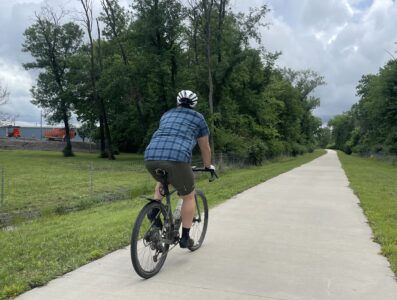
photo by: Sylas May/Journal-World
A cyclist rides on a section of the Lawrence Loop in the Pinkney Neighborhood on Friday, May 29, 2026.
So far in the 2020s, Lawrence has created miles of painted bike lanes, bike/pedestrian paths, even a couple of “bike boulevards.”
But it still hasn’t added something that many bikers say they want – bike lanes with physical barriers that protect them from cars.
That’s according to a recently released draft of the new Lawrence Bikes Plan, which will guide the city’s efforts to improve routes for cyclists in the coming years.
The draft says that from 2019, when the previous plan was approved, through 2025, the city has created about 2.6 miles of conventional painted bike lanes, marked 10 miles of lanes as shared between cars and bikes, and added about 13 miles of shared-use bike/pedestrian paths. But the number of miles of protected bike lanes was 0 in 2019 and still 0 in 2025.
Bikers want more than that, the draft plan says. It sums it up like this: “Paint alone does not feel like protection.”
The bikes plan doesn’t spell out specific projects where protected bike lanes might be used, although a couple are coming up soon. But it does say that the city should create routes that reach a certain “level of comfort” for cyclists, and that it might want to test out new bike infrastructure with temporary installations on the city’s streets.
It also includes a lot of data from a community survey about how bike-friendly Lawrence is, which gathered responses from hundreds of frequent bikers.
Seventeen percent of the survey’s 581 respondents said they use a bicycle as their primary mode of transportation. Twenty-one percent of respondents said they ride every day, 40% said they ride a few times a week, and 19% said they ride a few times a month. Eight percent said they never ride a bike.
Most of the bike riders say they ride recreationally – about 70% of survey respondents said their primary reason for riding is for fun or for exercise. But about 17% said they primarily ride to get to school or work, and 3% said they ride primarily because they’re concerned about motor vehicles’ effects on the environment.
On Wednesday evening, the committee that guided this new plan will be meeting to review it and give its final feedback, and it’s expected to go before several other advisory boards and the Lawrence City Commission after that.
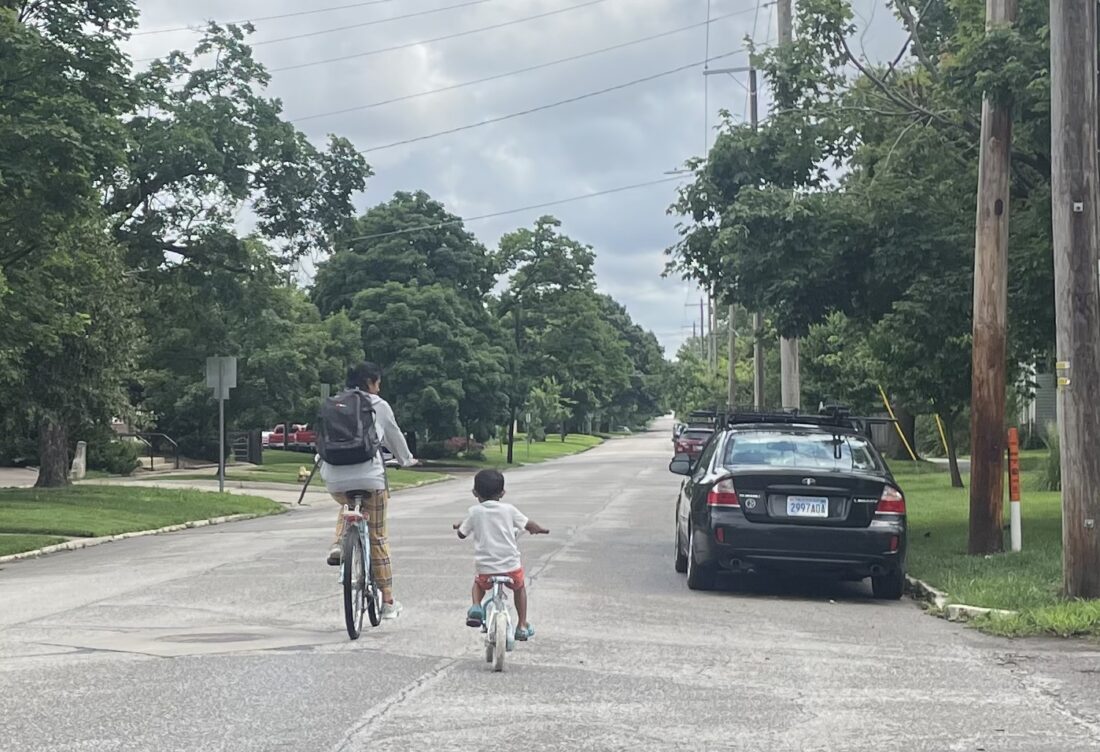
photo by: Sylas May/Journal-World
Bicyclists ride on East 13th Street on Friday, May 29, 2026.
• • •
One thing the data shows is that cyclists in Lawrence want more than just lane markings. “Simply painting lines on a street to designate a bike lane doesn’t make cycling any safer,” one respondent wrote.
A question on the survey asks how comfortable bikers would be with riding on a busy commercial street with shared car and bike lanes, dedicated bike lanes that were painted on the road, or physically protected bike lanes.
More than 50% were very or somewhat uncomfortable riding on streets with shared car and bike lanes, and nearly 30% were very or somewhat uncomfortable riding in painted bike lanes.
However, nearly 90% said they would be somewhat comfortable or very comfortable riding in protected lanes.
In their written responses, the survey-takers voiced more specific complaints with pavement markings. Many said they were skeptical about “sharrows” – the markings with an arrow and a bicycle symbol that indicate a road is for shared use by both bikes and cars. And some had doubts about painted bike lanes, too.
“‘Sharrows’ are unsafe,” one respondent wrote. “The first time I rode on New Hampshire with the shared-use arrow with my young daughter, someone in a car yelled at us to ‘get off the road’ and almost hit us. These sharrows just encourage people to bike in traffic with angry drivers. I’m never doing that again.”
“I understand the difficulty of installing a fully protected / barrier-walled bike lane along major throughways,” another said, “but I honestly ride as if the paint-marked bikeways didn’t exist on these roads because I feel like they offer a false security.”
Bike boulevards, one of the city’s ways of experimenting with bicycle infrastructure, also drew some criticism.
Lawrence began trying out bike boulevards in the 2010s on certain neighborhood streets such as 21st Street, adding features such as speed bumps, restricted entries and curb extensions that force motor vehicles to slow down or take different routes. The survey showed that some people do feel more comfortable on streets with bike boulevards, but it’s not universal.
In the survey, 62% of respondents felt very or somewhat comfortable riding on bike boulevards, and 18% felt very or somewhat uncomfortable, compared to 40% and 26%, respectively, on streets with no bicycle amenities. But some said the features that were intended to slow down traffic actually made drivers more unpredictable and more dangerous.
“The bike boulevard on 21st is awful,” one respondent wrote. “Cars are veering all over trying to figure out where to drive and swerve.” Another said the lane layout was confusing and it was hard to tell “where to ride and how to let cars pass.”
And yet another urged the city, “Whatever it is you did on 21st between Ousdahl and Mass., don’t do it again. That’s a confusing mess for drivers and riders alike.”
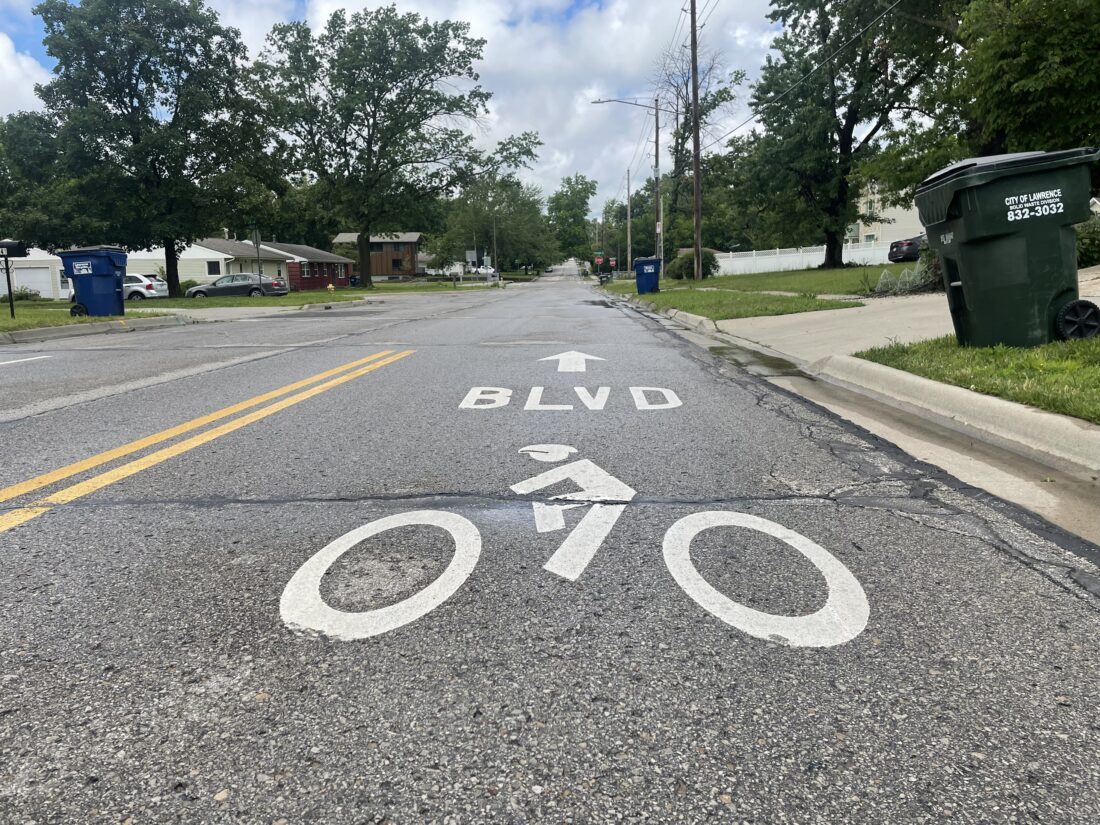
photo by: Sylas May/Journal-World
Road markings indicate the bike boulevard route on 21st Street in central Lawrence on Friday, May 29, 2026.
• • •
As the Journal-World has reported, there are plans to add protected bike lanes to at least two roadways in Lawrence.
One of them is Massachusetts Street, from 14th Street to 23rd Street. It is currently two lanes in each direction, but a new design will have one lane in each direction and a shared center turning lane, along with physically protected bike lanes on either side of the road. Construction is expected to start later this summer.
The other is Ninth Street. After the stormwater improvements there are completed, plans call for a “road diet” that will reduce the number of motor vehicle lanes and add bike lanes with physical “zebra” dividers, which are bumps that run in between the bike lane and motor vehicle traffic.
Some people in the community see more opportunities to add protected lanes in upcoming road construction projects.
At the City Commission’s May 19 meeting, a group of residents urged the commission to consider reconfiguring Tennessee and Kentucky streets when those streets are resurfaced in a couple of years. Both one-way streets are currently two lanes, but these commenters proposed reducing them to one lane of vehicle traffic apiece and adding protected bike lanes.
Mayor Brad Finkeldei said he would want to see how the projects on Massachusetts and Ninth worked first before moving forward with something like that. And Commissioner Mike Dever suggested that designs could be tested in a temporary, reversible format before the city committed to more permanent and expensive protected lanes.
That approach is one that’s included in the draft plan. It recommends using “quick build” projects to test how bicycle infrastructure affects traffic and safety on streets.
First, the plan says, the city would install a temporary design using pavement markings or barriers that could easily be uninstalled afterward. Then, it would gather opinions from the public about the design, and if the design worked, a semipermanent or permanent version could be installed.
That’s also similar to how the city has tested bike boulevards. For a proposed boulevard on Connecticut Street, the city painted the pavement in 2019 to show the design and put up vertical yellow “diverters” in the places where physical barriers were proposed. (The diverters were stolen multiple times during this test run, so the city eventually replaced them with traffic cones.)
More generally, the city wants to create more “low-stress” bikeways along more streets.
A map included with the plan shows bike routes according to residents’ “level of comfort,” with 0 being the most comfortable and 5 being the least. Much of the Lawrence Loop trail is a 0, while busy streets like Bob Billings, Wakarusa, 23rd and Massachusetts have some areas that are a 5. The draft plan calls for creating more bike routes that have a comfort level of 1: currently, these include some relatively short paths on the KU campus and in northwestern Lawrence, and a couple of longer stretches such as East 31st Street, which has a wide shared-use path.
The plan has a couple of quantitative goals for these “low-stress” routes, too. By 2030, it wants 55% of the city’s bikeways to be comfort levels 1 and 2 (currently, it’s 41%, but only 15% on the city’s highest-priority routes) and 80% of Lawrence’s population to live within a quarter of a mile of one of those bikeways.
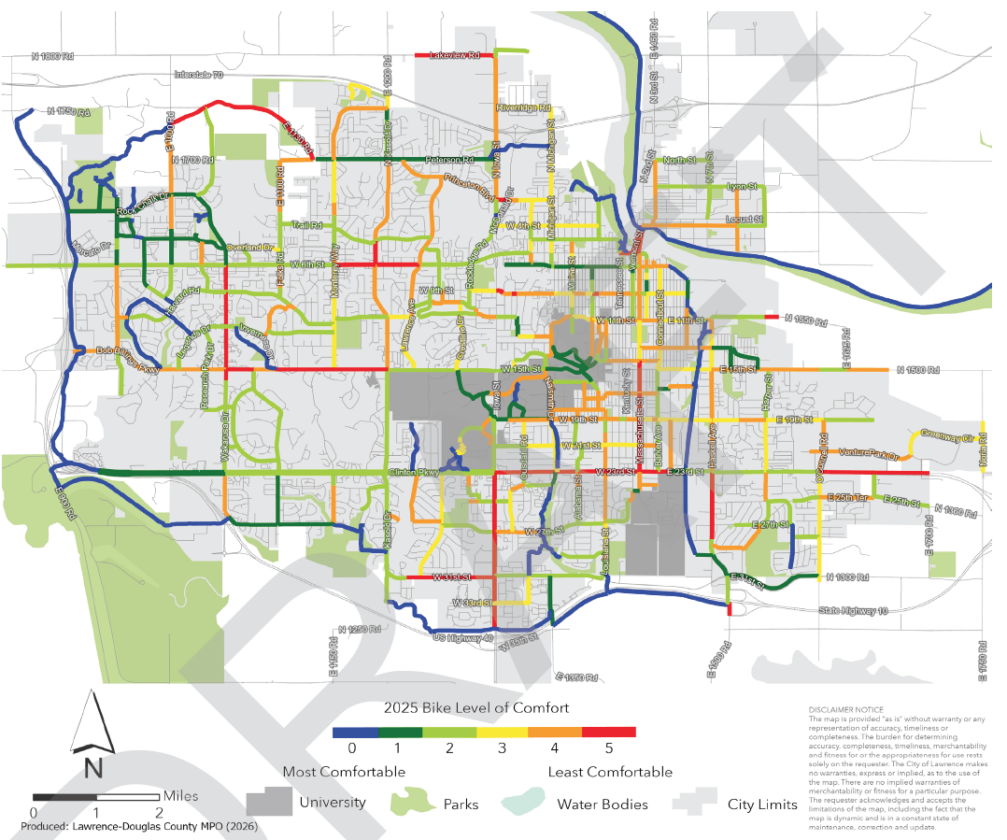
photo by: City of Lawrence
This map shows the “level of comfort” of various bike routes in Lawrence. Blue, or 0, represents the most comfortable routes, and red, or 5, the least comfortable.
• • •
Not all of the survey’s respondents wanted the city to prioritize bike infrastructure. Some said it was fine as is, or that certain bike improvements weren’t a good use of funds.
“Lawrence does not need to be spending money on this!!!” one respondent wrote. “You are cutting parks and recreation program(s) from our children, but then willing to spend money on something like this which benefits a small amount of the population that bikes.”
Some of the respondents were specifically opposed to road diets and traffic calming measures. One said the city would need more four-lane roads as its population grows; another said they rarely saw cyclists use the bike boulevard on 21st; and one even said that “Traffic calming is government oppression.”
Many of the comments that complained about bike infrastructure wondered how many people in Lawrence actually bike. One asked the city to “show me the numbers” about how many people use bikes as their primary mode of transportation, and another said bike infrastructure “Seems like a bad expenditure for the amount of bike traffic we have!!”
For those respondents who do bike, however, they said safety issues were the reason they weren’t biking more frequently.
A question on the survey asked, “What prevents you from bicycling more?” People could select more than one of these answers, and although 75 people skipped this question, 506 did provide at least one reason.
The single biggest reason people cited was careless or speeding drivers, at 57%. Behind it were gaps in the city’s bike routes (50%), unsafe roadway conditions such as potholes (42%), and aggressive or harassing drivers (37%).
And some specifically said in their written comments that their safety concerns are what’s stopping them from biking.
“I have a kid and I would use a bike to ride with them to school, then I would head to work,” one respondent wrote.
“But I won’t until there are safe routes and protected routes.”
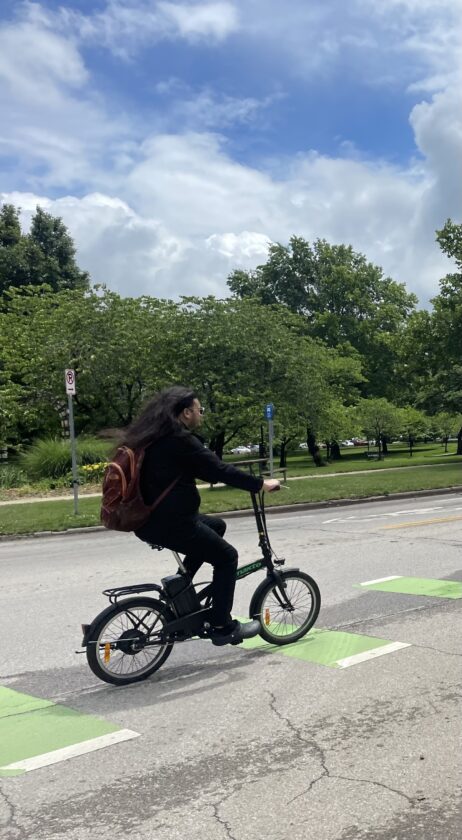
photo by: Sylas May/Journal-World
A cyclist uses one of the painted bike lanes on Massachusetts Street on Friday, May 29, 2026.
City Government
Lawrence City Commission to weigh whether Costco should be included in STAR bond district
As they approve bikes plan, Lawrence city leaders ask about data collection, Kentucky and Tennessee streets
Lawrence city leaders want to toughen tobacco licensing rules ‘sooner than later’
Algerian government invites Mayor Brad Finkeldei, Lawrence delegation for a visit
Construction on Wakarusa Drive to resume; city manager says KDOT’s secretary has apologized for delay