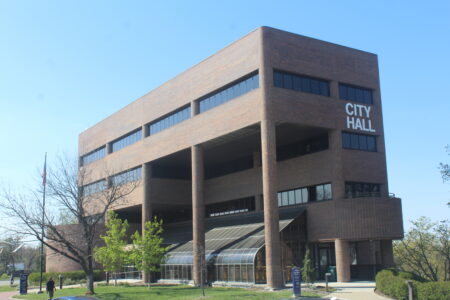
Lawrence city leaders disagree on whether audit findings are part of a pattern; they agree there’s room to improve
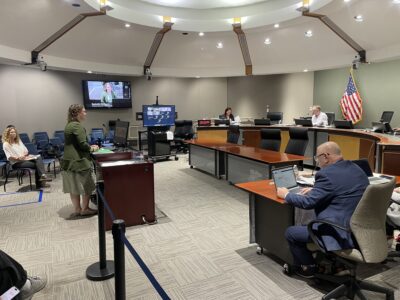
photo by: Sylas May/Journal-World
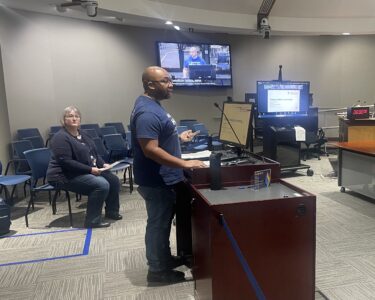
Finance Director Rachelle Mathews addresses the Lawrence City Commission on Tuesday, Aug. 11, 2026.
One city commissioner says the deficiencies in Lawrence’s 2025 audit are part of a pattern that goes back years. Others don’t think that’s the case.
But they do agree on one thing about the audit: It’s a chance to reflect on how the city could do better.
“Maybe there’s certain areas that we misstep in more than other areas,” Commissioner Kristine Polian said on Tuesday night, when the commission discussed the audit’s findings. “… If we’ve got some areas that we identify more regularly than others… that is a great opportunity, that’s where we go, ‘yeah, there’s a common denominator here.’ That’s the point of all this.”
As the Journal-World reported, the 2025 audit was made public last week, and it found two “material weaknesses” and two “significant deficiencies.”
According to the auditors’ report, a material weakness is a deficiency that’s associated with a “reasonable possibility that a material misstatement of the City’s financial statements will not be prevented, or detected and corrected, on a timely basis.” A significant deficiency is one that is “important enough to merit attention” by city leaders, but it’s less severe than a material weakness.
“Significant deficiencies really don’t scare me that much,” Polian said. “Material weaknesses do. And we’ve had a lot of them.”
Despite these findings, city Finance Director Rachelle Mathews told the commission that the auditing firm RSM still gave the city an “unmodified opinion” for 2025, also known as a “clean audit.”
One of the material weaknesses and both of the significant deficiencies were related to federal grants for airport projects. In April 2025, as the Journal-World reported, the FAA alleged that the private company that Lawrence partners with to operate the airport was charging aircraft owners to park their aircraft on the airport’s apron. These “tie-down fees” for use of the apron were not allowed, the FAA said, because work on the apron was funded with FAA grant money, and maintaining broad access to the aviation public was a requirement of the grant.
“We know what’s been going on at the airport, unfortunately,” Commissioner Mike Dever said Tuesday.
The other material weakness had to do with how the city recorded a transaction to refinance its debt, which is called a “debt refunding.” The finding said the city failed to properly account for one of these transactions in the water and sewer fund, and that resulted in the deferred gain from refunding being overstated by about $7.7 million. The city attributed this to its accounting software being improperly configured, and said it had worked with the vendor to correct the problem.
In response to a question from Dever, Mathews and Kristen Hughes of RSM was that it had been eight years since the city had last reported a debt refunding transaction. Hughes said she’d seen errors in these types of transactions in other audits she’d done before.
What this does do is give the city something to look out for next time, she said. It’s hard “to do a tick, tick, tick, every month on that,” but it’s on the radar the next time a similar transaction occurs.
Both Courtney and Dever noted that the software issue was not something where the city lost money. And Hughes confirmed that.
“This is not a cash issue,” she told commissioners.
Polian, however, was concerned about more than just the plans for correcting these specific issues. “Do we have larger systemic issues?” she asked.
Before the meeting on Tuesday, she said she had looked at past audits going back to 2019. She said that in that span of time, the city had at least one finding in every year except 2021 and 2022, and that in those cases there was an issue that “just wasn’t caught until ’23.”
“What I do see is a pattern,” she said. “We’re not going in the right direction.”
Other commissioners disagreed. “I don’t see a pattern,” Commissioner Amber Sellers said.
She noted that three of the findings in 2025 were related to the airport, and that the other one was related to a process that had been corrected. And Dever said that the fact that the majority of findings came just from the airport, which the city was already aware of, “for me, that’s a good sign.”
For Mathews, one important thing was that none of the findings were repeats from past years. She said that after the past findings, the city had been able to develop corrective action plans and stronger internal controls.
“We are correcting those and not repeating those,” she said.
Mathews said that issues can happen “as the city is growing and becoming more complex” with more transactions and staff turnover. And City Manager Majed Al-Ghafry agreed with that assessment. With “the diverse functions that we have in cities,” he said, “having one or two or three (findings) is not a bad thing.
“However, we need to not fall into those same issues again,” he added.
Polian, who has worked in government finance before, said she knew the finance department had experienced turnover, software changes and other obstacles, and that Mathews “inherited some of this stuff.” She said that if there were anything the commission could do to help, “We’re here if you need something.”
Sellers thought the audit was an opportunity for staff to “look at your systems.” She said that because the commissioners weren’t handling administrative tasks themselves, they wouldn’t know all the details of city processes.
And Al-Ghafry said that having an audit with no findings next year would be “amazing for us to do, and we’re going to work on that, we’re going to make sure we have the processes and procedures for that.” And he said that “it’s not on Ms. Mathews, it’s on every single department.”
He wanted to make sure that “we don’t have silos” and that the city understood everything it was doing in detail. By analogy, he looked back at his own background in engineering.
“When I was a project manager, I knew every single detail about a project,” he said. “… We need to get to that level of learning that, from level A to level Z in the organization.
“It is imperative to do that,” he said.
City Government
Lawrence City Commission to weigh whether Costco should be included in STAR bond district
As they approve bikes plan, Lawrence city leaders ask about data collection, Kentucky and Tennessee streets
Lawrence city leaders want to toughen tobacco licensing rules ‘sooner than later’
Algerian government invites Mayor Brad Finkeldei, Lawrence delegation for a visit
Construction on Wakarusa Drive to resume; city manager says KDOT’s secretary has apologized for delay