Would an Algerian sister city work? Only if Lawrence does the work, those with experience say
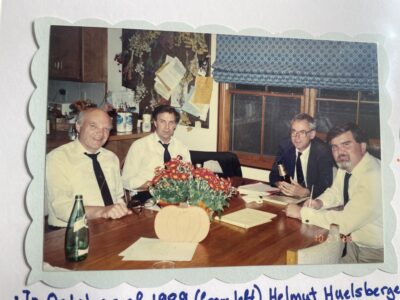
photo by: Sylas May/Journal-World
A picture from 1989 in one of Bill Keel's family scrapbooks shows, from left, Helmut Huelsbergen, Helmut Scheewe, Frank Baron and Keel working on the sister city agreement for Lawrence and Eutin.
There are healthy sister city pairings, says Bill Keel, chair of Sister Cities Lawrence. And then there’s Polittourismus.
That’s German for “political tourism,” says Keel, a professor emeritus of German studies at the University of Kansas. “You’re just kind of a political bigwig, you make a junket overseas to visit this city and vice versa. But the citizens aren’t involved; there’s nothing that adds to the community.”
This past week, Sister Cities Lawrence’s board met about a proposal – still in the very early stages – to partner with an Algerian city in the wake of the FIFA World Cup. And Keel said the board conveyed that Lawrence’s sister cities shouldn’t just be for show.
The proposal originated around the time the Algerian national team arrived in Lawrence for the World Cup. Keel was contacted by an Algerian who was living in the U.S. in Sacramento, California. The man’s father, Keel said, was a Fulbright scholar a couple of decades ago, and the family had ties to Biskra, a city of over 300,000 people on the edge of the Sahara that’s sometimes called a gateway to the vast desert.
Keel set up the meeting with them, and along with a representative from KU International Affairs, “we had a nice 30-minute discussion talking about what their vision was for a relationship.”
“The advisory board, I would say, essentially offered not criticism, but cautionary comments about what would be entailed by a full-fledged sister city relationship,” he said.
Lawrence has four sister city partnerships right now, and Keel says two of them are good examples of what functional sister city bonds look like. Those are the long-running friendships with Eutin, Germany, and Hiratsuka, Japan.
“When you think of the Eutin or the Hiratsuka (relationships) that go back both over 35 years now, it involves almost annual student exchange trips, and also cultural exchanges,” Keel said. “With Eutin … Lawrence Children’s Choir has gone abroad to Eutin, the Eutin Guitar Orchestra gave a concert at Liberty Hall, there’ve been artists that have exchanged exhibits … and even business interns, we’ve had medical interns go back and forth. So there’s been a lot of cultural and then person-to-person kind of visits.”
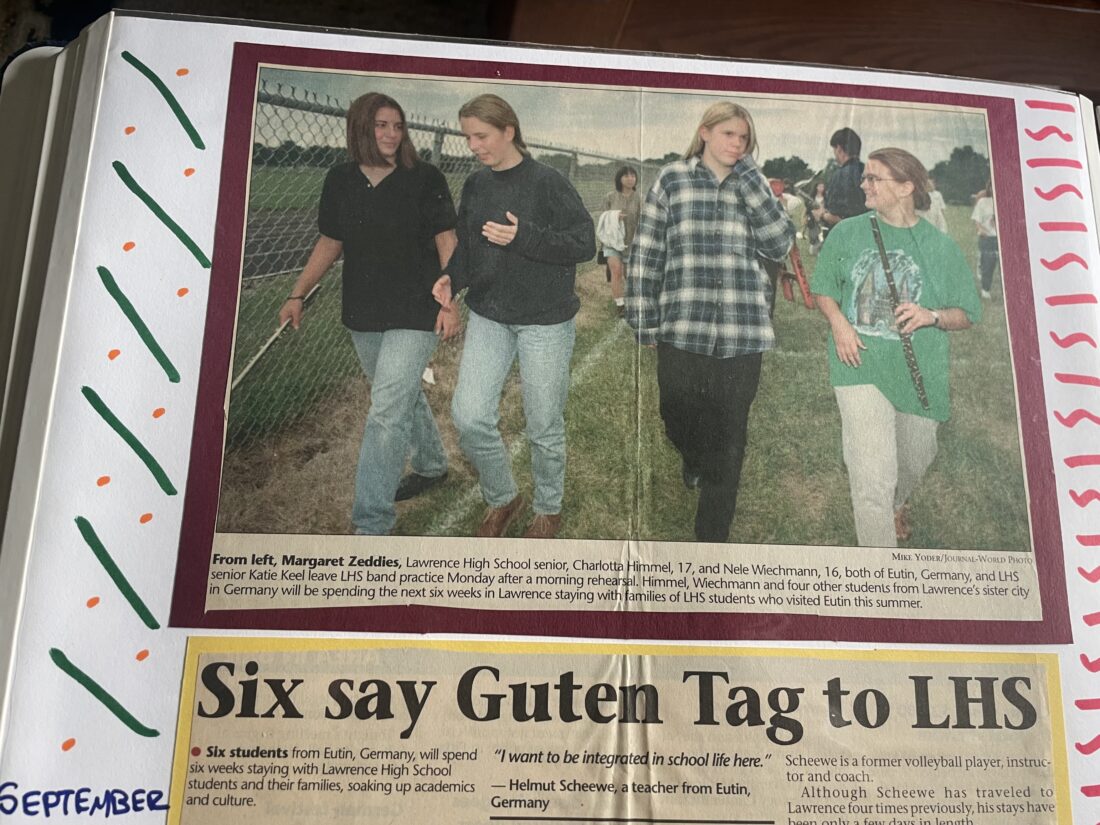
photo by: Sylas May/Journal-World
Students from Lawrence High and Eutin are pictured in this clipping in Bill Keel’s scrapbook. Keel’s daughter, Katie, is on the right.
“Those two programs, despite our limited assets, you might say, are still going,” Keel said.
“The other two are just kind of limping along.”
Those other two are Iniades/Messolonghi, Greece, and Tocopilla, Chile.
The Iniades program began in 2009 and grew out of a semi-annual study abroad program by the KU theater department. But it doesn’t have the same frequent exchange of visitors.
“It’s never really gone anywhere,” Keel said. “We’ve never really had any back-and-forth.” There have been recent efforts by Sister Cities Lawrence to get student exchanges going there, he said, but in the Greek city, the reaction to the idea wasn’t encouraging.
“I don’t know where that’s going to go,” Keel said.
The Tocopilla partnership is the newest one, formed in 2024 as part of the U.S. Department of Energy’s Net-Zero World Initiative. This was a Biden-era program to help countries work together to transition away from fossil fuels, and the partnership between Lawrence and Tocopilla was the first-ever sister city bond established by the program.
“But with the change in administration,” Keel said, “all the funding for that just disappeared.”
If Lawrence and Biskra were to work as a sister city pair, Keel said, they would need to have the student exchange component that Eutin and Hiratsuka have. They would also need to have a “friends” group – basically a group of people, deeply committed to the relationship, that “takes the bull by the horns and makes it happen.”
“I think these are valuable relationships, and I don’t wish this Algerian suggestion ill,” Keel said. “But it has to have some flesh and bones to really get off the ground.”
photo by: Contributed
The community of Elkader, Iowa, sister city of Mascara, Algeria, welcomes Algerian guests in this photo.
An Iowan ‘doing the work’
Some Algerian cities have built those flesh-and-bones relationships. Keel said Biskra has two sister cities already, including one in Russia. And a Wikipedia page on twin towns and sister cities in Africa lists more than 30 such partnerships in Algeria, including with cities in Canada, France, Spain, Turkey and Saudi Arabia.
But there’s only one American city on that page – a town of 1,200 people in northeast Iowa. And its bond with Algeria starts with its name: Elkader.
According to its website, one of the founders of the town in the 1840s was an admirer of Emir Abdelkader, an Algerian statesman and hero. Abdelkader fought against the region’s occupation by the French and was widely known abroad for his humane conduct in war and for rescuing Christians who were being persecuted by other Muslims and Druze.
So, when the town was platted, the founders named it in his honor.
“His values and personal character seemed appropriate ideals for Elkader’s founders as they formed a new community in a young country that shared those values,” the town’s website reads.
When Kathy Garms was growing up in Elkader, she didn’t learn about Abdelkader’s story. But she tells anecdotes about him now as if she’d known them her whole life.
“If he had prisoners, he treated them just like his own soldiers. If someone was hurt, he took care of them just like his own soldiers,” Garms said. “And when the French came and wanted one prisoner back, Abdelkader said, ‘What? You want one prisoner? But one man is not better than another man!’ So that was a mass prisoner exchange.”
“His life just went on like that, because he never wanted to be a warrior,” she said.
The city of Elkader didn’t come to Algerians’ attention until the U.S. Information Agency published an article about the name’s origins in an Arabic-language magazine in the late ’70s or early ’80s. A worker at the U.S. Embassy in Algiers read the article and saw the potential for a partnership between Elkader and his own hometown of Mascara, where Emir Abdelkader was born.
The embassy worker visited Elkader in 1983, and the two towns formalized their partnership in 1984.
“It was active in the beginning,” Garms says, though she wasn’t involved yet. Elkader sent a delegation and a student group to Mascara, and Mascara sent a delegation in return. “And, see, that’s just wonderful.”
But during Algeria’s civil war in the 1990s, she said, the program went dormant. For a long time, it was mostly social occasions: “After the 1990s, it was just like, when there was an Algerian in town, we would organize a potluck. That was it.”
It takes more to keep it up, she said. “You need to have somebody interested in doing the work.”
And in 2007, she decided she would be the one to do that work.
That year, she was asked to help with another Algerian potluck. “Of course, I will always help with a potluck,” she replied. “But we need to energize our sister city program. It’s too important, and there’s much more that we could be doing between our countries.”
She was only a few years into retirement and needed something positive to work on. “And so I treated it like it was a full-time job.”
Garms re-formed the board of their sister city organization and worked to build relationships and get the community involved. And within a year, she said, the mayor of Elkader was being invited to speak at an event in Algiers. But the mayor couldn’t go, and because Garms had done so much work to revive the program, he asked if she wanted to go instead. She accepted.
The event turned out to be a celebration of the 200th anniversary of Emir Abdelkader’s birth, and the audience Garms was speaking to was the Council of the Nation, the upper house of the Algerian parliament.
“It was so positive!” she said.
People from Elkader got to meet the new ambassador in 2008. Garms organized a choir for an annual Sept. 11 service between the two cities. John Kiser, an author who wrote a biography on Emir Abdelkader, asked her to help launch his book with a two-day event in town.
It wouldn’t last forever. Eventually, Garms said, the sister cities organization had a change in leadership, and Jennifer Cowsert, the city administrator and clerk of Elkader, told the Journal-World that the group is currently inactive. Cowsert said some of the lack of activity is because Elkader and its budget are so small.
“We are a very small town so budgeting funds to travel to another continent is not always something we can do,” Cowsert said. But she added that, if the money were available, “I would guess that the Mayor could have gone to Algeria at least once every two years or once a year.”
But Garms kept traveling to Algeria – “I’ve been a guest every time I have gone,” she said. And she kept her love of cross-cultural dialogue going with her nonprofit, the Abdelkader Education Project, which promotes cultural literacy and teaches about Abdelkader’s life and ideals.
And Elkader still welcomes some guests with Algerian ties. Cowsert said she’d heard about Lawrence’s recent experience hosting the Algerian team, and that Elkader had a couple of visitors recently who had just been in Kansas for the World Cup.
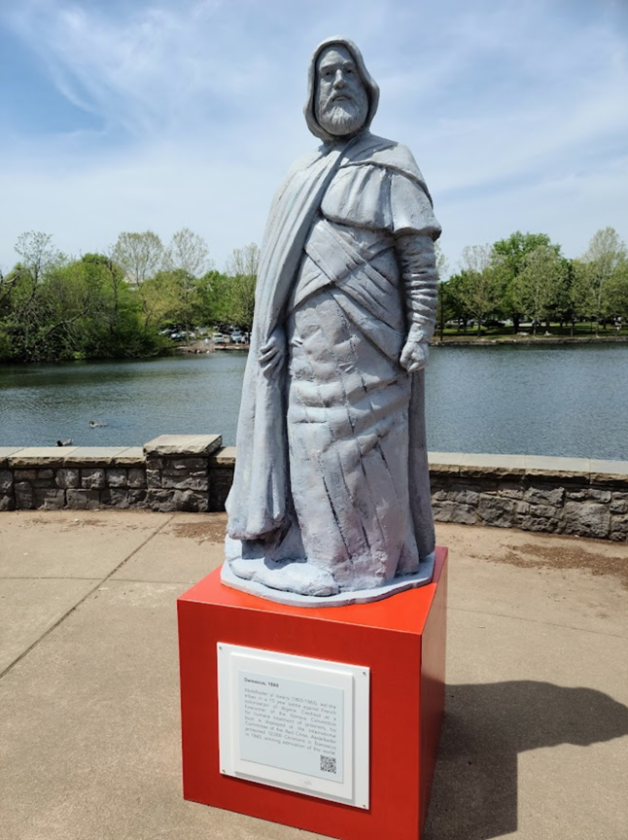
photo by: Contributed
A monument depicting Emir Abdelkader was displayed as part of Elkader, Iowa’s Art in the Park celebration in August 2023.
‘A different type of place’
If Lawrence does pursue a partnership with Biskra, it will be making a friend in a country that looks very different from Germany, Japan, Greece or Chile.
All of those countries are more democratic than Algeria and do more to protect human rights.
The nonprofit Freedom House rates Germany, Japan, Greece and Chile at 85 or higher out of 100 in its Freedom In The World report, which indicates that they are free societies where citizens enjoy robust political rights and civil liberties. But it rates Algeria at 31. Its report on the country says politics there are dominated by “a closed elite based in the military and the ruling party,” and that election fraud, corruption, suppression of protests and limits on press freedom are common.
The U.S. State Department, in its travel advisory for Algeria, says the country criminalizes “homosexual acts,” which can be punished by six months to three years imprisonment. And the country’s Family Code discriminates against women in matters of marriage, divorce, child custody and inheritance.
“That’s still an issue,” Keel said when asked about Algeria’s human rights record.
He said he’d already heard from a Lawrence resident who was “very critical about the treatment of women” in Algeria. This person sent him an email saying that young travelers, especially, might not appreciate the country’s record on women’s rights.
“It’s a different type of place,” he said.
“That being said,” he continued, “it is a city on our Earth. And in a way, we need to challenge ourselves to get along with people wherever they may be.”
Garms said she hasn’t seen discrimination in her trips to Algeria. “I’m treated like gold over in Algeria,” she said. “I never saw any persecution against women there.”
But when asked if other people in Elkader had reservations about Algeria, she said, “I know they are out there. Nobody has ever said anything to me.”
She talks about what she calls “red hat guys” – “those people who don’t want to learn about another culture.” She’s seen them comment anonymously on local social media groups.
While she talks about them, Garms recalls a quote from Emir Abdelkader: “Politics is a unifier, not a divider in itself.”
“People should talk about politics and religion,” she said. “And I’m just astounded at the people who don’t want to even engage in a conversation. I believe there is a time for a debate and there is a time for a conversation.”
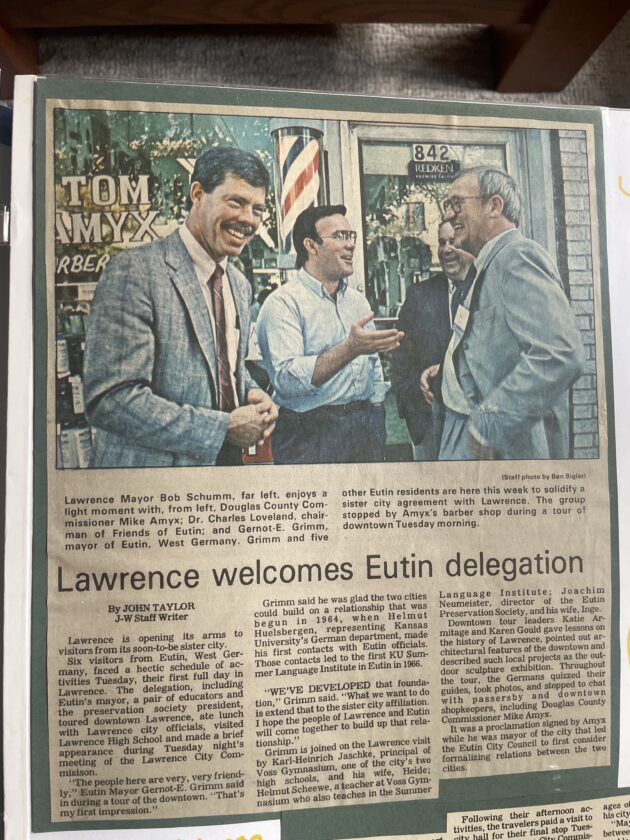
photo by: Sylas May/Journal-World
A newspaper clipping in Bill Keel’s scrapbook shows then-Mayor Bob Schumm, left, and then-City Commissioner Mike Amyx, second from left, meeting with the mayor of Eutin, Germany, Gernot-E. Grimm.
Building a two-way street
Lawrence’s first sister city story began with a cross-cultural conversation in 1980 – and nearly ended in a debate.
Decades before the City of Lawrence was even thinking about partnerships, the KU German department had established summer language programs in two cities in what was then West Germany – Eutin, near the Baltic Sea, and Holzkirchen, near the Bavarian Alps. These weren’t exchange programs; Eutin doesn’t even have a university, just college prep schools.
Keel remembers going to Eutin in 1980, when he was around 30 years old and working in the German department. He recalls the conversation he had with a teacher in Eutin, Helmut Scheewe.
“This is a one-way street,” Scheewe told him. “You bring KU students to Eutin, but we have no way to take our kids to Lawrence.”
A sister city program, Keel thought, might be a way to bridge the gap. But, when he came back to the U.S., his colleagues told him, “Oh, that’s crazy.”
“And so nothing happened, and I shut up because I was the low person on the totem pole,” Keel said.
Nothing continued to happen for most of the decade. But one year, when Keel was making his travel arrangements for the 25th year of the Holzkirchen program, his travel agent had a suggestion: “It’s the 25th anniversary; why don’t you get a proclamation from the City of Lawrence expressing bonds of friendship?”
“I said, ‘Well, how do I do that?'” Keel recalled. “She said, ‘I’ll just ask my husband; he’s the city manager.”
Yes, Keel’s travel agent was Faye Watson, wife of City Manager Buford Watson. And Buford Watson did one better – he got a key to the city to present to Holzkirchen, too. Keel’s colleague who was going on the Eutin program that summer thought it was a neat idea, and they got a proclamation and a key for Eutin, as well.
Holzkirchen put its key in storage, Keel said. But “in Eutin, they reacted very differently.” And in 1988, Eutin sent two high schoolers to Lawrence as ambassadors for a sister city partnership.
For the first time, it was finally a two-way street.
Soon, Keel’s colleague Frank Baron started a Friends of Eutin group, and in 1989 the City of Lawrence agreed to a sister city partnership. And that summer, Keel went to Eutin, “all gushy and happy – ‘Oh, it’s great to be in our future sister city!'”
But Scheewe told him to keep quiet. There was one last speed bump on the two-way street: “The Green Party is against this.” Keel went to a city meeting where the idea was debated, and he still remembers what one Green politician said: “‘It would be better for Eutin to have a sister city in Poland’ – which was then in the Soviet bloc – ‘than in Lawrence, Kansas, United States.'”
It was on the Fourth of July that the mayor and his deputies came to tell Keel and his students that the town’s governing body had approved the sister city relationship.
“We celebrated with vodka, which I thought was a little strange,” Keel said.
Strange, too, was the Eutin delegation’s first trip to Lawrence that fall. During their visit, on Oct. 25, 1989, Buford Watson died. The Eutiners attended the funeral of the man who got them the key to the city.
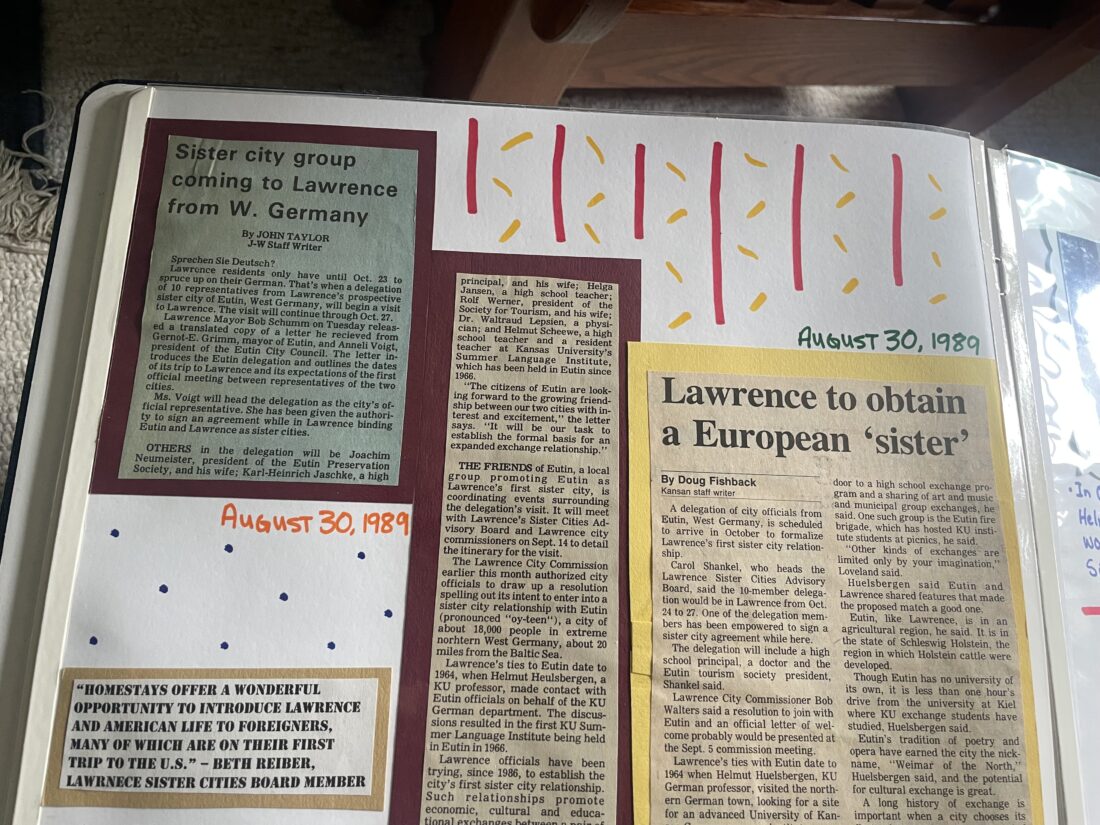
Newspaper clippings about the partnership between Lawrence and Eutin are preserved in one of Bill Keel’s scrapbooks.
‘The good and the bad’
After that, Hiratsuka joined Lawrence’s list of sister cities in 1990, and both of these partnerships are still going strong. In fact, Keel said, Lawrence is planning to welcome a delegation of 12 guests from Hiratsuka later this year.
And the bonds go deeper than academic or professional exchanges. Sometimes, sister cities help each other out in much bigger ways.
Keel recalls the summer opera festival, which had been a tradition in Eutin since the 1950s. But around 2010, Sister Cities Lawrence learned the festival was practically bankrupt and wasn’t able to put a show together.
After they found out, Keel and Baron talked to the dean of the KU School of Music and the director of the university orchestra. They said they could perform “Hansel and Gretel” by the German composer Engelbert Humperdinck – “We’ll take our whole orchestra and cast – and they did.”
The Journal-World reported that KU students performed all of “Hansel and Gretel” in summer 2011, and served as the orchestra for a performance of “Don Giovanni,” too.
“It was all done by KU students, and that kind of gave them time to get back on their feet financially,” Keel said, and some KU students, though not the whole orchestra, would go there and perform for a few years after that.
“It was pretty neat. It was quite a marvelous undertaking,” Keel said.
Garms has a story like that, too, but from the other side.
A while after she spoke at the Algerian parliament, she said, much of Elkader’s downtown was destroyed in a flood. She told her friends in Algeria about it, of course. “What I do is build relationships and friendships. That, to me, is really, really important. And with friends, you tell them the good and the bad, right?”
Then, she got a call from the Algerian embassy in D.C. “They said, we want to wire in some funds.” Soon after, $150,000 was wired to the sister city program to help the flood victims. Garms said the program wasn’t set up to handle things like that, so she gave it to the county’s disaster relief fund.
On top of that, she said, the president of Algeria sent a letter to Elkader offering condolences. “Isn’t that something?”
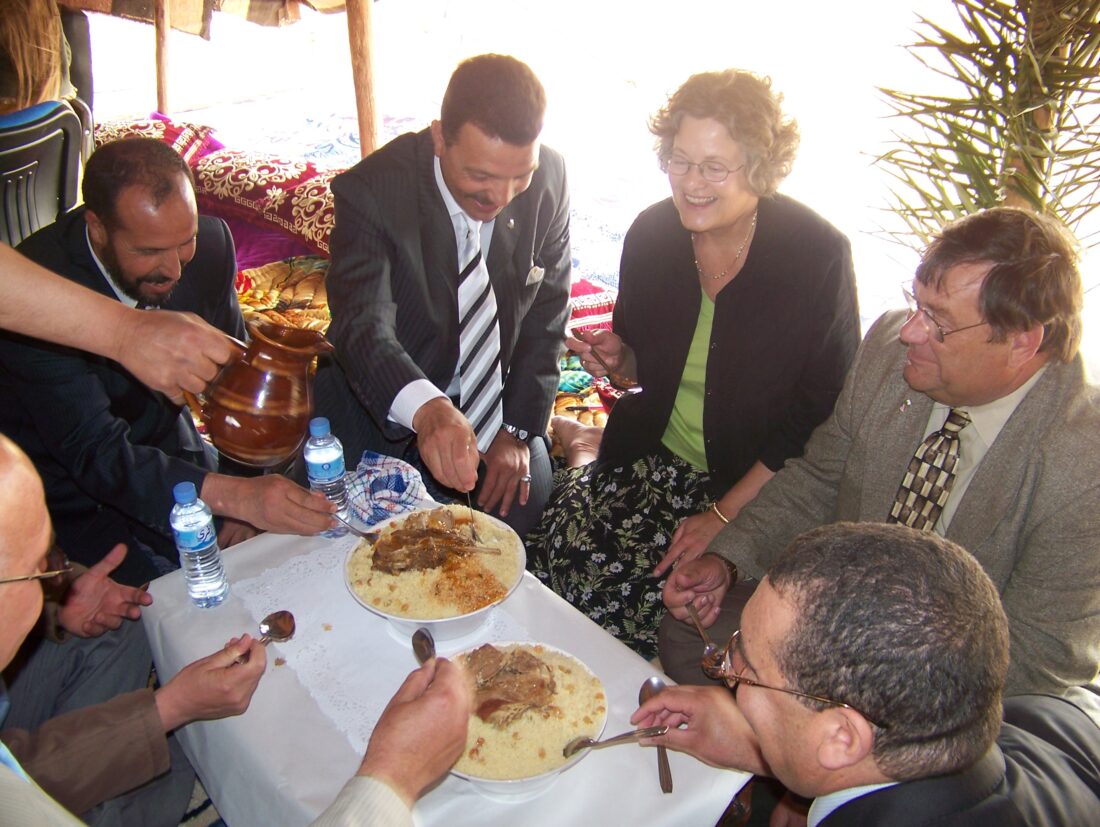
photo by: Contributed Photo
Kathy Garms and her husband share couscous with their drivers, bodyguards and interpreters on their first visit to Mascara, Algeria.
Who wants to work?
So, could Lawrence form a connection like that with Biskra or another city in Algeria?
Like Garms, Keel said sister cities only work if people are willing to work for them. He said there would need to be people stepping up and saying, “Hey, we really think the idea of an exchange or a relationship with this Algerian city is worth pursuing, and we’re going to do what it takes to make it happen.”
“Which is exactly what happened with Eutin and Hiratsuka 35, 36 years ago,” he said.
One place that might come from is KU, he speculated. The Eutin and Hiratsuka partnerships both originated at KU – Eutin through the language institutes, and Hiratsuka in research relationships between KU and Kanagawa University. “It all grew out of ongoing relationships that KU had generated.”
Biskra has a university, too: the University of Mohamed Khider Biskra. Keel said that at the meeting this past week, the representative from KU International Affairs was talking with the Algerians about making connections with the university, “so maybe something could come out of that.”
That conversation wasn’t long, maybe a few minutes, but Keel said “there was some hint that there could be some mutual relationships built off of that.”
“Now, if you get down to, say, a high school group? I don’t know. We’ve had no luck with Greece and even less luck with Chile in that regard.”
Keel also said he planned to contact Mayor Brad Finkeldei, the honorary chair of the Sister Cities Lawrence board, and ask about people who might be willing to make such a commitment. “Who can you name that wants to work on this?”
And, since it’s a two-way street, the Algerians who had contacted them would have a similar task in Biskra, he said.
“There needs to be, I don’t know how large a group in Lawrence, and similarly in Biskra, that really wants to make it happen and has concrete ideas as to what kinds of interactions – whether student exchanges or research exchanges or business, what have you – anything is possible, but there has to be something concrete,” Keel said.
“And people who are ready to pick up the ball and run down the field, not just say, ‘Oh, yeah, that’s a great idea.’
“That’ll get you nowhere.”
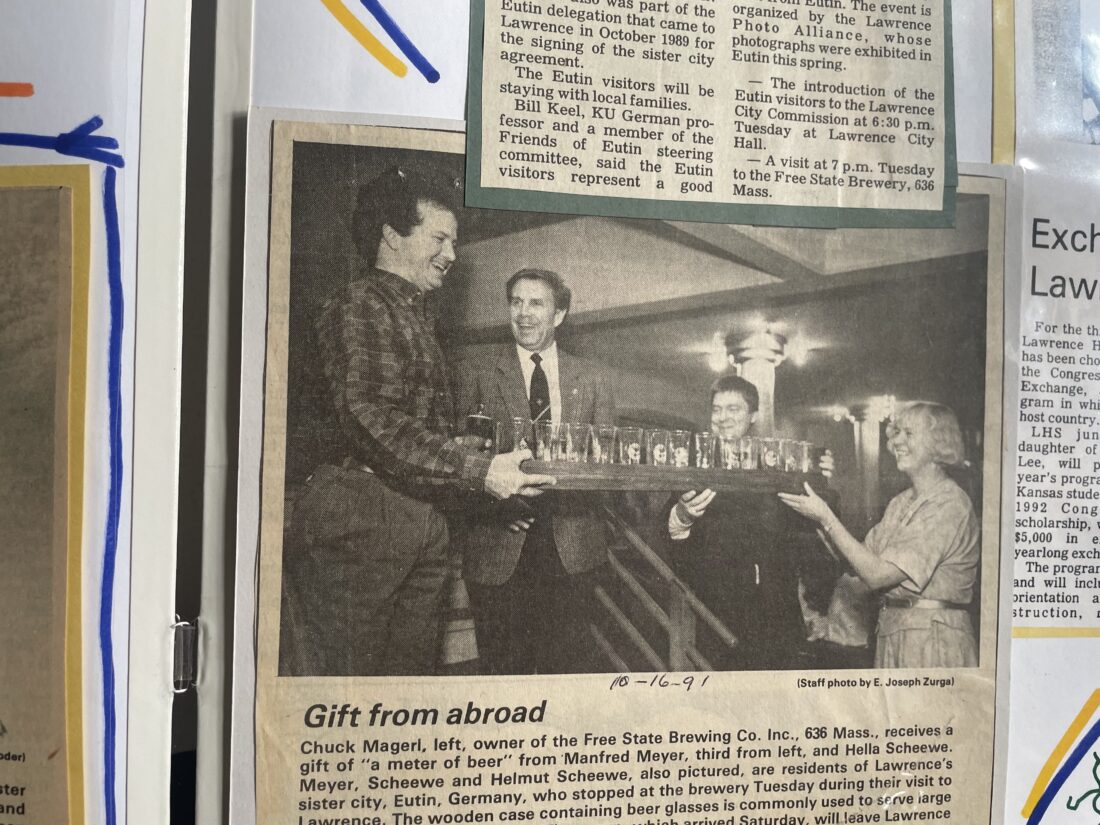
photo by: Sylas May/Journal-World
A newspaper clipping in Bill Keel’s scrapbook shows Free State Brewing Company owner Chuck Magerl receiving a “meter of beer” from visitors from Eutin, Germany.
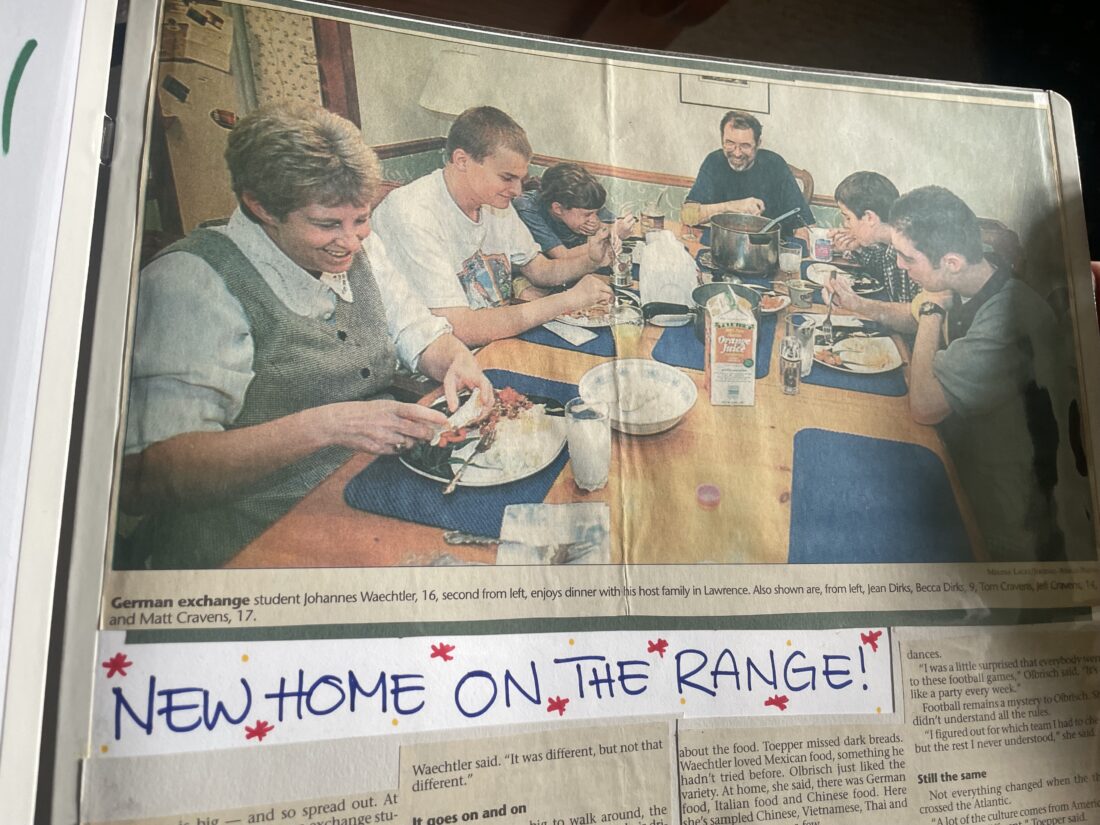
photo by: Sylas May/Journal-World
In this clipping in Bill Keel’s scrapbook, an exchange student from Eutin, Germany, Johannes Waechtler, second from left, eats dinner with his Lawrence host family.
City Government
Lawrence City Commission to weigh whether Costco should be included in STAR bond district
As they approve bikes plan, Lawrence city leaders ask about data collection, Kentucky and Tennessee streets
Lawrence city leaders want to toughen tobacco licensing rules ‘sooner than later’
Algerian government invites Mayor Brad Finkeldei, Lawrence delegation for a visit
Construction on Wakarusa Drive to resume; city manager says KDOT’s secretary has apologized for delay