From pre-approved designs to preserving older homes, Lawrence housing study’s strategies have precedents around the U.S.
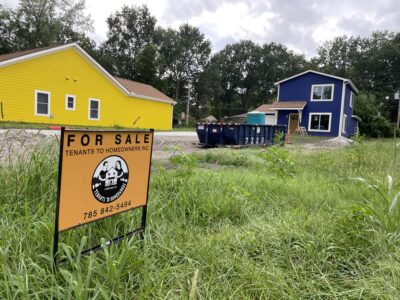
photo by: Sylas May/Journal-World
A Tenants to Homeowners development is pictured in the Pinkney Neighborhood on Friday, July 31, 2026.
If Lawrence wants to add hundreds of housing units a year, as its affordable housing study says is necessary, it’s going to need some new tactics.
The housing study, as the Journal-World has reported, was recently completed by consulting firm Development Strategies using a COVID-related grant. Among other things, it found that Lawrence had a severe shortage of housing of all types, and a demand for more than 6,300 new units of housing over the next 10 years – 2,920 for sale and 3,395 for rent.
But the study doesn’t just focus on the problems – it also proposes dozens of strategies the city could take to add that housing stock, preserve existing affordable housing in the community, and help people afford to buy a home or stay in the one they currently own.
Many of these strategies, though new to Lawrence, are not completely new ideas, and the Journal-World looked for research and real-life examples of these programs at work in other communities. It found that cities across the U.S. are doing things like setting targets for homebuilders to hit, helping developers buy existing apartments and keep them affordable, even creating portfolios of ready-made housing designs that can go through city permitting processes in a flash. And some of these strategies are even being tried in communities just up the road in the Kansas City area.
Here’s a closer look:
Housing production targets
What the study recommends:
Lawrence should set specific targets for new housing production and track progress toward them over time. The report recommends targets of 2,900 new housing units for sale and 3,400 new housing units for rent by 2036.
What’s been done elsewhere:
In 2025, The Urban Institute released a study on housing production targets in various parts of the U.S. One of its takeaways was that targets can be helpful, but should be accompanied by incentives or penalties to motivate developers to hit them.
“Although challenges remain about how best to calculate, enforce, and support these targets, the growing number of target-setting programs nationwide demonstrates their potential,” the report concluded.
Some of the programs the report reviewed were at the state level and had legal force behind them. Both New Jersey and Oregon have programs that set affordability or production targets for localities and then penalize them if they don’t comply, the report said.
Other programs, however, were voluntary, such as that of Washington, D.C.
In May 2019, D.C. Mayor Muriel Bowser set a goal of 36,000 new housing units by 2025, 12,000 of which would be affordable to households making less than 80% of area median income, according to the city’s online housing dashboard. By the end of 2024, the overall goal for new housing in D.C. was not only met, but exceeded by more than 4,000 units; affordable housing fell about 1,500 units short of the target.
Lawrence’s housing study notes that targets are primarily useful as tracking tools and to guide policy decisions, and The Urban Institute report says they’re most effective when combined with “carrots and sticks.”
Washington, D.C.’s program did have carrots – the dashboard says Bowser allocated $100 million to the city’s housing production trust fund in every budget since 2015. But as a voluntary program, it didn’t have sticks, The Urban Institute’s report said, and that might be a problem in other communities that try similar approaches.
“In Washington, DC, an interviewee noted that the District’s nonbinding, ambitious, yet achievable overall production goal helped the DC government mobilize the political will, internally and externally, to meet the goal,” it said. “But nonbinding targets are likely less effective in achieving housing production goals, particularly in jurisdictions resistant to growth.”
Pre-approved housing plans
What the study recommends:
Create a library of pre-approved housing plans, and streamline the review process for projects that use these plans. The study specifically recommends that these pre-approved housing designs be accessible for people with disabilities.
What’s been done elsewhere:
Up the road in the Kansas City area, pre-approved housing plans are catching on in local governments. These are basically designs for homes that the city makes publicly available and that can undergo a faster-than-normal permitting process, because the city already knows that the design meets its standards.
Overland Park approved a slate of “portfolio homes” recently, and Kansas City, Missouri, followed after it. Uday Manepalli, the head of KCMO’s engineering division, said the city had been talking about pre-approved housing plans for some time before that, and it worked with an architect to come up with seven designs.
The site for Kansas City’s program has designs for a duplex, two two-story homes, an accessory dwelling unit above a garage, and three one-story homes.
“That way somebody can come in and they just have to apply for a building permit,” said Rachel O’Neal, the city’s housing liaison. All it requires is a residential building contractor’s license and a site plan. “And they just pick the design that will work best with the lot that they’ve already chosen and go ahead and get their building permit.”
It’s hard to say how long a project that doesn’t use a pre-approved design will take to get its approvals, O’Neal said, because many plans don’t pass the first review. But she would estimate the normal timeline is about six weeks.
But for the pre-approved designs, O’Neal said, the city can usually get the building permit application done within five to seven business days.
“They just apply for the permit, and they can get started pretty quickly,” she said.
The program has been around for about three months now, Manepalli said, and developers and the city are still feeling it out. Developers had some requests and suggestions for the portfolio of designs, he said, and some wanted to see how it actually worked first before doing bigger projects.
Still, O’Neal said one project has been approved already, and two more are in progress right now and are close to being approved.
Preserving naturally occurring affordable housing
What the study recommends:
Lawrence should create tools and goals for preserving existing affordable housing projects and “naturally occurring affordable housing,” or NOAH, in the community starting in 2028. NOAH refers to older housing that naturally sells or rents at a lower price because of its age.
What’s been done elsewhere:
Because NOAH is by definition already built, most programs that focus on it are about keeping it affordable and livable by repairing it or preventing it from being converted into market-rate housing.
A housing policy collaborative called The Preservation Compact and DePaul University created a “NOAH Clearinghouse” that catalogues NOAH preservation strategies around the country. The U.S. cities represented here are mostly large metro areas, but the site still showcases a variety of programs, especially for rental units.
Some cities have established special funds to help affordable housing developers compete for existing buildings when they hit the market. For instance, Boston has an Acquisition Opportunity Program that lets affordable housing developers pre-qualify for up to $100,000 of acquisition funding per unit. Chicago has an Opportunity Investment Fund giving developers low-cost loans to buy existing rental buildings and keep them affordable. And in Portland, Oregon, developers can seek bridge loans of $300,000 to $5 million to purchase market-rate rental units and convert them into affordable rentals.
Other programs help homeowners and small landlords repair their existing properties. Some of these programs involve subsidies or loans, such as Pittsburgh’s Small Landlord Fund that provides 0% interest loans for repair projects to landlords with 10 or fewer units. Others have a municipal agency working with outside partners to get the work done, like Philadelphia’s Built to Last program, which makes it easier for low-income homeowners to apply for already-existing repair programs.
Lawrence has funded some repair and ADA accessibility programs before through its Affordable Housing Trust Fund. This year, it awarded $100,000 for Lawrence Habitat for Humanity’s Critical Home Repairs program and $75,000 for Independence Inc.’s Accessible Housing Program.
Helping renters buy homes
What the study recommends:
The city should expand its partnerships with affordable homeownership organizations by 2029 and explore tools such as “shared equity” models and other ways for renters to build equity.
What’s been done elsewhere:
Lawrence already has one type of arrangement that helps renters transition to homeownership: Tenants to Homeowners, a nonprofit Community Land Trust program. It uses ground leases to preserve its housing as permanently affordable.
According to its website, when someone buys a house from Tenants to Homeowners, the nonprofit retains ownership of the land it sits on and leases the land to the homebuyer. Through this arrangement, Tenants to Homeowners can require them to sell the home for an affordable price if and when they move out.
But Tenants to Homeowners’ model isn’t the only model for making homebuying more affordable.
In 2010, The Urban Institute did several case studies of “shared equity” homeownership programs around the country. Some of them were land trusts that worked similarly to Tenants to Homeowners, but others were housing cooperatives, and one was even a program run by a city government.
The institute studied two limited-equity cooperatives, one in California and one in Georgia, to show how that model works. Both of these cooperatives still operate today.
To live in one of the cooperatives’ units, you have to first buy a share in the cooperative (at a median price of $18,363 in the California cooperative and $5,524 in the Georgia one as of 2009, according to The Urban Institute’s figures.) Once you own a share, you pay a monthly assessment to live in the unit, which is lower than the market rent for the area. It’s something like the dues charged by a homeowners’ association – it covers insurance, property management, property taxes and other assorted costs.
Then, when you move out of the cooperative, you sell your share. To ensure that the unit remains affordable, there is a maximum sale price, but it’s going to be slightly more than what you paid up front. The maximum price increases annually, and sellers get a credit for any permanent improvements they made to their unit.
The Urban Institute also looked at a program from the City of San Francisco that has been operating for decades. It requires developers to set aside a portion of their residential units for sale or rent at below-market rates, and then uses restrictive covenants to ensure that future owners continue to sell them at an affordable price.
A separate study from the Terner Center for Housing Innovation at the University of California, Berkeley, said that as of 2019, the program had created over 1,300 permanently affordable housing units in the city. In an expensive city like San Francisco where home prices can be well over $1 million, qualifying buyers might see a price hundreds of thousands of dollars lower than market rates. The Berkeley study gave the example of a household purchasing a condominium unit for about $238,000, more than a $600,000 savings off the market price.
The developers’ side of the program has had difficulties in recent years, though. This year, San Francisco’s regular feasibility study said that including affordable units had become infeasible for developers due to rising construction costs, and the city recently cut its required percentage of affordable units from 15% to 5%.
A housing liaison
What the study recommends:
Lawrence should create a new position on its staff called a housing liaison, who would help developers navigate the city’s review processes and requirements. The position should be added by 2031 and should start with affordable housing, then broaden its scope to all housing development by 2036.
What’s been done elsewhere:
As part of its recent housing policy changes, Kansas City, Missouri, made O’Neal its housing liaison, and she describes her job mainly as “helping people with residential building projects.”
Kansas City is still working to define its goals and direction for the liaison program, O’Neal said, but right now she’s reaching out to the development community to let them know they can come to her with questions.
“If you are already a developer in Kansas City, you know how things work,” Manepalli said. But he expected that a liaison would be especially important for developers who are new to the community, or for individual homeowners trying to do smaller-scale projects.
“So, Rachel’s role is more geared toward the other two aspects (of homeowners and new developers), because developers who have been here for 25 years, 30, 40 years, they kind of know the process,” he said.
But the Kansas City planning staff also emphasized that neither the liaison role nor any of their other housing strategies is meant to work in a vacuum. Development specialist John Pajor said team members are working on process improvements, a vacant land plan, improving communications with the public and more.
“I think we’re trying to attack this problem from a lot of fronts,” he said.
So, could some of the strategies that Kansas City is using work in Lawrence? The KCMO planning staff said that, while they can’t really speak to what Lawrence should do, it depends on whether there’s buy-in.
“The question would be, is there an appetite in the community to take this approach?” Manepalli said. “Until or unless you test something and know how the community reacts, it will be tough to judge.”
City Government
Opinion: Environmentally conscious Lawrence is not focused on the biggest problem with electric vehicles
Locust Street apartments, Holcom housing development among this year’s applicants for $700K in Affordable Housing Trust Fund money

Business owners hurting from Wakarusa Drive closure say they’re getting no answers, no signs, no accountability
Planning Commission recommends adding more layers to approval process for data centers in Lawrence
Lawrence Loop trail may go along busy downtown street; city wants to steer clear of Riverfront for development reasons