

Lawrence’s housing study calls for hundreds of new units a year, repairing existing affordable homes
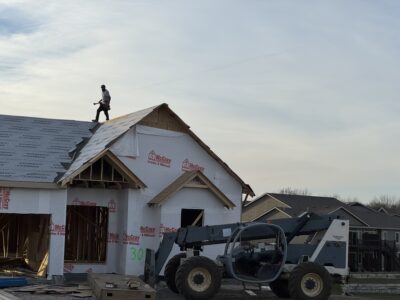
photo by: Chad Lawhorn/Journal-World
A construction worker does roof work on a new home in the 300 block of Dole Road in northwest Lawrence on Jan. 7, 2026.
Lawrence needs more new housing – hundreds of units a year – but it might also want to try rehabilitating some older properties to preserve its existing affordable housing stock.
That’s what Justin Carney, of consulting firm Development Strategies, told the Lawrence City Commission on Tuesday night. Development Strategies is the firm conducting the city’s housing study, and some of its main recommendations include producing new homes at a much faster rate and improving the condition of already-affordable homes in the community with repair and rehabilitation programs.
“This is just as important as production,” Carney said of the rehabilitation component.
The study hasn’t been released in full yet, but Carney gave some highlights on Tuesday, which he called “a morsel of all the work that we’ve done over the last several months.”
On the production side, he said that Lawrence had a severe shortage of housing of all types. The overview he presented showed that the 10-year projected demand would require more than 6,300 new units of housing – 2,920 for sale and 3,395 for rent.
“That’s a lot when you look at the deliveries and the components that have happened over the last five years or so,” he said.
As the Journal-World has reported, Lawrence has been adding more rental capacity recently, but single-family home starts have hit historic lows. In 2025, the city issued permits for nearly $60 million of apartment construction, which will add 389 new apartment units. But during that same year, Lawrence builders started just 36 new single-family homes.
The study calls for Lawrence to “unstick” its housing market by increasing annual housing production by 2028 to the city’s historic average, which it calculates at 500 units per year. It says about 46% of those should be for sale, and the rest should be rental units.
The city’s role in this might be to make development easier and more predictable, the recommendations say. Carney also said the city should be working to identify the best sites for development: “Where is new housing possible? Where are development and growth opportunities within the city?”
Danielle Davey of the Lawrence Board of Realtors addressed the commission about what it could do to help. She said that while it would take “more than just clearer codes” to increase development, it might be a good idea to revisit some of the rules.
One that she mentioned was in the city’s comprehensive plan. It requires annexations to provide some kind of “community benefit,” and states that this benefit “shall be considered by the Planning Commission, approved by the City Commission, and included in an annexation agreement.”
Davey called this requirement “poorly defined,” and City Commissioner Kristine Polian said she’d be interested in discussing it further.
But building more housing isn’t the only way to improve affordability, Carney said. The recommendations from the study will also include making improvements to existing housing, including not only a variety of home repairs, but also accessibility features.
Specifically, the recommendations call for the city to use existing sources of grant funding, like Community Development Block Grants, to improve the condition of 30 homes each year through 2030. Carney said that could entail all kinds of home maintenance, such as weatherization or repairing air conditioning systems or plumbing.
It also calls for targeted retrofitting of existing homes with improvements to make them more accessible for people with disabilities.
Carney used the term “preservation” to describe this work, and Commissioner Amber Sellers asked him to clarify what that meant.
“It’s not historic preservation. It’s homeowner preservation,” Carney said. “… How do we stabilize the existing housing stock to meet the growing needs of the community?”
Carney referred to this as “NOAH,” short for “Naturally Occurring Affordable Housing.” He said these properties might not be as marketable as new homes, but they were a key piece of the city’s housing infrastructure. “They’re cheaper, they’re often smaller and they need repair,” he said.
Several programs that repair existing homes or make accessibility improvements are already funded through the city’s Affordable Housing Trust Fund. Lawrence Habitat for Humanity received a $100,000 grant for this year for its critical home repairs program, which helps homeowners pay for things like new roofs, ramps, plumbing, and heating and cooling systems. And Independence Inc. received $75,000 for its Accessible Housing Program, which modifies the homes of seniors and people with disabilities to help them keep living there independently.
The housing study, which cost about $100,000 and was funded entirely by a COVID-related grant, will be presented in full to the City Commission later this summer.
City Government
As they approve bikes plan, Lawrence city leaders ask about data collection, Kentucky and Tennessee streets
Lawrence city leaders want to toughen tobacco licensing rules ‘sooner than later’
Algerian government invites Mayor Brad Finkeldei, Lawrence delegation for a visit
Construction on Wakarusa Drive to resume; city manager says KDOT’s secretary has apologized for delay
Evacuation drill planned Tuesday at Lawrence City Hall
