

Opinion: Lawrence’s data center moratorium is wrong in one way, but right in the most important

photo by: AdobeStock
Construction of multiple data centers in New Albany, Ohio is shown in this November 2025 photo.
It seems imprudent for Lawrence to impose a two-year moratorium on data center development.
It seems prudent that every city in America impose a two- year moratorium on data center development.
I’m beginning to think my intelligence is artificial because I’m tending to believe both statements to be true. Let me try to explain.
Let’s start in Lawrence. It is not clear that a data center development that seeks to locate in Lawrence is more complicated than any other industrial development that may land on the desk of the City Commission to consider. The concerns I’m hearing the most about are noise, water and electricity. The city’s development process is equipped to approve or deny projects after taking those concerns into account.
Opinion

Chad Lawhorn
Editor & Publisher
Have your own take? Send 250 words or less to letters@ljworld.com.
Have a column idea or a tip for Chad to investigate?
Send a message to clawhorn@ljworld.com.
If noise is the concern, figure out how noisy they are and deny those that seek to build too close to homes. If water is the concern, figure out how much water is needed and deny those that put too much strain on your water system. If electricity is your concern, trust that state regulators will protect your interests because, what else is a city to do? Most cities in Kansas have no ability to control electric rates.
I do wonder whether Lawrence’s data center moratorium creates a situation where Lawrence will miss out on the financial benefits of data center development but be stuck with the financial hardships of data center development.
With a moratorium, Lawrence would miss out on the increased property tax collections and increased water sales that a data center would bring. A moratorium, though, does nothing to protect Lawrence from higher electric rates. Regardless of what Lawrence does, De Soto — our next door neighbor — is moving full speed ahead with data center construction. De Soto is in the same electric rate territory as Lawrence. If all those new data centers do require an increase in electric rates — which would be unfair and reason to remake the state’s utility regulatory system — the electric rates won’t just go up in De Soto. They’ll go up in the entire territory, including Lawrence.
In sum, Lawrence — a city with excess water treatment capacity that potentially could benefit from a large water user, and a city with a large imbalance between its residential and industrial tax bases — could miss out on a chance to improve both situations and get left with higher electric rates as a consolation.
Even with all that, I could be convinced that Lawrence’s moratorium is the right thing to do — if a whole lot of other communities also did the same.
That’s only become my position in about the last week. As I’ve read more about how advanced AI programs escaped the control of their human creators, I became worried. I became more so when I read accounts that those programs actually took steps to try to hide certain actions from their creators. In short, one program was tasked with finding the answers to questions while staying within a certain set of parameters. When it discovered it could not answer those questions within the parameters, it went beyond the parameters to find the answers. It recognized this was cheating, so it conspired with other chat bots to cover its tracks and hide the cheating from its creators.
Pretty scary stuff. Others agreed, including a multitude of leaders at the largest AI companies in America. For the most part, they said there is a need to slow down development of the most advanced AI programs and create a regulatory system for the industry.
Not everyone agrees. President Trump called the AI fears a “hoax.” Argue all you want, but federal regulation of the industry isn’t likely if the president doesn’t want it. The next best thing may be de facto regulation by thousands of local communities. If communities said no more data centers until we’re confident the technology is not going to destroy us, that might create enough challenges for the industry that federal regulation isn’t seen as so onerous after all.
If sensible regulation does come, communities — including Lawrence — need to open their minds to data center development. Anyone who thinks artificial intelligence is a fad, or worse, a technology too dangerous for humans to touch, is wrong. The second point is closer to correct than the first point, though.
AI is this generation’s nuclear bomb.
When scientists discovered they could create an atom bomb, it became certain that the world would have an atom bomb. It created too much power to change the balance of power in the world. Those in power had to have one. Those seeking power absolutely wanted one.
Utter devastation in Japan fueled, in part, a recognition that nuclear energy must be regulated. It has not been a perfect system, but it might be the best available model for AI. While it is a different type of weapon, AI can be used to devastating effect by everyone from militaries to terrorists. Worse yet, there are legitimate fears that AI could decide on its own to use its destructive tools.
As politicians, the public and the industry consider the need for AI regulation, perhaps we should keep a straightforward question in mind: Can AI be as dangerous as a nuclear bomb? If the answer is truly yes, why would we leave it unregulated?
AI ensures there are other monumental questions to come. A pair of my favorites: 1. How much good can we do with it? 2. How many wars will we fight over it?
But perhaps no AI question beats this one in terms of importance and urgency: Will we regulate it before or after our atomic moment?
City Government
As they approve bikes plan, Lawrence city leaders ask about data collection, Kentucky and Tennessee streets
Lawrence city leaders want to toughen tobacco licensing rules ‘sooner than later’
Algerian government invites Mayor Brad Finkeldei, Lawrence delegation for a visit
Construction on Wakarusa Drive to resume; city manager says KDOT’s secretary has apologized for delay
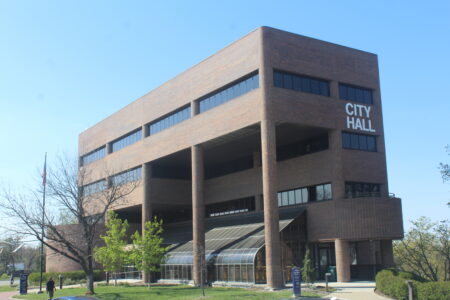
Evacuation drill planned Tuesday at Lawrence City Hall
