Opinion: Environmentally conscious Lawrence is not focused on the biggest problem with electric vehicles
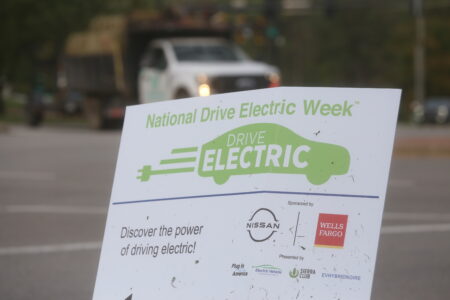
photo by: Chad Lawhorn/Journal-World
Happy National Drive Electric Week.
I’ve been seeing the signs all over town touting the week. They keep producing the same question for me: Is it odd that this environmentally conscious city seemingly has more electric vehicle signs than electric vehicle charging stations?
In fairness, the premise of that question is only half true. More specifically it is about 57% true in Lawrence.
In Lawrence, the Census Bureau estimates nearly 57% of residents are renters and 43% are homeowners. If you are among the 43% of homeowners, the idea that electric vehicle chargers are sparse may be overblown. Most home garages can serve as a battery charger for an electric vehicle. If upgrades need to be made, you’re the homeowner. Knock yourself out. (Actually, if this is a DIY project, that’s a bad phrase. Don’t touch the red wire.)
Opinion

Chad Lawhorn
Editor & Publisher
Have your own take? Send 250 words or less to letters@ljworld.com.
Have a column idea or a tip for Chad to investigate?
Send a message to clawhorn@ljworld.com.
But if you are among the 57% of Lawrence residents who are renters, the question may seem spot on. If I were an ordinary Lawrence renter, I would have these questions: You want me, a guy who lives in an apartment complex with a parking lot and no EV chargers, to start using an electric vehicle for my daily needs? Am I supposed to take it to the two-hour parking lot in downtown Lawrence and use the single charger there to get my vehicle ready for the next day? Maybe drive to south Iowa Street and use one of the chargers at an auto dealership, while killing time visiting with a salesman? Or perhaps I should drive to far northwest Lawrence and use one of the stations at Rock Chalk Park? I’m thinking of a scenario where my ability to get to work each morning relies on my dedication of going to the gym each evening. (I have a name for the workout program: Pink Slip Power.)
According to the electric vehicle website PlugShare.com, Lawrence has 36 public charging stations for electric vehicles. Despite Lawrence’s reputation as being the most progressive environmental city in the state — see the plastic bag ban — Lawrence’s EV charging station totals trail much smaller cities, including Great Bend, Salina and Hays, for example.
Of course, you can argue that no city has enough charging stations. Of course, you can argue that any electric charging station is one too many. We have had a pair of presidents who have done both. The Trump administration simply doesn’t see the transformative power of electric vehicles. The Biden administration did, but there’s a case to be made that fans of electric vehicles have more to lament from Biden than Trump. President Biden secured the funding to build lots of electric vehicle charging stations across America. Yet, we don’t have them.
Instead, the Biden administration turned electric vehicles into the poster child for one of the most serious problems facing government: The perception that government can’t get big things done. The perception is everywhere — from health care to AI regulation, more recently. Creating serious amounts of electric vehicle charging infrastructure from coast to coast is a big project. It is similar to the creation of the interstate highway system. Government once upon a time was up to that task, but it couldn’t meet the moment for electric vehicles. We had the money and we had the public’s attention. We didn’t have the bulldozers — mainly the ones that can push through the mass of bureaucracy that stalls these projects.
With gas over $4 per gallon, the public’s attention may be captured again. With the federal government an unlikely partner, it likely will be up to local governments to come up with EV systems that truly work for ordinary motorists.
You can argue Lawrence has a special responsibility to try. It is the type of community full of people who are failed by the current system. Lawrence has a ton of renters, and there is national research showing renters are getting hosed by the current system. Perhaps the best statistic is this: The Department of Energy estimates 80% of EV charging happens at home, yet the commercial real estate firm CBRE estimates only 5% of U.S. apartment complexes offer on-site EV charging.
Simply put, there are people interested in electric vehicles if they know they can plug their car in at night, take advantage of cheap overnight power rates, and be assured that when they wake their batteries are charged to get them through the day. But if you have to play a game of Whack-a-Mole just to find a charger, no thanks.
I sometimes worry that cities like Lawrence are more into EV strategies that make them feel good rather than ones that work well. While it is cool that Lawrence is on the cutting edge of electric-powered fire engines, it was a lot of money to spend on electrifying such a limited-use vehicle. If you converted 100% of Lawrence’s fire engine fleet to electric — which the city did not — you would have impacted fewer than 30 vehicles. Those vehicles don’t even produce that many miles of travel, especially compared to something like a delivery truck.
Would it have been better to spend the fire truck dollars — more than $1 million in local funds — on more public EV charging stations, or perhaps an incentive program for apartment complexes to add such stations? I don’t know, but it would make for an interesting — and I think, useful — debate.
The city still could act. It could put language in its development code requiring new apartment complexes to include charging stations. That, though, would create a debate about costs versus benefits in a community struggling with affordable housing. Some cities — Portland is an example — have put similar language into their codes. It creates a bit of a rich scenario: Government has failed mightily at building EV stations, even with money in hand, so now it simply will mandate that private development accomplish the task.
A more interesting scenario in Lawrence revolves around KU. The university is a publicly owned multifamily housing provider. It has thousands of dorm rooms rented to young adults who are the prime demographic for EV adoption. Just try finding one — let alone dozens — of EV charging stations in the huge parking lots serving those dorms. (Better yet, try finding any mention of the need for charging stations in KU’s 2024 campus master plan.)
So, there are things local leaders could consider doing. However, there are also these three points to consider: 1. If Lawrence adopted code language requiring EV stations in new apartment complexes, it seems likely the Kansas Legislature would nullify it; 2. If KU wants to get on President Trump’s list of hated universities, installing a couple of hundred EV stations would be a good way to do so; 3. Lawrence could do all of this, and more, and still not make a meaningful improvement in the environmental metrics tied to internal combustion engines. Such change really will require big governments doing big things.
That’s the ultimate point to remember about the future of electric vehicles: It really is a power problem — the kind that runs through political halls, not electric lines.
City Government

Opinion: An $80 million Hail Mary that combines Costco and Lawrence’s love of trails
Lawrence Police Department receives KDOT’s top traffic safety award for second straight year
Lawrence City Commission approves extra layers of oversight for data centers, asks for patience on further regulations
Lawrence to participate in program that helps nonprofits rehabilitate abandoned properties as affordable housing
Lawrence’s first bike lanes with physical barriers are installed on Ninth Street