

Lawrence city leaders set max mill levy at what budget proposal recommends; they also approve transit sales tax ballot question
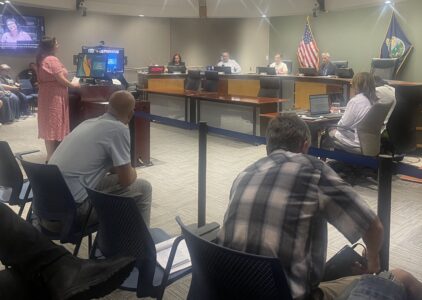
photo by: Sylas May/Journal-World
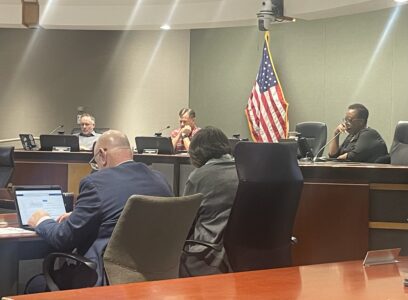
Transit director Felice Lavergne speaks to the Lawrence City Commission on July 14, 2026.
Lawrence city leaders voted on Tuesday to set the maximum mill levy for 2027 at what the current budget proposal recommends – but they said the rate might get lower as budget conversations continue.
They also decided to put a question on the November ballot about whether to increase the city’s transit sales tax.
The commission voted 4-1, with Commissioner Kristine Polian opposed, to set the maximum mill levy for 2027 at just over 36 mills, the property tax rate that was proposed in Acting City Manager Casey Toomay’s recommended budget. As the Journal-World has reported, the $415 million budget that Toomay is recommending would include a property tax rate increase of roughly 2 mills, and among other things would include expanded staffing for Lawrence-Douglas County Fire Medical and pay increases for city staff.
Tuesday night’s vote was to comply with state statute, which requires the city to notify the county clerk by July 20 of its intent to exceed the “revenue-neutral rate,” or RNR. That’s the mill levy at which the city would be collecting the same amount of money in taxes as the previous year, based on the current year’s property valuations.
The revenue neutral rate for the city would have been 32.068 mills. In the 2026 budget, the mill levy was 33.712 mills, and the proposed 2027 budget has a rate of 36.060 mills.
Polian, the lone no vote, said she was only willing to vote to exceed the revenue-neutral rate if the commission were to hold the mill levy flat. She said that the city had had property tax rate increases for “the past five or six years” because of increased property valuations, but had rarely increased the mill levy itself.
“We’ve always exceeded the RNR rate, but we never touched the mills. We worked within that means,” she said. “I’m in favor of going past the RNR rate, but only if we stay at flat level mills.”
She also said she realized that the rest of the commission might not see it that way: “I may be the minority, and that’s fine.”
Before the vote, Mayor Brad Finkeldei said that the city had come in under its maximum before. In his previous years on the commission, he said, even when the max was higher than the previous year, “in all but one of my years, we brought it down to be flat” before the final vote on the budget.
“I do think there are some ways we can get lower than that, for sure,” he said of the 36.060-mill rate.
The commission briefly discussed a few options for doing that, including two it had brought up before: reducing the size of the “steps” on the pay schedule for staff, and expanding Fire Medical staffing over two years rather than just in 2027.
In the recommended budget, Fire Medical staffing would increase by 15 full-time equivalent positions in 2027 in anticipation of the new Fire Station 6. But since the station building isn’t expected to be completed until 2029, commissioners have asked about splitting the recruitment of new staff over 2027 and 2028.
On Tuesday, city leaders had questions about whether that idea would cause problems between the city and the county, which operate the department jointly. Last year, the City of Lawrence and Douglas County were working off of a a stopgap agreement on how to split up funding for the service, and earlier this year the city and county commissions gave their input on a proposed new funding formula.
“The county has continued to advocate for expansion,” Toomay noted, and if the city chose a different timeline, some of the assumptions the two local governments had made before might change.
As for pay, budget strategy and performance director Alley Porter told the commission that certain steps on the city’s pay plans for staff are currently 5% pay increases, and that if those steps were all lowered to 2.5%, “there’s an approximate half-mill savings.”
Employee recruitment and retention has been behind the city’s push for pay raises, and Vice Mayor Mike Courtney asked whether the city could use other kinds of benefits to attract and retain talent, such as discounted rates on rec center memberships, aquatic memberships and golf course use.
“What could we do to have a package that’s beyond just straight compensation?” he asked.
The commission will have several more workshops to discuss specific budget issues before it takes its final votes in September. Staff on Tuesday said topics would include health insurance costs, prisoner care fees at the Douglas County Jail and the “key performance indicators” that the city uses to evaluate its work. The budget is scheduled for final adoption at the commission’s meeting on Sept. 15.
Commissioners on Tuesday also voted unanimously to place the question on the November ballot that would increase Lawrence’s transit sales tax from 0.2% to 0.3%.
Transit director Felice Lavergne has said the increase is necessary to avoid cuts to service after the city’s contract with its current service provider expires at the end of 2028, as the Journal-World has reported. Commissioner Amber Sellers noted that federal support for transit might be lower in coming years, too: “This is not going to close the gap; it’s going to stop a little bit of the hemorrhaging,” she said.
Polian told the other commissioners that regardless of her personal opinions on the sales tax increase, she wanted to put it on the ballot and see what the community said.
“Very rarely should we deny the voters an opportunity, so I would love to just leave it to the taxpayers, to our residents,” she said.
Finkeldei agreed. “Let’s see what they do,” he said.
City Government
As they approve bikes plan, Lawrence city leaders ask about data collection, Kentucky and Tennessee streets
Lawrence city leaders want to toughen tobacco licensing rules ‘sooner than later’
Algerian government invites Mayor Brad Finkeldei, Lawrence delegation for a visit
Construction on Wakarusa Drive to resume; city manager says KDOT’s secretary has apologized for delay
Evacuation drill planned Tuesday at Lawrence City Hall
