Lawrence’s acting city manager says roughly 2-mill increase in 2027 budget is a ‘last resort’; one commissioner wants to avoid it
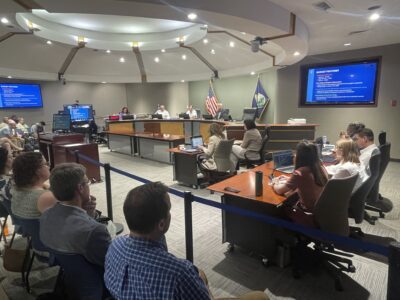
photo by: Sylas May/Journal-World
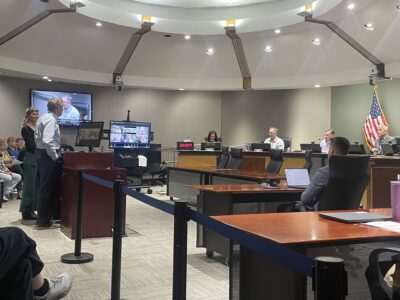
The Lawrence City Commission hears a presentation on the 2027 budget proposal on Tuesday, July 7, 2026.
Right after a parade of department heads presented their 2027 budget plans to the City Commission, Acting City Manager Casey Toomay told commissioners the budget was “more than just a collection of numbers.”
Instead, she said, it was a collection of priorities. And among the top priorities for city staff are fire and medical expansion, a raise for city workers and more funding for transit.
The roughly $415 million budget that Toomay is recommending would include a property tax rate increase of roughly 2 mills, which city staff says is mostly to help fund the expansion of Lawrence-Douglas County Fire Medical. It also would include a 2.5% general wage increase and a “step” pay increase for city employees, and it assumes a question will be placed on the November ballot to increase the city’s transit sales tax from 0.2% to 0.3%.
Toomay described the mill levy increase as a “last resort,” something that was only being done to prevent big cuts elsewhere.
But Commissioner Kristine Polian said she wanted to do whatever she could to avoid that last resort. She had concerns about raising taxes without many departments’ service levels increasing too.
“The reality is, it’s all about how we’ve been trending,” Polian said. She recalled that city staff said that increase would amount to nearly $70 extra in taxes for a $300,000 home. “That is not very much. But we are trending in the wrong direction, because our budget increases have increased beyond inflation.”
Mayor Brad Finkeldei, meanwhile, said that the mill levy had been relatively flat before, and that service hadn’t improved largely because of that.
“Keeping the mill levy flat, we have not really added any service or service level. Indeed, we’ve cut service levels in many areas,” he said. “And so, to add 15 employees in one department (LDCFM), that feels like something really different from what we’ve been doing.”
Commissioner Amber Sellers said much the same: “We are putting money into a system because we’ve never fully funded the system to do the work it’s supposed to do.”
The commission didn’t take any action on the budget on Tuesday, but that will begin next week when it sets its maximum mill levy for 2027. Here’s a look at what commissioners and city staff had to say on some of the plan’s priorities.
• Fire medical expansion: The budget proposal would add a net 21 positions to city staff, and the majority of those are related to the upcoming addition of LDCFM Station 6 in northwest Lawrence. While the station isn’t slated to open until 2029, the department wants to train recruit classes in advance and possibly put a truck back into service that was cut last year.
In the budget are 15 positions that would staff that truck, which would move to the new station after it opens. Two more positions would be added in part to support those new employees, budget strategy and performance director Alley Porter said: an additional position in human resources and an additional position in facilities.
In addition, the budget would maintain funding for 12 current Lawrence-Douglas County Fire Medical positions that are being temporarily funded by Douglas County for 2026 only.
Joe Hardy, the acting LDCFM chief, told the commission that personnel costs were 73% of the department’s budget proposal. “We are a people-driven service,” he said as he pointed it out on the pie chart. “This pie shows that.”
• Raises, healthcare: The 2.5% general raise and pay scale “step” increase were both recommended by the city’s recently concluded wage study. But in addition to those raises, the budget would include a lot of money for benefits, as well, mostly driven by rising healthcare costs.
For years, Porter said, the city “has been utilizing accumulated fund balance in our healthcare fund,” but she said that was now “no longer tenable.” A report from staff said that the proposal included about $15 million in additional spending on compensation and benefits, and almost half of that, around $7 million, would go toward the city’s contribution to the employee healthcare fund.
“The biggest shock in this budget was the healthcare change,” Finkeldei said. “… A $7 million swing in the budget, this budget would look a lot different if you didn’t have the healthcare swing.”
On wages, Polian said she would support the cost of living increase of 2.5%, but that she wasn’t willing to support a 5% step increase. “That is far, far too high,” she said.
Sellers, in response, said pay was key to retention – she’d worked as a state employee before and had left because of the pay. She also said that if other commissioners opposed the wage increase, they should have informed staff earlier: “It took two months to get one person to say it.”
• Transit sales tax question: The budget assumes an increase in the city’s transit sales tax from 0.2% to 0.3%, which is something that the public would have to approve in a ballot question. Transit director Felice Lavergne said the commission will be asked to approve language for such a question at its meeting next week, July 14.
Lavergne said the increase was necessary to keep the transit system fare-free through 2029.
“This adjustment is not about expansion or new features,” she said. “It’s about keeping the system stable.”
• Police not targeted for cuts: Chief Rich Lockhart told the commission that, for the first time in two years, the budget proposal didn’t target police for cuts. “We are pleased with this budget,” he said.
Some of the department’s costs will be rising in 2027, including the amounts it pays to Douglas County Emergency Communications and the Lawrence Humane Society for their services. There are also the higher prisoner care costs at the Douglas County Jail; however, City Attorney Toni Wheeler said Tuesday that the plan was to shift $1 million of those costs into her department’s budget.
“We will have half of the prisoner care expenses in our budget,” Wheeler said.
Lockhart noted that school resource officers and foot patrol wouldn’t be reduced in the budget. “Those are really important relationships that we’re building” in those programs, he said.
• Free play ending: The downtown Community Building, unlike the city’s other recreation centers, is currently free to access, but Interim Parks, Recreation and Culture director Lindsay Hart said no funding had been identified to staff it next year.
“Our budget is relatively flat, same as the 2026 budget,” she said, and all of the additional funding to keep the Community Building open has been approved by the commission on a trial basis. The commission has three times voted to keep the building staffed temporarily – first from January through March, then from May through June, and most recently through the end of 2026.
• Library mill increase: In addition to the city’s nearly 2-mill increase, the Lawrence Public Library board recently approved a budget that would raise the library mill levy by 0.4 mills. Like the city as a whole, library director Brad Allen said the library was struggling with rising healthcare costs.
• The next steps: At its next meeting on July 14, the City Commission is expected to set a maximum mill levy and notify the county of its intent to exceed the “revenue neutral” rate, or the rate at which the city would collect more money in property taxes than it did the previous year. Once this is done, the commission will still be able to lower the mill levy, but it won’t be able to increase it beyond the maximum that it agreed to.
Polian wanted more discussion sessions on the budget in future weeks, to dive deeper into certain topics. But there will be at least a few more meetings on the budget before the process is over. The budget is not scheduled for final adoption until September.
“We’ll be back next week to take some action and start the process,” Finkeldei said.
City Government
Lawrence Police Department receives KDOT’s top traffic safety award for second straight year
Lawrence City Commission approves extra layers of oversight for data centers, asks for patience on further regulations
Lawrence to participate in program that helps nonprofits rehabilitate abandoned properties as affordable housing
Lawrence’s first bike lanes with physical barriers are installed on Ninth Street
Opinion: Don’t give up on trying to use Costco to take tens of millions of dollars from the state of Kansas