

Sustainability board wants the environment to be ‘an underpinning’ of Lawrence’s next strategic plan
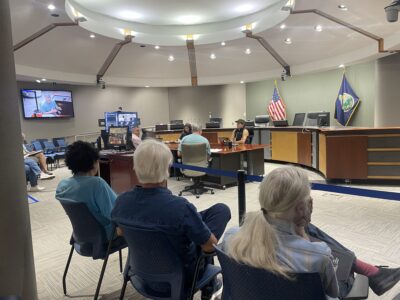
photo by: Sylas May/Journal-World
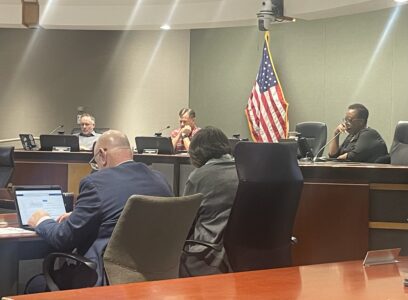
Members of the public watch the Environmental Sustainability Advisory Board's meeting at City Hall on Thursday, July 23, 2026.
When Lawrence’s new strategic plan is crafted in the coming months, the Environmental Sustainability Advisory Board wants to make sure its vision is a green one.
The board met on Thursday night to further discuss what environmental policies and projects it should recommend to the City Commission, and its members said that while they should be coming up with policy recommendations in the near term, they also should be thinking ahead to the strategic planning process that will soon start in earnest.
“I think it’s really important that we do it in two phases,” board Chair Nancy Muma said. “We have some priorities that we put forth now, and that we really engage in the strategic plan … we make sure that we can get environmental sustainability as a underpinning of many of the goals and plans and (performance metrics).”
The strategic plan is a document that, among other things, sets goals for the city and establishes how it will measure progress toward them. The previous five-year strategic plan did include environmental sustainability as one of the city’s commitments, Sustainability Director Kathy Richardson told the board.
But board member Patrick Ross said said he’d seen “a lack of environmental stewardship and care” in other parts of city government, and that he wanted a stronger sustainability framework for the city. Ahead of the meeting, he put together a 460-page “Environmental Policy and Initiative Compendium” as part of that work.
“The city’s going to go through a strategic plan restructuring with a new commission here in September, so this would certainly fall into that as far as how we rework our strategic plan collectively as a city,” Ross said.
This document, which the board hasn’t taken any formal action on, includes suggestions for city policies, from an environmental data dashboard to a new noxious weeds and native plants ordinance to adding more solar panels to city buildings. But it also includes ideas Lawrence could advocate for at the state and federal levels, such as a new regional passenger rail link between Topeka, Lawrence and Kansas City, and longer-term goals that could span decades, such as making Lawrence “energy-positive”: a community that produces more clean energy than it consumes.
Ross said he was inspired by a conversation with Mayor Brad Finkeldei at a meeting in March. Back then, Finkeldei told the board that city decision-makers would appreciate a list of ideas for environmental policies, instead of having just “one good idea” presented to them at a time.
“When he asked, ‘What is everything we can possibly do?’ I tried my best to come up with a list in that totality of ideas,” Ross said.
Many of those ideas would connect to the strategic plan. One of them is a “state of the environment” report, which the compendium says would be “an annual benchmark for evaluating progress” on the strategic plan’s environmental goals. It would be a report on environmental conditions that would go before the board and the city and county commissions each year, and it might include data on things such as pollution and per-capita electricity use.
“Patrick, you have a really great overall plan that you’ve started to put together, and that’s going to be a great starting point for our discussion when we’re going through the strategic plan,” Muma said.
She also, however, wanted to focus on some more short-term objectives. The board has talked about several of those in the past couple of months, including a styrofoam ban, an anti-idling ordinance and changes to the city’s weed control rules, but it still hasn’t forwarded any of them to the City Commission level.
Board member Joe Fearn wanted ideas that don’t “require significant buy-in from other people,” like public education campaigns on proper recycling. “I’m a big person that wants action and results immediately,” he said.
Last month, the board asked members of the public to come to this month’s meeting and share what they thought the immediate priorities should be. About a dozen people spoke to the board on Thursday about such issues as the weed ordinance; using native plants in city landscaping instead of monoculture lawns; more bicycle safety measures, including possibly lowering the speed limit on residential streets; and renewable energy infrastructure.
One commenter spoke about a friend who had been cited for violating the weed control rules because of plants she grew in her yard for food or medicine. Another said there should be “a structured citywide prairie restoration program.”
“I think the weed ordinance and stopping the monoculture has really come through” in the comments, Muma said. And board member Josh Roundy said solar power and transportation were two other themes that he saw a lot of support for.
The commission will continue its work on immediate recommendations at its next meeting. And the strategic planning process, which will involve new City Manager Majed Al-Ghafry, will be taking place throughout the second half of the year. Richardson said there will be a community survey coming out in August to help shape the plan, and that the goal is for the city to adopt the strategic plan by the end of the year.
City Government
As they approve bikes plan, Lawrence city leaders ask about data collection, Kentucky and Tennessee streets
Lawrence city leaders want to toughen tobacco licensing rules ‘sooner than later’
Algerian government invites Mayor Brad Finkeldei, Lawrence delegation for a visit
Construction on Wakarusa Drive to resume; city manager says KDOT’s secretary has apologized for delay
Evacuation drill planned Tuesday at Lawrence City Hall
