Lawrence’s sustainability board interested in changes to weed control ordinance that would promote native plants
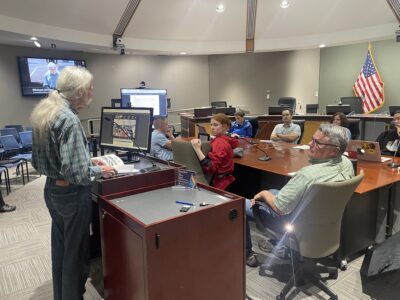
photo by: Sylas May/Journal-World
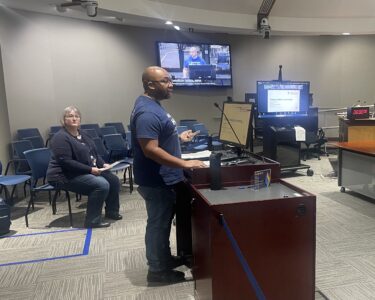
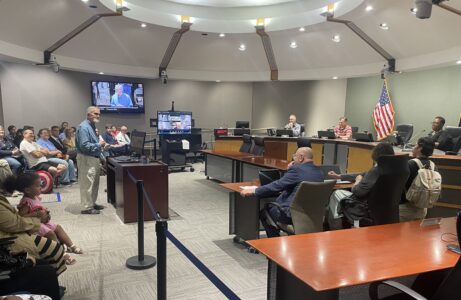
Michael Almon, left, of the Sustainability Action Network, addresses the city's Sustainability Advisory Board on Thursday, May 28, 2026. Sitting at the corner of the table, front right, is Joe Fearn, landscape manager at KU and a member of the board.
Sustainability advocate Michael Almon says that “when all you have is a mower, every problem looks like a weed.” But that includes many native plants that grow above the height currently permitted in landscaping by Lawrence’s city code.
That’s why Almon and Lawrence’s Sustainability Advisory Board are interested in exploring changes to the city’s weed control rules to promote native, “natural” landscaping. At its meeting on Thursday, the board briefly discussed a recommendation for a noxious weeds and native plants ordinance, which is something the board developed in 2023.
Almon, of the advocacy group Sustainability Action Network, said he was on the board when the recommendation was developed, and he spoke to the current board on Thursday about its history. He said the ordinance was put on hold back then because the city was crafting its new Land Development Code and the noxious plant rules might be incorporated into that document instead.
“We now have a new Land Development Code,” Almon said. “They hardly incorporated anything.” Now, he wants the city to have another try at changing the rules.
Among other things, the recommended changes from the 2023 document would give property owners more latitude to plant different types of landscapes.
The current weed control ordinance says that property owners can’t “allow the excessive growth of vegetation” on their property, and it defines “excessive” as higher than 12 inches. But that rules out landscapes based around native plants, the recommendations say, because landscaping “with vegetation native to our region … (is) often taller than 12 (inches).”
“The existing ordinance is pretty much bankrupt as far as I’m concerned,” Almon told the board.
The recommendations would permit a lot more kinds of landscapes, Almon said, including meadow-style landscapes, permaculture or xeriscaping, which doesn’t require irrigation.
Under the recommended changes, property owners who wanted “managed natural landscaping” could submit a plan to Parks, Recreation and Culture detailing what they wanted to do, including the heights of the plants.
If the department approved the property owner’s plan, the owner would still be responsible for managing invasive plants and noxious weeds, and would also be required in most cases to maintain the landscaping “at least once a year through trimming below 12 inches, mowing or, if appropriate, through burning after obtaining a prescribed burn permit.” What they wouldn’t be required to do is keep their native plants below 12 inches at all times.
The recommendations would also require the city to prioritize the use of native vegetation in its own landscaping, and would still require vegetation that wasn’t being cared for or managed on properties to be removed or trimmed.
Board member Joe Fearn, who is the landscape manager at the University of Kansas, said “this is right in my wheelhouse.” At KU, he said, he’d used native plants in landscaping, which saved money and resulted in “a far better product.”
But he was concerned that requiring property owners to submit their natural landscaping plans to the city would discourage people from doing natural landscapes at all.
“I think that becomes onerous, and it’s actually an obstacle to participation,” he said.
Fellow board member Patrick Ross said he had been trying to create a landscape on his own lawn with native plants, but realized that “I was doing everything wrong according to code, because my grass was way taller than whatever that limit was.”
“I don’t want to jump through all these hoops,” Ross said. “I just want to get into the ground and get dirt on my hands and put plants in the ground.”
The board didn’t make any kind of motion on the recommendations, but it did briefly discuss incorporating them into a list of environmental priorities to forward to the City Commission at a later date. Other priorities that could be on that list include sustainable infrastructure investments like solar panels and heat pumps in city buildings; public education and awareness campaigns; and even suggestions for other new ordinances, such as bans on Styrofoam, requiring restaurants to ask customers if they want single-use utensils or condiment packets, or restrictions on idling in vehicles.
Board chair Nancy Muma said the expectation was to work on the list at the board’s meeting next month.
City Government
Lawrence City Commission to weigh whether Costco should be included in STAR bond district
As they approve bikes plan, Lawrence city leaders ask about data collection, Kentucky and Tennessee streets
Lawrence city leaders want to toughen tobacco licensing rules ‘sooner than later’
Algerian government invites Mayor Brad Finkeldei, Lawrence delegation for a visit
Construction on Wakarusa Drive to resume; city manager says KDOT’s secretary has apologized for delay