

From styrofoam bans to ‘ecosystem personhood,’ Lawrence’s sustainability board has a lot of policy ideas to narrow down
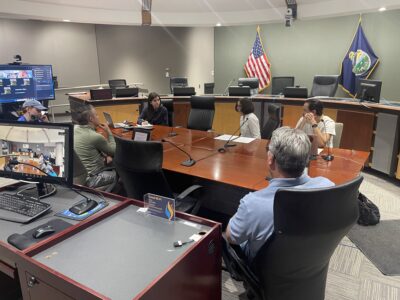
photo by: Sylas May/Journal-World
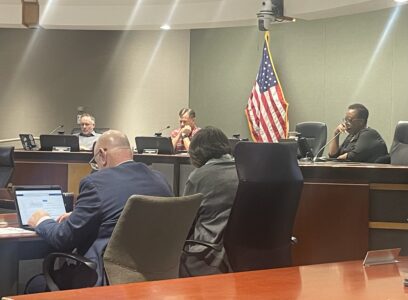
Lawrence's Sustainability Advisory Board meets at City Hall on Thursday, June 25, 2026.
From a styrofoam cup ban to an anti-idling ordinance to an “ecosystem personhood” protection for the wetlands, Lawrence’s sustainability board has dozens of ideas for environmental policies.
Now, the problem will be choosing the best ones.
The board at its meeting on Thursday had two batches of proposals to review, suggested by members Nancy Muma and Patrick Ross, for policies that it could recommend to the Lawrence City Commission in the future. But it spent much more time discussing how the ideas should be narrowed down, or if they should be narrowed down at all.
“To me, the task was just throwing as much as we could at the wall and giving (city leaders) the potential of ideas,” Ross said. “But I like the idea of identifying which ones we like more than others.”
Muma’s list of ideas included a ban on styrofoam cups and food containers. “These are especially toxic,” Muma said. In her list, she noted that polystyrene is a contributor to microplastics in the environment, doesn’t biodegrade and can poison animals that mistake it for food.
A couple of board members did briefly discuss the styrofoam ban and said it was a good idea.
“It’s a great, simple way to try to reduce the toxicity of exposure, waste and other things” said member Josh Roundy. He said that this could be a “really simple” way to make an impact.
Muma also proposed investing more in solar panels and heat pumps for city buildings, as well as creating an ordinance restricting idling in vehicles, “especially near schools … with children being especially sensitive to the air pollution that idling causes.” And she suggested requiring restaurants and other businesses not to distribute single-use plastic items like cutlery or condiment packets unless a customer requests them, which is sometimes called a “Skip the Stuff” law.
Ross’ list, meanwhile, included a bike share program and ways to incentivize people to ride bikes, more protected bike lanes, keeping buses free to ride, data center moratoriums and implementing climate-resilient zoning, among a couple dozen others.
Some of Ross’ ideas involved advocating for changes at the state level or in other things that the city couldn’t control. These included requesting more passenger rail service and advocating for legalizing “plug and play” solar panels that could be installed more easily and quickly. He said those were common in European countries such as Germany and Spain: “That’s something that is already working in other countries, but we don’t do it here.”
He also proposed a separated recycling system, instead of the city’s single-stream system where everything goes into one bin, and an “ecosystem personhood” measure that would grant legal rights to the Haskell and Baker Wetlands.
The board members didn’t discuss the specific proposals much, but did talk at length about what the best approach for making recommendations would be. Ross said part of the point of his ideas was to start conversations about important topics.
“Sometimes you have to force the issue,” Ross said. “And if Lawrence right now said, ‘We define the Haskell and Baker Wetlands as a person,’ that would run up the chain really high and it would be addressed and people would talk about it.”
Other members wanted the board to focus on “low-hanging fruit” that could easily win approval from the City Commission and the public. Roundy said he thought the proposals that already had models in other cities were probably the best approach for making change.
“Ones that other big cities have already implemented and are pretty tried and true are going to be a lot easier to sell to the commission and the community,” Roundy said. “… Like, the styrofoam one, there’s a lot of cities that have done that.”
Muma noted that all three of the ordinances she proposed have precedents in other states and countries, and the styrofoam ban is “pretty common throughout the country.”
Seventy nations, including the European Union, Canada, India and China, and 12 U.S. states had enacted styrofoam drink cup and food container bans, she said; more than half of U.S. states have anti-idling laws; and three states and major U.S. cities such as New York, Los Angeles, Chicago, Denver and Washington, D.C., have “Skip the Stuff” regulations.
Lawrence itself has already implemented a ban similar to the styrofoam ordinance, its ban on single-use plastic bags. That was approved in 2023 after years of public debate and took effect in 2024.
Ross wondered whether the board still had the efficacy to get proposals like that moving.
“I’m new to the board, but I do know that the board’s changed,” Ross said. “And I think a lot of the reason why they changed is you guys were effective, and then people didn’t like that you were effective with the plastic ban, you know.
“As an individual myself, it’s frustrating to just sit and watch the world destroy itself and not advocate for things in a way that makes sense,” he continued.
At one point, board member Chris Reimer suggested creating an organized list of top priorities and sending it to the City Commission alongside Muma’s and Ross’ full lists of ideas, in order to “show our process.” And the board agreed to do that prioritizing work at its next meeting.
Muma said that she wanted to hear from members of the public, too; only one person showed up to offer public comments at Thursday’s meeting.
“I think we’ve got a plan for our next meeting,” Muma said, “We’ll work on trying to get the items together so we can get the agenda out early, so that we can talk to a lot of people and get some people here for public comments.”
City Government
As they approve bikes plan, Lawrence city leaders ask about data collection, Kentucky and Tennessee streets
Lawrence city leaders want to toughen tobacco licensing rules ‘sooner than later’
Algerian government invites Mayor Brad Finkeldei, Lawrence delegation for a visit
Construction on Wakarusa Drive to resume; city manager says KDOT’s secretary has apologized for delay
Evacuation drill planned Tuesday at Lawrence City Hall
