Polian thinks Lawrence City Commission can still find consensus on forensic audit of capital projects
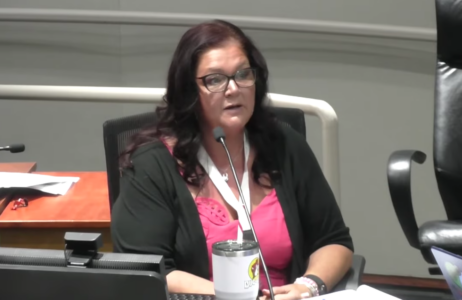
photo by: Screenshot/City of Lawrence
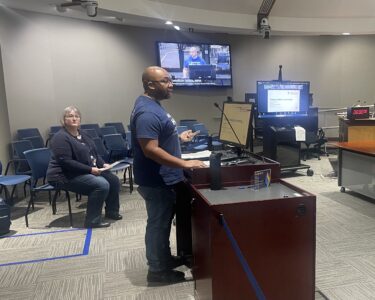
City Commissioner Kristine Polian speaks about her forensic audit proposal at the commission's meeting on Tuesday, July 21, 2026.
City Commissioner Kristine Polian, who’s worked for two decades in municipal governments, knows “audit” isn’t a pleasant word to hear.
“Audit, and add ‘forensic’ to it, forensic audit, it’s a four-letter word for most people,” she told the Journal-World on Wednesday.
She’s calling her proposal for a forensic audit of 15 major city projects a “stewardship initiative” instead, and she expected that the other four commissioners would see it as that. But when she presented it to them on Tuesday evening, she says, that wasn’t the reaction she got.
“My hope was that it would be received as more of stewardship,” Polian said. “And I am concerned that a few of the commissioners took it as a way to place fault with the city, which was not my intention.”
Two commissioners – Amber Sellers and Mike Dever – had a number of critiques and questions about the proposal at Tuesday’s meeting, ranging from its wording, to the particular projects it would examine, to what role incoming City Manager Majed Al-Ghafry would play in it.
“I’d like to identify the reasons and purposes behind these things before I lay out a list of projects I’m going to investigate,” Dever told her on Tuesday. “I want to know the scope of work, I want to know what we’re trying to identify, and then I want to know what the tangible results are going to be at the end.”
And Sellers told her: “I’m not trying to stick you on the ‘why,’; I’m just trying to understand the ‘what.'”
For her part, Polian believes the idea still has a path forward.
“I absolutely believe that every commissioner wants to provide the best service to our community, and I am confident that they will want to pursue some level of this review,” she said.
And she wanted them and the community to know that she’s more interested in the integrity of the city’s processes than in hunting for specific mistakes.
“Given the amount of projects that we have done in the past five years, and given the amount of debt that we have issued for these projects, and given the manner in which we have issued the debt, there is a higher chance of missing something,” she said. “… If you have so much going on – if you’re answering four phones and taking messages and making french fries, you know – you’re bound to miss something.”
“The problem isn’t in any possible errors that may have occurred,” she went on. “The bigger problem would be if we didn’t identify them, fix them and improve our processes moving forward.”
A ‘report card’ for projects
Polian has been calling for a forensic audit of the city’s capital projects for months, and the proposal makes it clear that this wouldn’t be like the independent audits of the city’s financials that most people think of. “The Initiative is not intended to replace the City’s annual financial audit or other legally required audits and compliance reviews,” it reads.
Those audits are meant to ensure that the financials the city is presenting are accurate and not misstated. But a forensic audit, Polian said, is “a deeper dive – we are going to deep-dive and cover all the details.”
“OK, when was the project supposed to be completed, and when was the project completed?” she said, as an example of what a forensic audit would look at. “And, if the contractor was late, did we collect liquidated damages if that was built into the contract? Did we ensure that we noted that that contractor was late on this project, so in the future will that impact whether we choose them again?”
“It’s a report card for us, basically,” she summarized.
The report card she had proposed would have 15 major capital projects on it, all from the past five years, that had been completed or were nearing completion.
In her proposal, the city would have hired a consultant to examine those projects. Twelve of them would have been selected by the consultant, but the proposal also included three specific projects that “shall be designated by the City Commission for mandatory review:” Rock Chalk Park, road improvements near Southwest Middle School and the Airport Master Plan update.
While the proposal itself didn’t elaborate on why these were mentioned, Polian gave more details at the meeting on Tuesday, in response to Dever’s questions.
She said there were three big topics she wanted to look into: bonding, procurement and agreements with outside entities. She chose Rock Chalk Park to examine its agreements between the city and the University of Kansas; the road improvements because they were a bonded project that may not have been done “as initially intended”; and the airport plan to examine the city’s procurement processes.
Other commissioners’ thoughts
Sellers and Dever both said that while they weren’t against the idea of a forensic audit altogether, they had issues with the specifics.
Sellers said that the commission’s work was about policy decisions, not administrative details, and she thought the audit proposal was “putting the cart before the horse.” She told Polian, “I don’t want to get into too much of the business of directing administrative processes, because that’s what the city manager is for.”
It would be a better idea, Sellers said, to direct Al-Ghafry to look into the city’s capital projects once he arrives in August.
“Let him get into this, let him bite into it. Then, we can have these conversations with him, so we don’t have to have them on the dais,” Sellers said.
Polian clarified to Sellers that she wasn’t proposing that the commission micromanage the city’s administration.
“In no way, shape or form is it our role, I agree with you, to sit here and scale out how things should change administratively,” she said.
Dever, meanwhile, said he didn’t understand why the proposal singled out those three projects. After he asked Polian about each one, he told her, “I think I understand more now, but I wish you would have made it clearer, so that the rest of us could understand exactly what you’re after here.”
When it came to Rock Chalk Park, which was approved when Dever was mayor in the 2010s, he wondered what the proposed audit would really uncover.
The park is a public-private partnership between the city, KU entities and developer Thomas Fritzel, and Polian said she’d heard concerns about its jointly constructed trails, which a Journal-World investigation found were about 2 miles short of what the agreement called for.
“But that’s not work that’s been done in the last five years,” Dever told her. He said that most of the people who were involved in the agreement’s negotiations “aren’t around” anymore, and that studying an agreement from more than a decade ago would be outside of the audit’s five-year scope of work.
“Do you know the way that park is structured?” he asked Polian. “Do you know all those agreements are with the owner of the property, which is Thomas Fritzel and his (company) Bliss Sports? We have very little as far as actual processes going on there besides our own property.”
At Lawrence Regional Airport, Dever said that “legal issues and malfeasance, in some people’s eyes” were more important to focus on than the procurement process for the master plan update. He noted the city’s issues with the Federal Aviation Administration – how, in 2025, the FAA notified the city that it and its private partner that operates the airport were out of compliance with provisions of past FAA grants.
“The update is the smallest concern, in my mind,” Dever said.
Dever also noted that those three projects were labeled as “mandatory review” items, while Polian said they were actually suggestions. “When I see ‘mandatory’ in a letter, that tells me I have to do it, and I’m not going to agree to that at this point,” Dever said.
‘Always looking to be better’
Polian told the other commissioners on Tuesday that the whole proposal was actually a suggestion, and that she was willing to be flexible.
“There’s no expectation on my part that it will stay looking like this,” she said.
Among other things, she said she would be open to using a random list of capital projects, something that Dever and Vice Mayor Mike Courtney were both in favor of. And she agreed with Sellers that Al-Ghafry should be included in the conversation, too.
Al-Ghafry has a background in civil engineering and public works, and Polian told the Journal-World on Wednesday that she thought, “in some way, shape or form, he will be interested in doing this.”
“Because he is a capital projects expert, I really look forward to him giving his insight and his feedback on this proposal and shaping it to what he thinks, along with the commissioners who aren’t quite sure if they want to move forward,” she said.
And, if Al-Ghafry decides this isn’t something he wants the city to pursue, Polian said, “I will adhere to that. Because I, too, have confidence in his knowledge.”
Whatever the conversation looks like, what she wants is “a way to tell the public, ‘We are always looking to be better.'”
It’s something they need to hear from the city, she thinks. Sometimes she’s heard residents worry about specific projects, and other times she’s heard “general statements that we just spend money unabashedly.”
“None of those have been proven to any extent, but when you hear the community concerned about how we are managing their tax dollars, it’s always a good opportunity to go, ‘Hey, we appreciate your concerns, we hear you, and let us prove to you that we are good stewards of the money.'”
And in the end, she hopes that the other commissioners feel the same way.
“I think everybody has the same goal, ultimately,” she said. “And that is to be good stewards.”
City Government
Lawrence City Commission to weigh whether Costco should be included in STAR bond district
As they approve bikes plan, Lawrence city leaders ask about data collection, Kentucky and Tennessee streets
Lawrence city leaders want to toughen tobacco licensing rules ‘sooner than later’
Algerian government invites Mayor Brad Finkeldei, Lawrence delegation for a visit
Construction on Wakarusa Drive to resume; city manager says KDOT’s secretary has apologized for delay