New question arises around Rock Chalk Park trails: Why are nearly 2 miles of them missing?
City commissioner renews call for special audit of construction projects
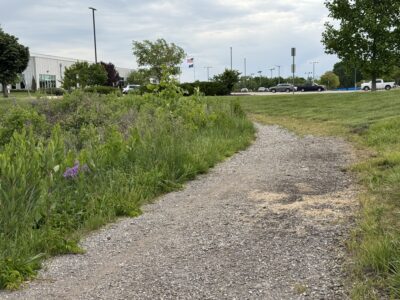
photo by: Chad Lawhorn/Journal-World
A crushed asphalt trail at Rock Chalk Park is pictured on May 8, 2026. The city's Sports Pavilion Lawrence recreation center is in the background
UPDATED 4 P.M. May 22
The trails at Lawrence’s Rock Chalk Park are creating a question, and this one doesn’t fit into the typical hiking categories of “what’s that bird?” or “was that poison ivy?”
Instead, the question at the more than 10-year-old facility in northwest Lawrence is: What happened to nearly 2 miles of trails?
An investigation by the Journal-World has found that the number of trails built at Rock Chalk Park is significantly less than what a 2013 development agreement between the city, University of Kansas entities and a private developer called for at the complex.
The investigation, though, hasn’t turned up an answer as to why the complex appears to have only 3.4 miles of jointly constructed trails rather than the “approximately five miles” of trails that the agreement specified.
City officials had little definitive information about the issue when asked by the Journal-World. An assistant director for the city’s parks and recreation department who was on staff during the construction of Rock Chalk Park said via email that his “recollection” was that 5 miles of trails had been built as part of the project in 2014. However, signage at Rock Chalk Park – along with various trail-related websites – lists 3.4 miles of nature trails at Rock Chalk Park.
City officials did not provide an explanation for why that discrepancy exists but said it is possible that some access drives and sidewalks on the properties might have been counted as trails when the project was built. However, a review of the 2013 development agreement states those pieces of infrastructure should be counted separately from any nature trails on the site.
After Friday’s online publication of this article, the city sent an additional response that said it was confident five miles of trails were built as part of the original project but didn’t provide information on how it determined that. In its response, the city also said the trail system had been adjusted since its original construction — some of the original crushed asphalt trail was replaced with a concrete trail as part of the Lawrence Loop project in 2017. However, the city didn’t address whether those adjustments had removed 1.6 miles of trail from the complex, and if not, why the city’s trail map signage at the complex lists 3.4 miles of nature trails rather than five miles of trails that the city said once existed.
While an answer remains elusive, it is the type of question that City Commissioner Kristine Polian said she is becoming more concerned about with city construction projects. Polian told the Journal-World that she is finalizing a proposal to conduct a special audit of city construction projects to determine if the city is following proper financial and procurement procedures. She said the audit also needs to review whether city construction projects – often built by third parties – are actually delivering what they promised.
“Basically, it will look at what happened versus what we were told should happen,” Polian said of the proposed audit.
Polian said she currently is developing a proposed scope of services for the audit and intends to present the idea at a City Commission meeting in the next few weeks for possible approval.
Polian was not aware of any questions surrounding whether the agreed-upon number of trails had been built at Rock Chalk Park, but said the question was an example of what she wants reviewed. She said she is envisioning an audit that would review about two dozen city-funded construction projects that have occurred during the last five years. Some would be selected randomly, while other projects would be specifically chosen for review.
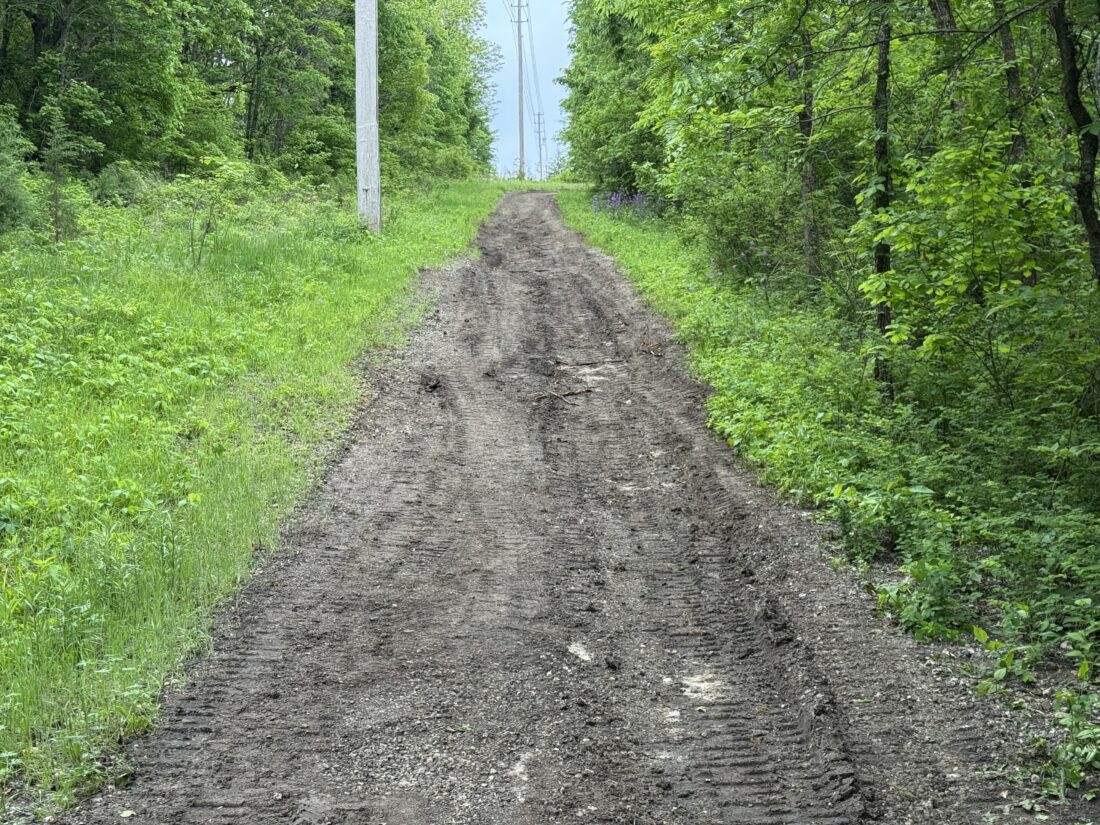
photo by: Chad Lawhorn/Journal-World
Markings of recent trail maintenance at Rock Chalk Park are pictured on May 8, 2026.
The Journal-World discovered the Rock Chalk Park trail discrepancy while investigating a separate issue involving the trails at the sports complex. As the Journal-World reported earlier this month, an investigation revealed that the city had backed away from a maintenance agreement that required Kansas Athletics to be the lead agency for all trail maintenance at Rock Chalk Park and called for Kansas Athletics to pay for half of all maintenance costs.
City staff members, at some point, decided to no longer follow that agreement. Instead, the city became the lead entity responsible for trail maintenance at the complex and began paying for all of the costs associated with the trail maintenance. In a statement to the Journal-World, a city spokeswoman said staff believed the change was a good one because the city could ultimately conduct the maintenance at a lower cost than Kansas Athletics could, but also acknowledged that the agreement had not been changed and that Kansas Athletics had not been paying for any of the maintenance work.
In reviewing the 2013 agreement that governed the construction of Rock Chalk Park, the Journal-World noted that the Rock Chalk Park partners had agreed to jointly build “approximately five miles” of trails at the complex.
Signs at the Rock Chalk Park site show a map of the complex’s trail system and list the trails’ lengths. In total, the signs list 4.25 miles of trails – consisting of 3.4 miles of crushed asphalt trails and 0.85 of a mile of concrete trails.
Given that “approximately five miles” is an imprecise amount, arguably 4.25 miles of trails might meet the spirit of the agreement. However, upon further review of the 2013 agreement, it is clear that the concrete “trails,” which largely function as sidewalks along the major streets and parking lot drives serving the complex, do not count toward the requirement of 5 miles of nature trails.
The 2013 development agreement created a line-by-line list of required infrastructure improvements. The approximately 5 miles of nature trails are on one line, while the sidewalks and concrete multi-use paths are listed on other lines.
With the concrete paths/sidewalks removed from the mix, that seemingly leaves only 3.4 miles of trails that were built as part of the Rock Chalk Park construction project. That’s a 32% reduction from what the agreement required. The agreement estimated the value of the 5 miles of trails at about $405,000. A 32% reduction would mean that about $130,000 worth of trails were not constructed.
Due to the way the partnership agreement was structured, it is not likely that the city would have realized any of those savings. For its share of the project, the city provided $22.5 million of public funds to build a city-owned recreation center, plus infrastructure, parking lots, trails and other amenities that would benefit both the city-owned recreation center and track and field, soccer and softball facilities that were constructed for KU. Any costs over the $22.5 million were to be covered by the private developer of the project, an entity led by Lawrence businessman Thomas Fritzel. Thus, cost savings on the trails wouldn’t have done anything to reduce the amount of money the city was providing to the project.
The question of whether the City of Lawrence was getting a good deal for its $22.5 million payment became hotly debated as the Rock Chalk Park project was being constructed in 2013. The public grew skeptical of the financial arrangement after the KU Endowment Association – which owned the land – and the Fritzel entity resisted using the city’s competitive bidding process to build the project.
Concerns around the project actually sparked an audit of Rock Chalk Park and its infrastructure shortly after construction concluded. That audit did not specifically address the issues of the trails, as the public’s concern was centered on the parking lots, the amount of concrete used and expenses the city was being asked to pay.
But the auditing firm did make a finding that is noteworthy to the trail issue today: The city and its partners decided not to create an “as-built” set of drawings for the project. Many construction projects produce a set of drawings at the conclusion of a project to show what has actually been built, given that a project can change from the time of initial design to construction.
“Based on discussions with the City Manager and City Engineer, a decision was made to save money by not requiring as-built drawings of the infrastructure,” the auditors wrote in their 2015 audit.
The auditing firm, McDonald & Associates, noted the absence of as-built drawings made it difficult to precisely determine what had been constructed. Instead, auditors relied on interviews with city employees who had been involved in the inspection process of the project to determine that the developers had met their infrastructure obligations.
There are no signs, however, that the audit specifically looked at the trails portion of the project. The Journal-World has found no record of the Rock Chalk Park partners publicly agreeing to reduce the number of trails to be constructed at the complex. Any suggestion to reduce the number of trails likely would have drawn backlash from the public because a large contingent of the public already was questioning whether the city was paying too much for the project.
Today, Polian said her proposed audit might choose to look at the Rock Chalk Park trails issue, although the amount of time that has passed may make a meaningful review difficult. But she said she definitely wants the audit to look at many public construction projects of the last several years. Polian, who is a former chief financial officer for various government entities, raised concerns about the city’s financial processes during her campaign last year.
She reiterated her call for an audit of construction projects last month as the Journal-World published a three-part series investigating rising water and sewer rates. Among the findings of that investigation was a $1.8 million discrepancy in a utilities construction account.
Polian has not alleged that fraud or malfeasance is the cause of any discrepancies with City Hall finances. Rather, she said city processes can be complex and ripe for error. She said now is an excellent time for an audit, given that the City Commission is in the process of hiring a new city manager.
“We want a clean slate for a new city manager,” Polian said. “If we don’t have everything fixed, that is OK, but if we can identify issues, then the next city manager can make those a priority to address.”
Other city commissioners largely have not committed to whether they believe such an audit is necessary, given that the matter hasn’t yet been placed on a city agenda for consideration. Polian said she hopes to have the item on a City Commission agenda “very soon.”
City Government
Lawrence City Commission to weigh whether Costco should be included in STAR bond district
As they approve bikes plan, Lawrence city leaders ask about data collection, Kentucky and Tennessee streets
Lawrence city leaders want to toughen tobacco licensing rules ‘sooner than later’
Algerian government invites Mayor Brad Finkeldei, Lawrence delegation for a visit
Construction on Wakarusa Drive to resume; city manager says KDOT’s secretary has apologized for delay