As Lawrence grows west, City Manager Majed Al-Ghafry wants it to build ‘strong communities’
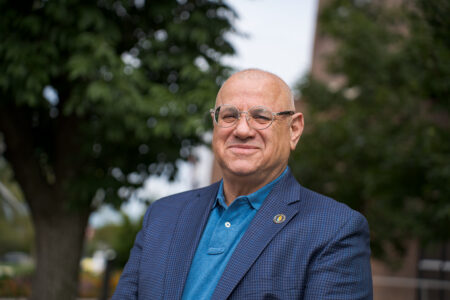
photo by: Taylor Mah/City of Lawrence
City Manager Majed Al-Ghafry is pictured at City Hall.
Majed Al-Ghafry thinks the city where he started his municipal government career – Chula Vista, California – has some lessons for Lawrence about growing smart.
Al-Ghafry has now been Lawrence’s city manager for almost a month, but back in the early ’90s he was starting out as an engineer in that San Diego-area city, and it was in the middle of a growth spurt. In the mid-’80s, a builder had decided to create not just a housing development on its east side, but a complete, self-contained community called EastLake.
According to the San Diego Union-Tribune, EastLake was made possible by a 1985 annexation that was the largest in California’s history. It was designed with 10,000 homes, industrial, shopping and office uses, and still kept some of its land reserved as open space, according to another article on the EastLake Educational Foundation’s website.
In 1986, it began construction, and it was followed by two other similar projects, Rancho del Rey and Otay Ranch, in 1989 and 1999, respectively. In just two decades, they added multiple schools, pools, parks, trails and more.
“Chula Vista, California, is a great example of what west Lawrence is trying to do,” Al-Ghafry said.
As the Journal-World reported, just last week, city commissioners approved one of the biggest annexations Lawrence has seen in decades to the west of the South Lawrence Trafficway, where a developer hopes to build a complex called Beacon Landing with single- and multifamily housing, commercial space, a multipurpose arena and other entertainment options. This coming week, the Planning Commission will consider another annexation request in the same area that could result in space for more than a thousand new homes.
“Chula Vista was very responsible and responsive for building very strong communities to the east, much like what we have in Lawrence to the west,” Al-Ghafry said. “… Thousands of acres that were developed, but they were developed methodically, and they had the public facilities in mind, they had the retail in mind … they had the diversity (of) housing in mind as well. So when you go to those areas, you see a mixture of everything, which allowed Chula Vista to grow responsibly and allowed it to actually thrive under the circumstances where other areas do not succeed.”
The Journal-World sat down with Al-Ghafry this past week to learn about what he thought Lawrence’s biggest opportunities and challenges are as it enters what could be a major growth spurt.
He said that he’s still evaluating some things – “the first three weeks are not a full telling of what is happening, just a snapshot” – but among his initial thoughts are that Lawrence has a “systems problem,” and that developments can’t succeed without diversity.
What kind of growth?
It’s not just Chula Vista that reminds Al-Ghafry of Lawrence. He’s worked in other cities – he mentioned San Antonio, Texas – that he thinks managed their growth well.
What he thinks is most important to that is a mix of uses that allow neighborhoods to stand on their own, without relying on other parts of the city for basic needs.
“Successful cities can do it right, if they create that system that says, ‘I’m checking the box on all of those items,” he said: diverse housing, entertainment, infrastructure, recreation, public safety. “All of that stuff has to be built methodically.”
One essential part of a neighborhood, he said, is “supportive services” – the things other than physical infrastructure that allow it to function on its own. Some of these are public safety improvements, like the Fire Station 6 project that will eventually serve Lawrence’s western growth area.
But other “supportive services” are spaces that provide jobs, goods and services people need and things for people to do.
He gave the example of one of his own favorite neighborhood spaces – a cafe near Sixth and Wakarusa.
“I started hanging out in one of the coolest coffee shops, in J&S,” he says – joking “They haven’t paid me, although they should!”
Then he mentions what else is near this local coffee shop: a Dillons grocery store, restaurants, retail.
“In all seriousness, those are the great places,” he said. “… Those are supportive services that you need for a good neighborhood. I chose that neighborhood because I needed the convenience.”
Neighborhoods with a mix of uses contribute not just property taxes and sales taxes, but also “the character that we continue to strive for, which is, again, a very inclusive, welcoming city,” Al-Ghafry thinks.
And he thinks that people should be welcoming of growth, too, and not intolerant toward it.
“NIMBYism is very dangerous,” he said, referencing the acronym for “Not In My Backyard.” “NIMBYism is very dangerous for us, because we are a diverse city.”
He does think that this mix of uses can’t be achieved just anywhere; there are some residential areas that would have to “rip up” too much to accommodate new developments. But if there’s “a sync among every stakeholder” – those who want residential development and those who want big-box retail being the two extremes in his mind – he thinks there are places where different kinds of projects than the norm could happen.
That includes some existing neighborhoods, like North Lawrence. A couple of weeks ago, he was at Cleo & Leo on Elm Street with volunteers, getting comments on the city’s strategic planning process. “A couple came in, and they were just saying how much they loved the neighborhood, and the husband says, ‘You know, I would love to see a local market be supported, so we can walk to it instead of having to drive across the bridge, across town, to go to the supermarket.’
“And I thought that was on point,” he said. “Those are the types of projects.”
How North Lawrence, specifically, will grow is something the city has been talking about recently, with its corridor study for the areas north of and immediately south of the Kansas River. Consultants for that study have said that a multi-use development near the turnpike interchange, possibly with a grocery store, and housing and recreational uses along the levee might be realistic.
Al-Ghafry said that without well-planned development, some parts of the city will be “dependent on other neighborhoods for survival, if you will.”
And, “when people don’t see the convenience of everything around their neighborhood, they’re going to sell and leave. Or they’re going to rent the place, find another place they can live in and make this a rental … You don’t control the destiny of your neighborhood anymore with that.”
‘A systems problem’
With his engineering background, Al-Ghafry has already had some city commissioners asking him for his perspective on projects. But he said engineering, on its most basic level, isn’t about streets or sewers or buildings.
“Engineering is about building systems, right?” he said. “So, I haven’t seen an engineering problem. I’ve seen a systems problem.”
The examples he gave of this problem include things being done on an ad-hoc basis and things that happen in “silos.”
Lawrence Regional Airport, he said, was one local system that was too ad-hoc. In April 2025, as the Journal-World reported, the FAA alleged that the city violated provisions of a federal grant for work on the airport. The airport’s grants were recently the focus of three of Lawrence’s 2025 audit findings, a material weakness and two significant deficiencies.
Al-Ghafry said the city had good people working on the airport, but a bad system. He noted that the airport had not had a permanent manager until midway through this year, and thus there was no expert who specialized in just that part of city government.
“It was about system management,” he said: “‘I know A to Z what to handle, including the intricacies of the financial aspect, the governance aspect, the relationship aspect.'”
Affordable housing was another example he mentioned. Here, the problem involves identifying not just the right roles for city staff, but for all of the city’s external partners, too.
“Creating a system that is not just a place for all, but what are some of the responsibilities that the different partners have to have?” he said. “What are the things that they are responsible for? How do you bring metrics to it?”
Al-Ghafry also says that even though he’s the top administrator of these systems, he can’t fix the systems on his own. He told the City Commission a couple of things recently: No. 1 was, “I don’t want to be Superman.”
“Because Superman is always about addressing issues, right? I want to be at a point where I’m very comfortable saying, ‘We don’t have any issues; how do we move forward?'”
“And, two, I don’t know it all. I mean, I know enough about city management to, obviously, be the city manager, but I’m not the expert in every subject.” He is an expert in some areas, but he says there are others where he may rely more on his team’s expertise, like finance, housing or communications.
“That’s why we depend on professionals,” he said. “… It’s important to understand my role, and also to appreciate the role of others.”
City Government
Opinion: Don’t give up on trying to use Costco to take tens of millions of dollars from the state of Kansas
Abandoned housing pilot program, data center rules, funding clawback for Bert Nash project on City Commission’s agenda

KU professors, middle school band director, radio personality among this year’s Phoenix Award honorees: ‘It’s a cool mix’
Housing Stabilization Collaborative’s request for city trust fund aid won’t be considered because it was filed late
On sister city visit, delegates from Hiratsuka, Japan, see Lawrence’s friendship firsthand