
Voters Guide: Lawrence voters will decide whether to raise transit sales tax
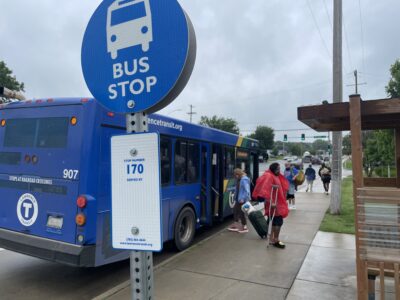
photo by: Sylas May/Journal-World
A Lawrence Transit bus picks up and drops off passengers at Sixth and Michigan streets on Friday, May 22, 2026.
Voters in Lawrence will decide this year whether to increase the sales tax that funds the city’s bus system, something transit staff says is necessary to avoid major cuts in the future.
The transit sales tax is currently 0.2%, and it was last approved in 2017 with about 70% of the vote. It is on track to sunset in 2029, but even if it were to continue at the 0.2% level, Lawrence Transit has said that it will need to make significant cuts to its services because of increasing costs and less money coming in from the federal government.
The question on the ballot this year is whether to raise the transit sales tax to 0.3% and extend it through spring of 2037.
Election Day is Nov. 3, and advance voting is underway. The last day to apply for a mail-in ballot is Oct. 27, according to the Douglas County elections office.
Below is some more information about the question and what might happen to Lawrence Transit if it does or does not pass:
What a ‘yes’ vote would do
If the ballot question passes, the transit sales tax will increase from 0.2% to 0.3% starting in April 2027. The tax will last through March 31, 2037.
What a ‘no’ vote would do
If the ballot question does not pass, the transit sales tax will remain the same at 0.2%. Its sunset date will stay the same; if voters don’t agree to extend it, it will automatically end after March 31, 2029.
A “no” vote doesn’t necessarily mean that the tax will sunset, however, because there might be another chance to extend it. City leaders have said that there is still an opportunity to put a question on the ballot next year if this year’s question doesn’t pass. Transit Director Felice Lavergne has said that if that happened, the city would probably just be asking for the sales tax to continue at its current level.
Why Lawrence Transit says it’s necessary
Lawrence Transit is seeking the increase because of rising costs, an expected decrease in federal funding and the timing of its contract with its service provider. The contract is up for renewal in 2029, and staff has said the state of the sales tax at that time will determine what Lawrence Transit looks like in the future.
If the tax were to continue past 2029 at 0.2% – which is not an option on the ballot this year, but might be in a future question if this one doesn’t pass – staff has said the transit system would have to make some hard choices, including whether to continue the city’s downtown bus station project and whether to change the frequency of certain routes.
If the tax sunsets, staff says on Lawrence Transit’s website, “transit as we see it today will not exist.”
If the tax is raised to 0.3%, that will give the transit system a cushion for upcoming years. Lavergne previously told the Journal-World that Lawrence Transit would build up its savings in preparation for a series of years further out when expenses will grow faster than revenues, and the increased revenue will mean it won’t have to spend down as much of those savings. That will allow the transit system to avoid major cuts.
What about fares?
Lawrence Transit doesn’t currently charge fares for fixed-route bus service. But staff has said repeatedly that bringing fares back would not solve the department’s budget problem.
“Fare free or not, our budget will remain structurally unbalanced without this 0.1% increase,” the transit system’s website reads.
Projections of the transit system’s budget with the tax increase have shown that from 2027 through 2029, the increase would let the department grow its savings by $2.7 million. Without the increase, the department would spend down more than $500,000 of its savings in 2027; more than $600,000 in 2028; and about $2.5 million in 2029.
Fares, meanwhile, had been a small part of the budget when the system was charging them. Lavergne previously told the Journal-World that fares would normally generate a few hundred thousand dollars a year.
City Government
Voters Guide: Lawrence voters will decide whether to raise transit sales tax
Lawrence City Commission agrees that Costco shouldn’t be in STAR bond district
Lawrence City Commission to weigh whether Costco should be included in STAR bond district
As they approve bikes plan, Lawrence city leaders ask about data collection, Kentucky and Tennessee streets
Lawrence city leaders want to toughen tobacco licensing rules ‘sooner than later’