
How Algeria ‘rolled out the red carpet’ for Lawrence leaders, and what that could mean for the future
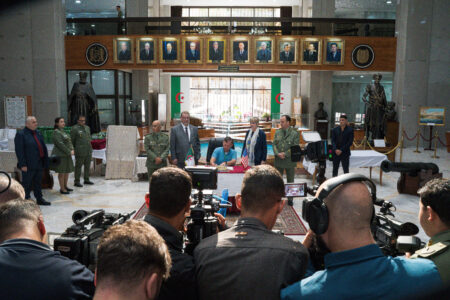
photo by: City of Lawrence
Mayor Brad Finkeldei signs the guestbook, or "Golden Book," at the Central Army Museum in Algiers in November 2026.
At a desk in a stately marble hall in a foreign capital, with uniformed military brass on either side of him, sits Lawrence Mayor Brad Finkeldei.
Behind him are bronze statues of war heroes and a row of portraits of the country’s presidents; in front of him, a page, a pen, and a press pool of state media. He signs the page – something he’s used to by now – as a gaggle of cameras capture every moment.
“I sent that to my brother, and he was like, ‘Can you sign military treaties?'” Finkeldei says of the surreal scene.
It wasn’t a treaty he was signing last week in Algiers; it was a guestbook, and this is just what you do when you’re a foreign guest of the Algerian government. He and a delegation of more than 30 other people from Lawrence, invited by Algeria’s President Abdelmadjid Tebboune, experienced this scene and others like it again and again and again last week.
Their invitation came a few months after Lawrence hosted the Algerian men’s national team for the 2026 FIFA World Cup. The team stayed in Lawrence at the DoubleTree Hotel by the turnpike, practiced in Lawrence at Rock Chalk Park, and Lawrence organized downtown watch parties for the games. Businesses put up Algerian flags; the Lawrence Arts Center displayed a sculpture of the team’s mascot, the fennec fox; the University of Kansas marching band learned the country’s national anthem and played it at an open practice; police officers helped direct traffic for fans leaving town for the games in KC, and one of them, Detective Meghan Bardwell, starred in a viral video where she danced with Algeria supporters in the street.
Most of the invitees for last week’s trip, which was paid for entirely by the Algerian government, were people the Algerians thought had played an important role in this summer’s festivities. The delegation included Finkeldei, Lawrence City Commissioner Amber Sellers, Bardwell, other city and county staff members, students in the KU band, the chair of the university’s African Studies department and more. It also included City Manager Majed Al-Ghafry, who began working in Lawrence shortly after the games concluded.
“I guarantee they had it planned since they left Lawrence,” Al-Ghafry said. The Lawrence invitees may have found out just a couple of weeks before the trip, but he’s convinced “they had been planning the perfect time for them to really go all out and host us.”
During their weeklong stay, the Lawrence delegation were treated as guests of honor everywhere they went, served elaborate meals, given so many token gifts that the hosts also had to provide each person an extra suitcase to take them back in. Finkeldei and Sellers have both been on official trips out of the country before, to Lawrence’s sister cities, but the mayor said this trip was nothing like that – it was a federal-level affair, a true state visit.
“They rolled out the red carpet for us,” Finkeldei said. “From the average citizens on the street who wanted pictures with us and were waving at us and thanking us, to meeting cabinet-level members, to walis, which is like their equivalent of a governor … Every place we went, that’s who greeted us.”
Al-Ghafry said there were a couple of reasons for this.
“One, they want to show their gratitude,” he said. “But the other thing is, they really want to solidify the relationships with Lawrence, Kansas, and the U.S. And I think that was very intentional in showing their genuine interest in us.”
So, while Finkeldei didn’t sign any treaties in Algiers, he and Al-Ghafry think there are many opportunities for formal partnerships ahead, involving Lawrence, KU and possibly more.
“This is the beginning of a long-lasting, beneficial relationship for both Algeria and for us,” Al-Ghafry said, “and I mean as a region, not just Lawrence.”
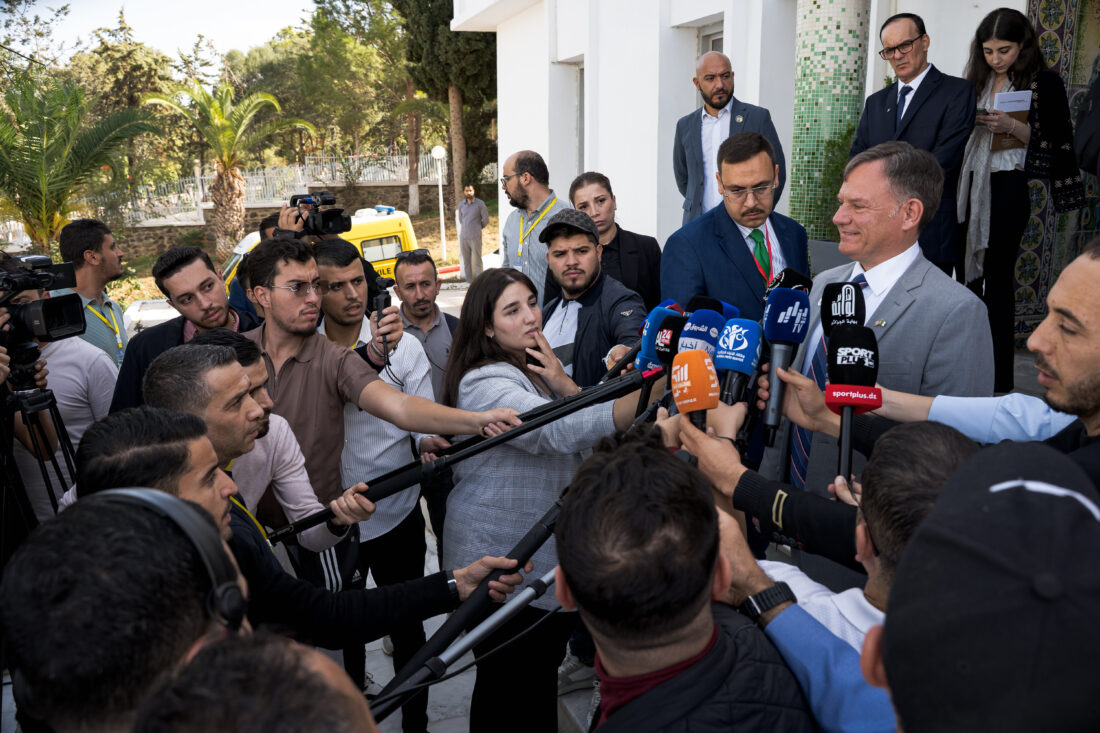
photo by: City of Lawrence
Media members crowd around Lawrence Mayor Brad Finkeldei in Tipaza, Algeria, in November 2026.
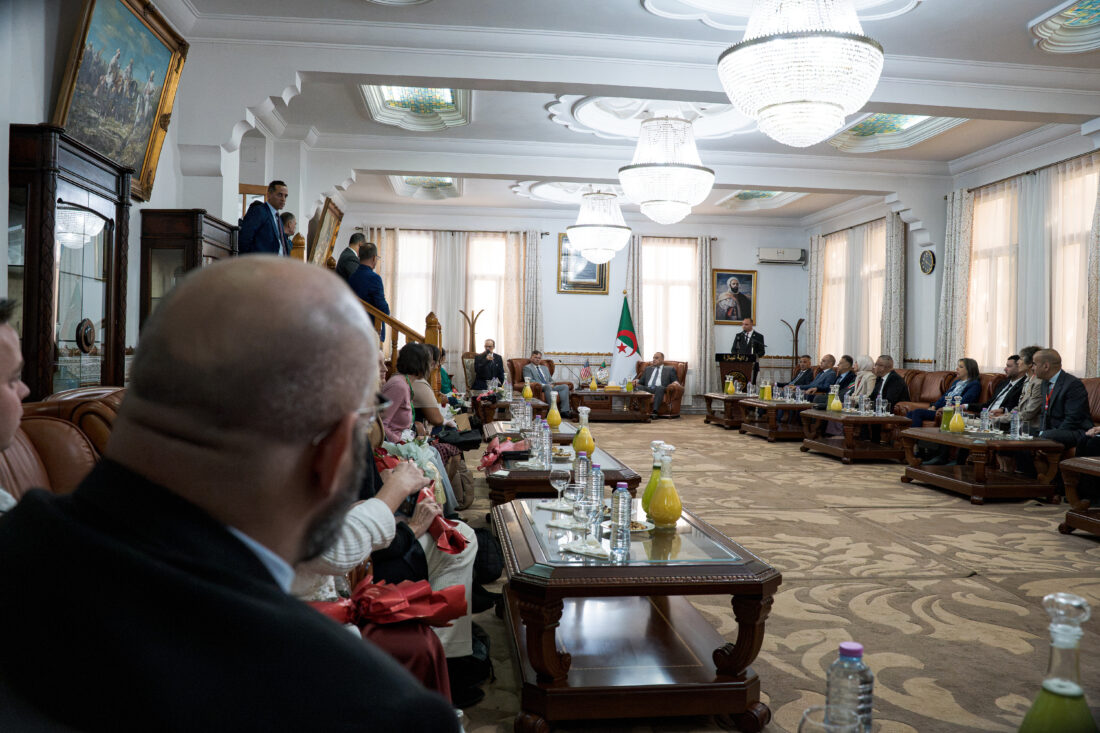
photo by: City of Lawrence
Lawrence Mayor Brad Finkeldei sits in a “hall of hospitality” with the wali of Tipaza, Algeria in November 2026.
The formalities
For Algerians, “formal” relationships can be very formal. To illustrate, Finkeldei walked through a typical stop on the Lawrence delegation’s itinerary.
Wherever they’re going, he and the other delegates arrive in a motorcade. The wali is waiting there to greet them, along with the equivalent of the city’s mayor and several other high officials.
“I typically was the first one to come out to greet them,” Finkeldei said.
The rule in Algeria, says Al-Ghafry, who’s from Syria, is that the politicians greet the other politicians first, then their staff follows. “They’re very formalized” in how it works, he said.
“Administrators like me wouldn’t be in the initial wave,” Al-Ghafry said. “It would always be the mayor and the wali sitting specifically together and talking. So, staff can talk to staff, but they are very big on that structure … [The conversation between the political leaders] is the dominant conversation in the first few minutes, and that’s what gets publicized online.”
The formal reception to welcome guests takes place in a building or room that the Algerians call the “hall of hospitality.” Every wali has one for receiving guests, Al-Ghafry said. Finkeldei recalled the couches all along the walls of these rooms, and tables set with flowers, tea, cookies, pastries, dates and fresh fruit.
“It was interesting to me that always that first step was a small reception,” Finkeldei said. “Even if it only lasted 10 or 15 minutes, it was important to them to have that setting before we moved to the next stage.”
The first time they encountered this custom was at the airport, soon after they got off the plane, said Cori Wallace, the city’s communications director. When they were promptly greeted by the airport’s leadership and ushered into the reception room, they thought it was just a one-time thing to celebrate their arrival.
Wallace remembers what one of the KU band students told her then, with a shocked expression on his face: “Man, I just play the trombone.”
The student and the other delegates would become more used to this as the week went on. This highly structured and formal environment, with a state-supervised press pool there to meet you and a full security detail surrounding you at all times, “it really does something to your brain,” Wallace said.
“We had students engaging in three to five interviews a day,” she said. “Every member of the delegation was in this really different experience of really radical hospitality, all day.”
Everywhere they went, they’d sit down in the house of hospitality and visit with the officials for a bit before they did whatever they were scheduled to do next, whether it was going to a museum, going to a meeting, going to lunch – even watching a soccer match. There was a reception area at the stadium, “greetings and all that, and then we stepped out into the box to watch the game,” Finkeldei said. “That’s how it had to start, was that hospitality,” and then, at halftime, they’d go back to the hospitality room.
And, before your visit to a place is over, someone also has to sign the guestbook.
“They call it the Golden Book,” Finkeldei said. (He doesn’t know if there’s a more official name, but that’s what the Algerians would always refer to it as.) “When dignitaries come, they sign the book, ‘thank you for showing up,’ so I would sit down and sign the book on behalf of our delegation.”
That’s how there came to be those photos of Brad Finkeldei signing that document, flanked by officers in full dress. It was from their visit to the Central Army Museum in Algiers, where he said they were greeted not just by the director of the museum, but by three generals.
Finkeldei signed the Golden Book in restaurants, museums, a hotel. “The first time I did it, I thought, ‘This is unique!'” he said. “But the fifth or sixth time I did it, you understood this is just how they do it.”
In his opinion, all of this structure isn’t just cosmetic.
“They did it in ways that it was not pretentious,” Finkeldei said. “They were so thankful we were being there and so hospitable – it was just formal, but not in a bad way.”
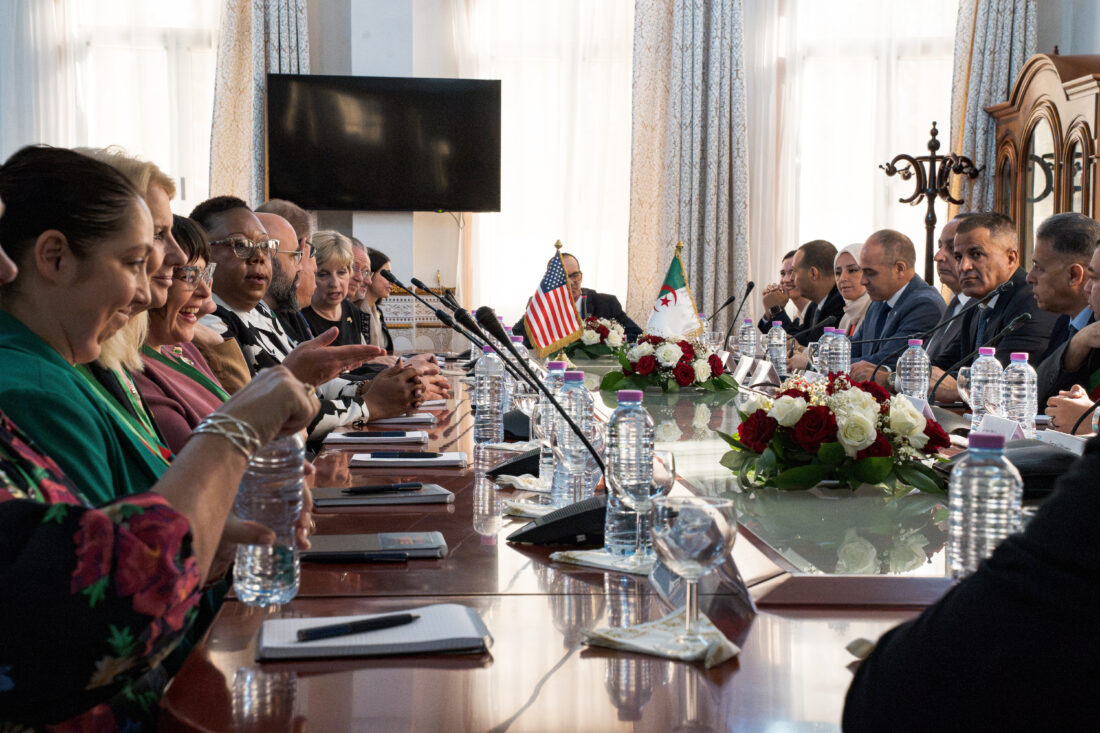
photo by: City of Lawrence
A meeting between officials from Lawrence and Tipaza, Algeria, takes place during the Lawrence delegation’s trip to Algeria in November 2026.
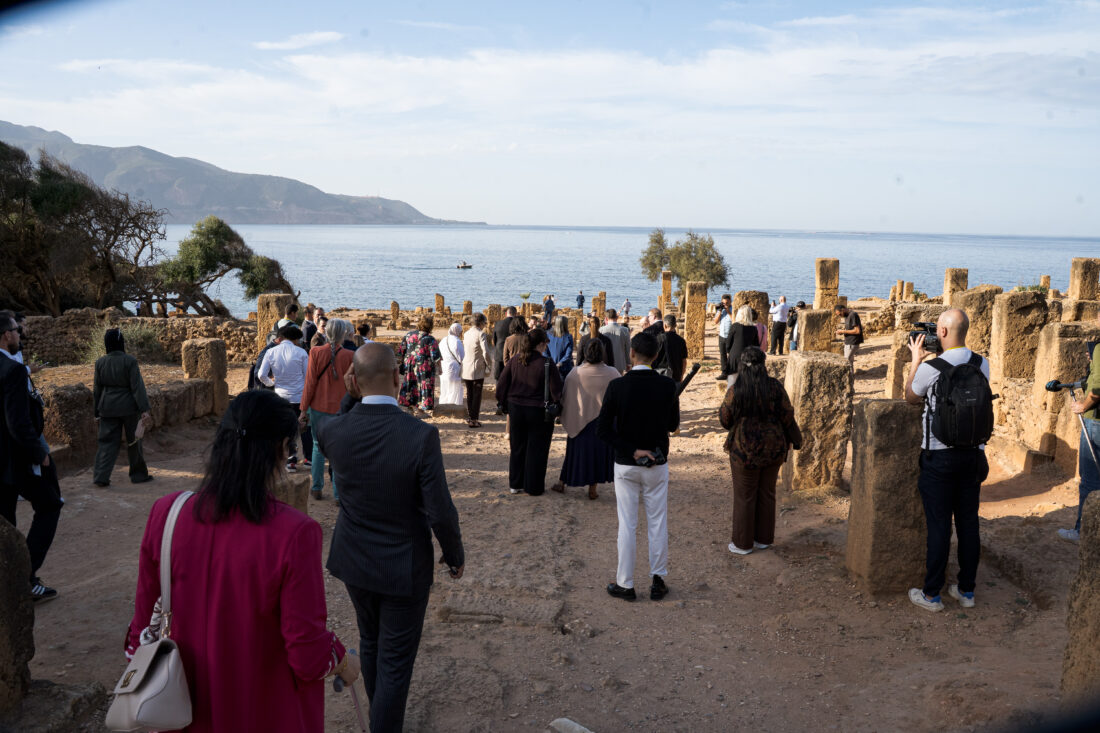
photo by: City of Lawrence
Members of a delegation representing Lawrence tour ruins in Tipaza, Algeria, in November 2026.
Future partners
On the trip with the Lawrence delegation were some rare Americans who had experienced this before: officials from tiny Elkader, Iowa.
Elkader is a town of about 1,200 people, whose founders named it after the Algerian statesman and military hero Emir Abdelkader. His name became known around the world in the 1800s as he fought against the French invasion of his homeland, and the founders of Elkader admired his religious tolerance and the humane way he conducted his campaigns.
In the 20th century, this name sparked a sister city relationship between Elkader and the Algerian city of Mascara, which was Abdelkader’s hometown. People of Elkader have been recognized by the Algerian government – on the 200th anniversary of Abdelkader’s birth, the leader of Elkader’s sister city board, Kathy Garms, was invited to give a speech to the upper house of the country’s parliament.
But for Elkader, it wouldn’t be empty hospitality. Once, when a flood struck the town, the Algerian government insisted on wiring money, $150,000, to the sister city organization to help the flood victims, and the president of Algeria sent a letter with his condolences.
Finkeldei said he learned from Elkader’s leaders that formal displays of hospitality and face-to-face meetings are how Algerians build relationships.
“[Elkader is] a lot different, because they’re a small town of 1,200, they don’t really have the same possibilities for connection that we might,” Finkeldei said. “But we did learn that the person-to-person relationship is important to Algerians. Their hospitality is genuine, but they also build trust that way.
“To Americans, they’ll email each other, get on a phone call and say, ‘Hey, let’s do this.’ To [Algerians,] face to face was the important part of building that trust.”
What might this lead to in the future? One possibility is a partnership much like Lawrence’s existing sister city relationships with Eutin, Germany, and Hiratsuka, Japan.
The most in-depth talks about a future partnership that the Lawrence delegation had were with the wali of Tipaza Province, Mohamed Amine Benchaoulia. Tipaza is a city of about 25,000 people on the Mediterranean coast and is a tourist destination known for its Roman ruins.
Finkeldei said the wali and officials from the local university and the cultural and tourism departments met with the delegation for about an hour and a half. They talked about their two cities and what they could offer each other, and Finkeldei thought both sides wanted to keep the conversation going.
Eventually, this could lead to some sort of formal agreement being signed. “They used the term ‘twinning agreement,'” Finkeldei said, which may not be exactly the same as a sister city, but would be conceptually similar.
But Finkeldei and Al-Ghafry don’t want to stop at just a partnership with Tipaza. They went to five different waliya on their trip (the term for the province governed by a wali), including Constantine, the president’s hometown, which is home to multiple universities and is a center for biotech and pharmaceutical research. Finkeldei said there was some interest in cooperation between scholars there and KU Innovation Park.
“I think us going there and meeting people face to face, meeting the walis, accelerated anything that could happen so much greater than it might have been to Americans,” he said.
Al-Ghafry thinks it’s not just going to be a city-level thing. “They’re looking forward to working with us at all levels,” he said. “Which is great to hear. But also, we want to meet the expectations. So we were very careful to listen … We wanted to listen and understand what their needs are.
“They threw a lot of ideas,” he said. “They were very excited about even the simplest of things – student exchange programs, you know, things like that. But I think there are collaborative opportunities; we just need to focus on what we truly can deliver.”
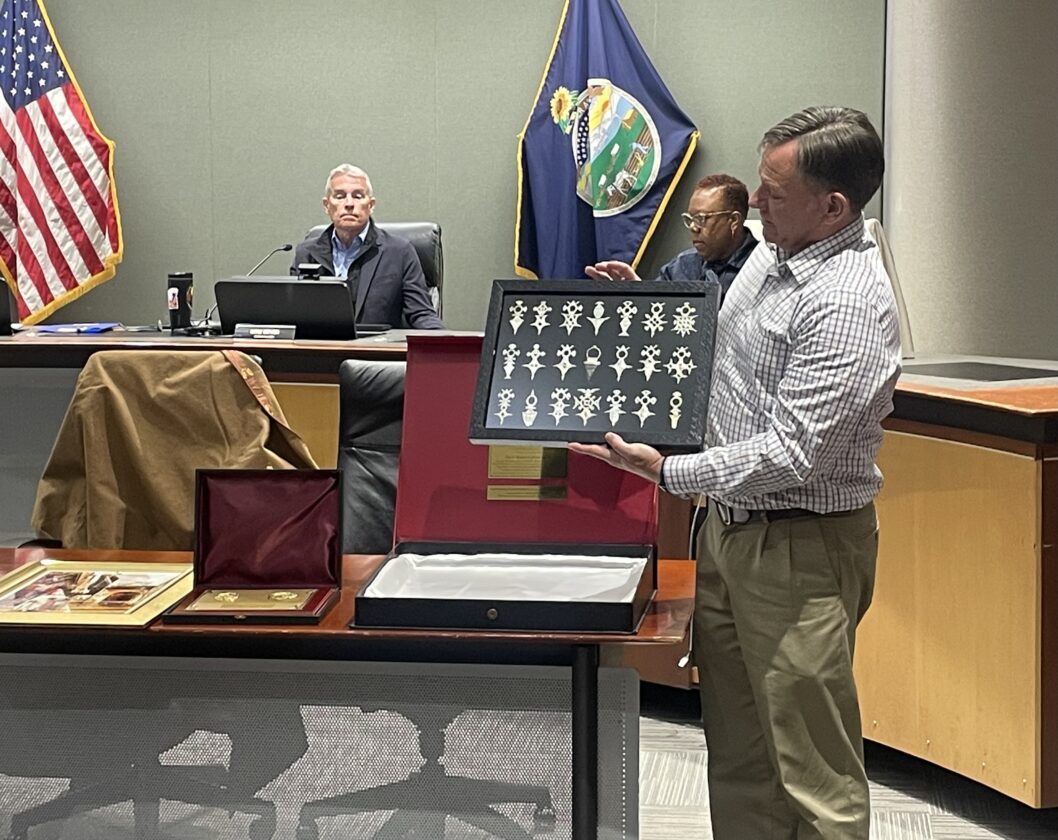
photo by: Sylas May/Journal-World
Lawrence Mayor Brad Finkeldei holds up a collection of silver emblems representing Sahara Desert tribes at the Lawrence City Commission’s meeting on Tuesday, Nov. 17, 2026. The symbols were a gift from the president of Algeria.
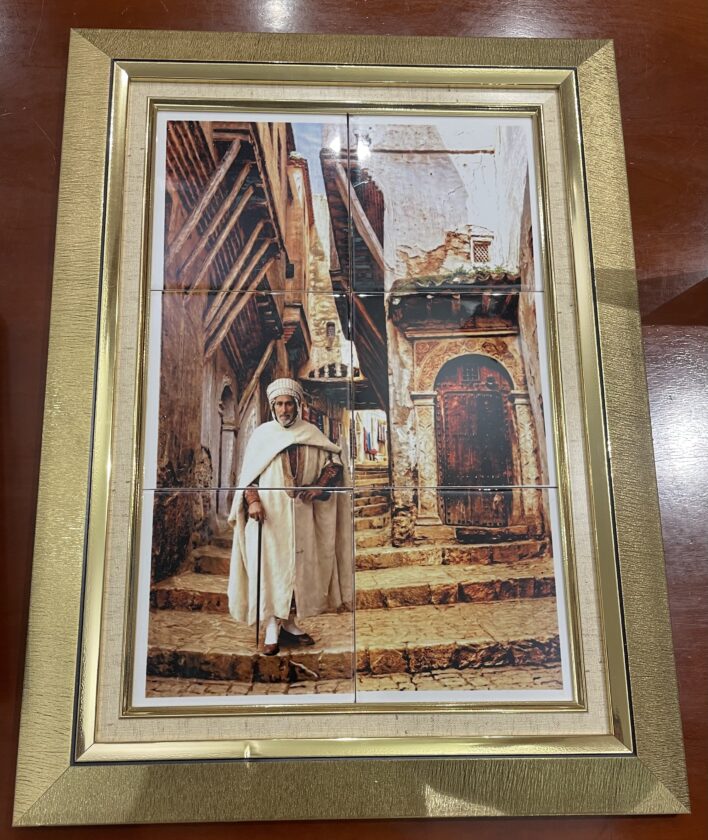
photo by: Sylas May/Journal-World
Painted tiles showing the kasbah in Algiers are pictured at the Lawrence City Commission’s meeting on Tuesday, Nov. 17, 2026.
‘The best of the best’
All through the trip, the Algerians were eager to show the Americans what they could deliver. “We’re sharing the best of the best with you” was the message the delegates got, Al-Ghafry said.
The meals were lavish. A menu for just one meal in Tipaza had a tapas course with octopus salad, marinated sardines and other appetizers, then a soup, then the main dish of grouper with shellfish and couscous, then semolina pancakes called beghrir and iced nougat for dessert, and finally coffee and tea.
“I want you to imagine a two-and-a-half-hour lunch, with a full band of esteemed Algerian musicians – I’m talking about people that have been the soundtrack to people’s whole lives – playing in front of us,” Wallace said. “You sit there for two and a half hours and enjoy a lunch that might be four or five courses, always with couscous, always with honey, with a big bowl of fruit at the end, maybe a traditional dessert, and then, like, fruit, dates, tea at the end of every meal. And they really want you to enjoy yourself.”
One dinner had its own fashion show, Finkeldei said. “I assumed it’d be some kids, you know, with local dress coming out. No. It was the premier designer for the country of Algeria.” The models were all top professionals, too. “People would say, ‘This guy’s famous.’
“He took a picture with me and my wife and put it on his social media, and I could see how many followers he has, because he’s the premier fashion designer in the country, and he did a fashion show with us with professional models.”
Al-Ghafry said these banquets could be overwhelming. “At one point I actually – I’m sure most of us did – we left our dinner half-eaten.”
But the hosts insisted on this treatment. After the delegates took in the soccer game, he said, it was about midnight, and they were ready to get some sleep. But the Algerians said, “Please, why don’t we go have dinner?”
“I’m going, ‘Huh?'” Al-Ghafry said.
“So, they have the restaurant open for us, for a full buffet, at 12 o’clock, 12:30 at night,” he said. “… It was a choice for us to eat there, but they were gently insisting that, well, you didn’t have much food, you really need to eat.”
And then there was the suitcase-load of gifts for each of the 38 guests.
“Thirty-eight bottles of olive oil, 38 boxes of dates, 38 T-shirts, 38 hats from the military museum,” Finkeldei said. These things were given to all members of the delegation – nobody got extra-special treatment because of their position or title; the KU band members got the same thing as the mayor. Finkeldei said they were mostly token gifts, “but a small token from everywhere adds up quickly.”
But there were also special gifts from the president to the City of Lawrence as a whole.
Painted tiles depicting the historic kasbah or citadel of Algiers. A plaque from the national security directorate. A set of 21 solid silver emblems representing the 21 tribes of the Sahara Desert.
These will be permanently displayed on the fourth floor of City Hall along with artwork and other gifts from Lawrence’s sister cities through the years. That part of the building isn’t normally accessible to the public, but Finkeldei put the gifts on display at Tuesday night’s City Commission meeting.
Another fragile gift to the city will have to be shipped over because it couldn’t go on the plane: a porcelain tea set.
When faced with all of these gifts, Wallace said some members of the delegation had an instinct to reciprocate. People asked her what they should do, what would be proper in that situation. Eventually, she just had to tell people, “There is no way, in this moment, to reciprocate.”
“The best way to reciprocate is just to say thank you,” she said. “… Just sit and enjoy, and that will be a show of gratitude.”
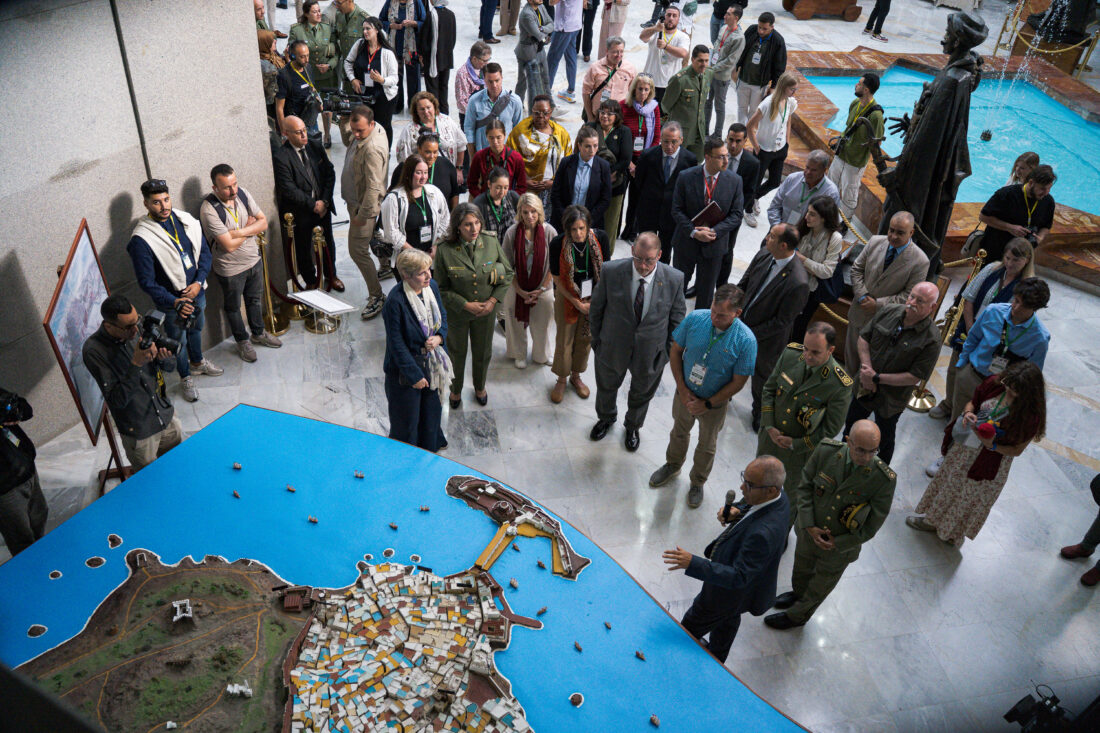
photo by: City of Lawrence
Members of a delegation representing Lawrence tour the Central Army Museum in Algiers in November 2026.
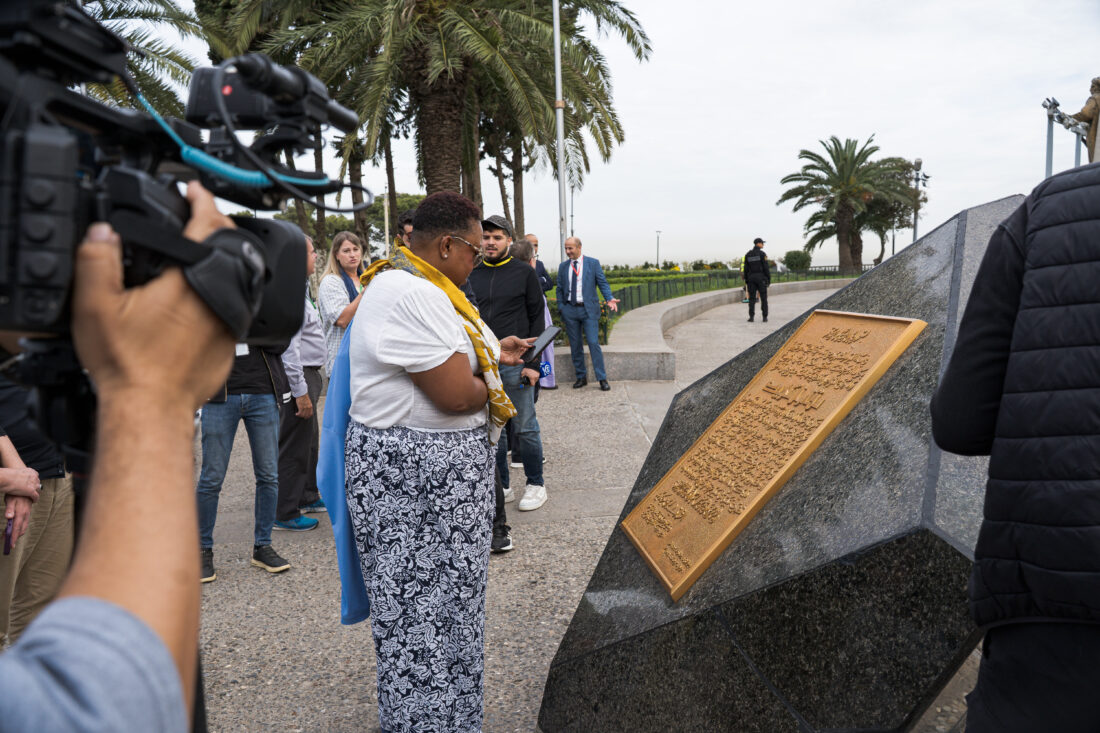
photo by: City of Lawrence
City Commissioner Amber Sellers looks at a plaque outside of the Maqam Echahid, or Martyrs’ Memorial, in Algiers in November 2026.
Kindness begets kindness
Al-Ghafry told one of the internal affairs officials he met on the trip, “Wow, you guys are treating us like royalty.”
The gifts, the food, the sights, the celebrity treatment might seem a little gratuitous to an American. But he thinks the Algerians didn’t see it that way.
He believes that Algeria’s World Cup experience could have gone much differently if the national team had chosen a different city, or if Lawrence hadn’t done all that it did to welcome the team and its fans. During the tournament, Al-Ghafry was still working in the Dallas-Fort Worth metro area, which hosted the teams from Sweden and Czechia, and he knows that there was sometimes tension between the teams and local officials.
“Not every experience is a pleasant experience,” he said.
The Algerians paid attention to how Lawrence treated them, he and Finkeldei said. Lawrence’s representatives weren’t just guests of honor – they were people whom ordinary Algerians recognized and wanted to meet.
Even before they got to the country and were surrounded by officials and press, they were recognized. When they stopped in Montreal, which has a sizable Algerian diaspora community, before the transatlantic flight, Finkeldei said there were people in the airport who’d seen them before. “We had people talking to us in Montreal, wanting to take pictures with us, knowing who we were,” Finkeldei said. The flight attendants on the plane recognized them.
“Everyone I met, the first words out of their mouth was ‘Thank you,'” Finkeldei said. “‘Thank you for what you did, thank you for your community.’ They really felt that.”
The fashion designer who took the selfie with him, Finkeldei said, seemed excited to meet the mayor of Lawrence. “It wasn’t like someone ordered him to be there and do this.” The musicians seemed excited to play for them.
“They wanted to thank us, each of them individually,” he said.
Al-Ghafry says that there’s a verse in the Quran about this. First, he recites it in his native Arabic, then he translates it – “An act of kindness wouldn’t be treated otherwise than with another act of kindness.”
“Meaning, what Lawrence did to them, would you treat it any other way?”
And he thinks this reciprocity isn’t something that happens just once and then fades away.
“An act of kindness,” he said, “brings in an act of kindness, brings in an act of kindness. And it goes on.”
City Government
How Algeria ‘rolled out the red carpet’ for Lawrence leaders, and what that could mean for the future
Reconfiguration of southern Massachusetts Street set to begin soon; drivers should watch for utility work, city says
Lawrence city leaders signal support for Aldi incentive; final vote postponed because of public notice error
Lawrence city staff says a 6-month tobacco license pause will be enough to craft new rules, and commissioners approve it
Proposed Aldi store in northwest Lawrence receives approvals from Planning Commission; City Commission to vote on incentive soon