
Opinion: Many Lawrence shops charge extra sales tax but don’t have a sign alerting customers, despite city policy
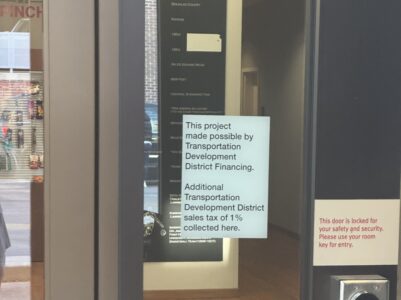
photo by: Chad Lawhorn/Journal-World
A city-required sign alerting shoppers to a special sales tax is shown at the Marriott hotel at Ninth and New Hampshire streets on Nov. 20, 2026.
It sure seems like an odd time for the Lawrence City Commission to be supportive of an idea that raises the cost of groceries. Elections across the state and country seemed to send a loud message that voters expect government to do its part to make the necessities of life more affordable.
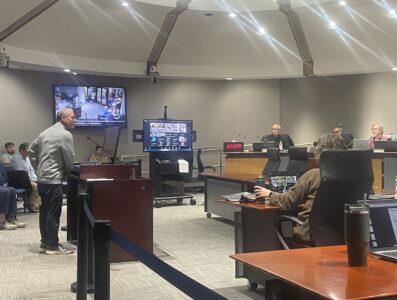
City commissioners this week, however, gave preliminary approval to a plan that would allow a proposed Aldi’s grocery store in northwest Lawrence to charge a special 1% sales tax. In other words, shoppers at the store would pay a sales tax rate 1% more than the city’s standard rate. The tax proceeds would be used by the developers to install public infrastructure, arguably making the store more feasible to construct.
Opinion

Chad Lawhorn
Editor & Publisher
Have your own take? Send 250 words or less to letters@ljworld.com.
Have a column idea or a tip for Chad to investigate?
Send a message to clawhorn@ljworld.com.
You know what? I’m generally fine with that type of arrangement. Taxpayers aren’t being asked to give up any future tax revenues. Rather, the business is taking the risk that its customers will be willing to pay a higher tax, presumably for the convenience of having a store at that location. A vacant lot that pays next to nothing in property taxes gets converted into a commercial enterprise that will pay hundreds of thousands in property taxes. Hopefully that helps reduce the property tax burden on ordinary residents.
But here’s the thing: For this bargain to be fair, shoppers must know they are paying the extra tax.
There was a time that Lawrence city commissioners agreed with that sentiment. All the way back in 2011, commissioners approved a resolution requiring any business that charges the special tax — either through a Community Improvement District tax or it cousin known as a Transportation Development District tax — to prominently display a sign at each entrance notifying shoppers of the tax. The regulation goes so far as to say the sign must be at least 8.5 inches by 11 inches and use an easy-to-read 30-point typeface.
Commissioners later repealed that ordinance and replaced it with a more comprehensive economic development policy, most recently in 2019. That economic development policy continues to reside on the economic development page of the city’s website. The policy includes the requirement for CID signage alerting shoppers of the special tax.
What doesn’t seem to exist is many signs.
I’ve been travelling the city this week looking for them. I have found one instance of the required sign being used — the Marriott hotel at Ninth and New Hampshire streets. I haven’t been to every impacted business, so maybe there are others. What I did find is a whole lot of businesses that charge a special tax but don’t have a sign.
Take the Bauer Farm development at the northeast corner of Sixth and Wakarusa, for example. That development has a grocery store, Sprouts, that charges a 1% tax, but there’s no sign there. The same for a tire shop, a drugstore, and a mobile phone store. Think of this for a moment: Some of those places are selling items that cost a thousand dollars or more. That’s at least an extra $10 you are paying in tax. In many cases — the tire shop, grocery and pharmacy are examples — there are literally businesses across the street selling the same product without the special tax. Do shoppers understand that?
The issue became much bigger earlier this year. On Jan. 1, the city’s largest ever Community Improvement District started charging a special tax. That district is the entire University of Kansas campus, including its West Campus property. The district was approved by the City Commission as part of the incentives package to help KU complete its renovation of the football stadium and the creation of a new conference and convention center.
The KU CID actually charges a 2% special tax. You are paying that when you buy concessions at the football stadium or at Allen Fieldhouse. Students are paying it when they buy textbooks at the Kansas Union or a soda at Wescoe Beach. I found no signs on the front doors of Allen Fieldhouse nor at the gates of the football stadium.
A technically separate but related district charges a 2% special tax at the new Dillons grocery store near 23rd and Iowa streets, which is located on land owned by the KU Endowment Association. The special tax would add $200 a year to the bill of a family that spends $200 a week on groceries. I found no sign at that Dillons store, nor at the The Olive Garden restaurant across the street that is in the same special taxing district.
I reached out to the city for an explanation, and a spokeswoman confirmed the policy is still active. She noted some special tax districts have been approved but aren’t yet collecting the tax — the Q39 restaurant district is an example — and thus don’t yet have to post a sign. But the KU districts are collecting the tax, and the spokeswoman made no mention of any exemptions from the signage requirements.
“We do monitor compliance annually and when we become aware of a business that is not meeting the signage requirements as outlined in the development agreement, we issue a notice and provide an opportunity to correct the violation,” Susie Carson, the city’s director of economic development told me via email.
For what it is worth, the Dillons store has been open since October 2025. The taxing district for KU campus began collecting taxes in January of this year. I plan to follow up on this issue in a couple of weeks to see if KU properties have started posting signs. I also may seek to get clarity on whether some of the city’s oldest districts are required to comply with the policy. Bauer Farm, for example, started collecting special taxes in 2009, which was a couple of years before the city passed its policy. It is unclear to me whether the policy can be applied to districts created prior to the policy’s approval.
Some of you may be confused because you remember that the state of Kansas eliminated the sales tax on groceries a couple of years ago. That’s true. The state no longer charges a sales tax on grocery items. But the state law also says that if a city or county charges a local sales tax, it must continue to charge that sales tax on groceries. So, when you buy groceries, none of your sales tax dollars go to the state, but they do continue to go to the city and the county.
At one point, Lawrence — generally considered the most liberal town in Kansas — was full of people who believed making people pay a tax on necessities like groceries was the prime example of regressive, improper taxation of the low income. If the Aldi’s proposal is given final approval in the coming weeks, the city will have agreed to let at least three grocery stores charge special taxes.
Again, I’m not arguing against the idea of CID taxes. If there is good transparency, I think they can be an elegant development incentive. I do wonder if such a tax is a misread of the public’s mood currently, but that’s neither here nor there.
Having some signs to read here and now, though, would be good.
City Government
Opinion: Many Lawrence shops charge extra sales tax but don’t have a sign alerting customers, despite city policy
How Algeria ‘rolled out the red carpet’ for Lawrence leaders, and what that could mean for the future
Reconfiguration of southern Massachusetts Street set to begin soon; drivers should watch for utility work, city says
Lawrence city leaders signal support for Aldi incentive; final vote postponed because of public notice error
Lawrence city staff says a 6-month tobacco license pause will be enough to craft new rules, and commissioners approve it