
Housing Stabilization Collaborative’s request for city trust fund aid won’t be considered because it was filed late
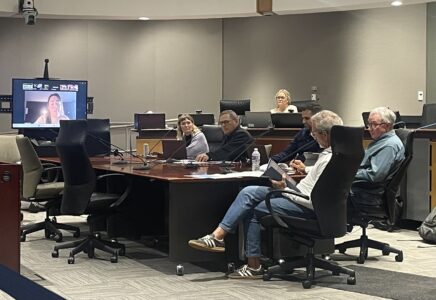
photo by: Sylas May/Journal-World
The Affordable Housing Advisory Board meets on Oct. 14, 2026, at Lawrence City Hall
Lawrence’s affordable housing advisers won’t be considering the Douglas County Housing Stabilization Collaborative’s request for city funding for 2027 – not because they don’t want to fund it, but because its application came in too late.
The Housing Stabilization Collaborative, or HSC, was created during the COVID-19 pandemic to provide rent and utility assistance to low-income residents, and it had requested $350,000 from the city’s Affordable Housing Trust Fund for next year. But, because of an oversight by county staff, its application was submitted on Sept. 11, seven days after the deadline for funding applications.
And on Wednesday, the Affordable Housing Advisory Board, which makes the recommendations on which projects the trust should fund, voted 4-3 not to consider the application for funding. Board Chair Mariel Ferreiro and members Faith Lopez and Donnavan Dillon were the three dissenting votes.
In a memo to the board explaining the situation, Affordable Housing Administrator Lea Roselyn wrote that the county notified city staff on Sept. 9 that it had accidentally overlooked the deadline, and submitted the application two days later. City staff then told the county that it would be up to the board to decide what to do with the application.
On Wednesday, Assistant County Administrator Jill Jolicoeur urged the board to consider the application anyway. She said the county had consistently met its deadlines and reporting requirements in past funding cycles.
“Precedent, that’s really important, but I’d say our track record has been consistent,” Jolicoeur told the board. “… We do not have a backup plan for this funding.”
As the Journal-World has reported, HSC has already had to scale back its operations in recent years and change how it distributes assistance because of a decline in city funding.
Originally, HSC relied on COVID funding, but it now uses funding from both Douglas County and the city’s housing trust. The county funding for the HSC has remained consistent at $330,000 a year for the past few years. But the award from the city’s Affordable Housing Trust Fund went down in both 2025 and 2026 because the trust had less money to distribute. In 2025, it fell from $509,000 to $200,000, and in 2026 it fell again, to $150,000.
When pandemic aid ran out, HSC had to change its operations from a first-come, first-served approach to a lottery system with distributions of funding twice a month. Then,in 2025, it reduced the lotteries to once per month and limited eligibility to households with active eviction notices or disconnected utilities. And this year, it replaced the lottery with rolling, need-based allocations that give priority to demographic groups most at risk of housing instability, such as people on fixed incomes and single-parent households.
Roselyn said that both the city and the county were invested in HSC’s success. “We’re very close partners with the county, and we all want to see this program succeed,” she said.
But, at the same time, she said that there was “ample notice” of the deadline, which was communicated to potential applicants through news releases, meetings and other means. And, even on the application itself, “it’s clearly stated that applications submitted past the deadline will not be accepted.”
“I’m personally a rule follower, and as much as I hate to say it, I think we’d set a somewhat questionable precedent if we accept late applications,” board member Monte Soukup said.
Board member Matthew Pauly agreed: “It sucks, but the reality is if we don’t draw the line, we’re going to be back here year after year after year.”
But Lopez thought the HSC’s consistency should count for something. “It’s not some new developer that’s coming into town,” Lopez said. And Dillon thought not considering the application “would set the work that we’re doing as a board back.”
Ferreiro, meanwhile, said the larger problem was that the trust fund – which is also used for one-time allocations for affordable housing construction and rehabilitation projects – wasn’t a good mechanism to allocate city funding for this program.
“I just have to voice an incredible amount of frustration I have with the city,” Ferreiro said.
The county includes the HSC funding as a line item in its budget, and the fact that the city doesn’t do the same thing “consistently puts this board, this trust fund in a very difficult position,” she said. “We’re not able to see our city leadership do what I think is the responsible thing, which is create a budget line item for this and fund it that way.”
Before the meeting ended, Soukup suggested creating a statement for the City Commission explaining the situation and the importance of funding the program, and the board agreed. But board member Mark Buhler said that he didn’t want it to come off as demonizing the city or the county.
“I think we should make a statement for good things, and that program is a good thing,” he said. “But to pick the villain, I’m not about that.”
City Government
Housing Stabilization Collaborative’s request for city trust fund aid won’t be considered because it was filed late

On sister city visit, delegates from Hiratsuka, Japan, see Lawrence’s friendship firsthand

Voters Guide: Lawrence voters will decide whether to raise transit sales tax
Lawrence City Commission agrees that Costco shouldn’t be in STAR bond district
Lawrence City Commission to weigh whether Costco should be included in STAR bond district