
Lawrence Transit sales tax increase passes; mayor says he appreciates voters’ support
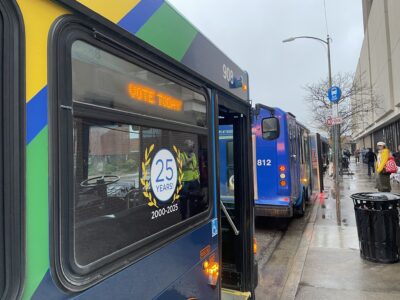
photo by: Sylas May/Journal-World
A sign on a Lawrence Transit bus reminds people to vote on Election Day, Tuesday, Nov. 3, 2026, in the 700 block of Vermont Street.
Voters have passed an increase in the sales tax that funds Lawrence’s bus system, according to unofficial election results Tuesday night.
As of around 9:45 p.m. Tuesday, with 100% of precincts reporting in Douglas County, voters in Lawrence were split about 56% yes and 44% no on the tax question, which asked voters whether to raise the transit sales tax from 0.2% to 0.3% next spring and extend it for 10 years.
That’s not as large a margin as previous votes on the transit sales tax – the last time it was on the ballot, in 2017, it passed with about 70% of the vote. But Mayor Brad Finkeldei said Tuesday that he was pleased with the results.
“It’s certainly a big night for the city,” Finkeldei said. “It’s the third time the voters have approved this sales tax, and you know, obviously this time it’s a slight increase, but it’s necessary to keep the current service level and look for ways to expand it.”
The tax, which Lawrence Transit depends on to fund its operations, was on track to sunset in 2029, and the transit system wanted the increase to help offset rising expenses. The question asked voters to raise it starting in April 2027 and extend it through March 31, 2037.
As the Journal-World has reported, the transit system’s costs have grown significantly over the past decade – in 2016, operating costs were $5.8 million, but by 2025 they had grown to $11.1 million. And Lawrence Transit officials expect that trend will continue in the next few years, with less money coming in from the federal government and with the system’s contract with its service provider up for renewal in 2029.
The transit system has also been spending down hundreds of thousands of dollars of its savings, and it projected that without the tax increase it would spend more than $500,000 of savings in 2027, more than $600,000 in 2028 and about $2.5 million in 2029.
Although Lawrence Transit does not charge fares for its fixed-route bus service, the city has said that bringing back fares would not generate enough revenue on its own to make the system sustainable.
With the additional revenue, the department hopes to build a cushion for the more expensive years it expects down the road. Transit staff has also said the tax increase would help fund the city’s downtown bus station project, which city leaders chose a site for in 2024. Construction has not begun yet on that project, which would be in what’s currently a parking lot in the 700 block of Vermont Street, but Finkeldei said he expected that when it was finished, it would get more people riding the bus.
“The ability to have a downtown station, however it finally looks, up and running, and being able to sustain our on-demand services as well as our routes, will lead to increased ridership,” he said.
Lawrence Transit’s ridership has declined in 2024 and 2025, something city staff and Finkeldei attribute to the time it takes riders to adjust to redesigned routes.
“We changed our routes a little bit a couple of years ago and saw a slight decrease in ridership,” Finkeldei said. “But I think that as we work through that and as we can now focus on the next 10 years of support for the program, we can hone in on that and find the right routes and find the right balance that should increase ridership.”
The city government had been discussing the sales tax for months as part of its budget conversations, and Finkeldei, who presided over those discussions as mayor, wanted to thank the community for its support of the transit system.
“It certainly sets us apart from some other cities our size to be able to have this service, and it’s also a great tie for us and KU, so I appreciate the city’s support on this,” he said.
City Government
Lawrence Transit sales tax increase passes; mayor says he appreciates voters’ support
Lawrence City Commission OKs up to $100M in bonds for second phase of KU’s Gateway project
Lawrence city leaders to vote on issuing bonds for KU’s Gateway project
Douglas County sees nearly 18,000 in-person advance voters; here’s what to know ahead of Election Day

Opinion: Why should the sales tax to support public transit increase when ridership on the system is decreasing?