Health savings accounts, LMH partnership among potential remedies for City of Lawrence’s ailing healthcare fund
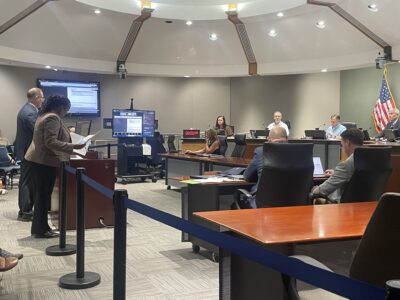
photo by: Sylas May/Journal-World
Consultant Zach Besheer, left, and human resources director Shakeva Christian, second from left, address the Lawrence City Commission on Tuesday, Aug. 18, 2026.
Early in the 2027 budget process, Lawrence’s employee healthcare plan got a worrying diagnosis – the fund used to pay out benefits wasn’t sustainable.
City commissioners have known that for a while; in the city manager’s recommended budget that was released earlier this summer, about half of the $15 million in new spending on compensation and benefits would go toward shoring up the healthcare fund.
But this week, they discussed some other treatment options that might be less bitter to swallow – things like shaking up the network of providers, offering health savings accounts, and making a special agreement with LMH Health.
At its meeting on Tuesday, the commission heard from human resources director Shakeva Christian and benefits broker Arthur J. Gallagher & Co., who have been working on those issues for several months. “Currently, our healthcare fund is kind of unstable, and there’s a lot of things that have caused us to get there,” Christian said.
The city’s health care plan is self-funded, meaning that for the most part, it pays for claims out of its own funds. It does have “stop-loss” insurance that helps insulate it from the largest claims – if a claim is over $125,000, the stop-loss insurance pays any cost above that.
But city leaders have said that the costs of healthcare are rising, and that the city has been spending down its fund balance to cover those increased expenses.
By Gallagher’s projections, the city’s 2026 healthcare expenditures are on track to end the year more than $700,000 over budget. That would require the city at the end of the year to again dip into the balance of the healthcare fund to cover the excess, budget strategy and performance director Alley Porter told the commission. (It doesn’t come out of the city’s general fund, she said.)
The city’s budget process is still ongoing, with adoption slated for Sept. 15, and Christian said the details of potential changes would be coming back to the commission soon. A report to the commission ahead of the meeting said they could include adjustments to deductibles, co-pays and premiums. But on Tuesday, Gallagher consultant Zach Besheer said there could be bigger changes, too, and some of them might give employees new options in addition to saving the city money.
Health savings accounts
One such change could be a high-deductible plan with a health savings account, or HSA.
HSAs allow people to set aside money, before tax, to pay for future medical expenses. They can also invest that money, and, past age 65, they can withdraw it for anything, not just medical care, although non-medical withdrawals are taxable at that point.
Besheer said these types of plans are especially appealing to younger workers, who typically use less healthcare, and to higher earners, who may see them as a longer-term investment.
“Either you can use those funds for medical costs, or you can save those funds and invest those funds for your future,” he said.
If the city were to create a high-deductible plan with an HSA, Besheer said it could set a premium that would be much lower than a more traditional health insurance plan to encourage employees to switch.
Sometimes, employers also make contributions to their employees’ accounts as an added incentive. Besheer said any decision like that would be up to city leaders, but that the “benchmark” for other government employers was about a $500-per-year contribution for plans that just cover the employee, and about $1,000 per year for those that cover an employee and their family.
Mayor Brad Finkeldei said he’d seen a positive response to health savings accounts at his own workplace, the law firm Stevens & Brand.
“At my office, we offer an HSA plan, and it’s chosen by about 70% of our employees, and it saves us money,” Finkeldei said.
Shaking up the network
Although Lawrence’s healthcare plan is self-funded, it still uses a major insurer, Aetna, to actually administer the plan. Aetna is what’s called a “third-party administrator” for the city, which means the city pays it a fee to process its claims.
“The insurance company’s not paying those claims; you’re paying those claims,” Besheer explained to the City Commission. “They’re just taking the bills and paying the bills on your behalf.”
But Aetna also provides other services to the city as part of a bundled package, he said, including acting as a pharmacy benefit manager – the middleman between the city and drug manufacturers and pharmacies. And Besheer said changing that arrangement could open up new savings.
“If we unbundle those with a different insurance carrier and a different pharmacy benefit manager and a different stop-loss carrier, we’re able to actually make a greater impact to the cost savings,” Besheer said.
Besheer said unbundling would allow Lawrence to customize its network of healthcare providers a lot more. “Right now, employees can go to any pharmacy they want to within the Aetna network and get very high-cost drugs. They could be $10,000 per month or $20,000 per month,” he said.
But if the city could change the network, it could exclude higher-cost providers, and still get people those drugs in other ways, Besheer said.
“If we carve out that plan, they’re still able to receive those medications, but we’re able to reduce the cost of those claims through patient assistance programs, through manufacturers, the distributors of those medications,” he said.
Weight-loss drugs
One category of treatments where the city could see savings, Besheer said, is “GLP-1” weight-loss medications, a category that includes drugs like Ozempic and Wegovy. He said the city’s plan spent about $1.7 million on weight loss drugs last year.
If an employee gets GLP-1 medications through the city’s plan, he said, they cost the city between $12,000 and $15,000 per year, “but they’re significantly less than that if they’re carved out of the plan and the employee pays those costs themselves.”
While he didn’t share many details, he said it might be possible to have an arrangement where employees pay for these drugs on their own, but with a discount of some sort: “The city will still offer those same services, but through a cash basis; those employees will pay for those on their own at a significantly reduced rate.”
He didn’t say how much those out-out-pocket costs might be, but GLP-1 medications seem to have a wide range of costs. Forbes published an article in June that said that the list price can be as low as $149 a month for some of them, such as the pill form of Wegovy, and well over $1,000 a month for others.
A deal with LMH
Another idea Besheer had was a special arrangement with LMH Health. “If your employees do go to LMH Health, we will negotiate a cost savings,” he said.
Besheer noted that, as one of the largest employers in the area that LMH Health serves, the city had a lot of room to negotiate. He said the city had about 1,000 employees total and about 750 on the plan.
“For LMH Health, we do have the ability to say, ‘We have this many members and families that are in Lawrence.’ If we say that ‘we’re going to offer an incentive – perhaps a smaller co-payment or co-insurance – and then you’ll in return offer a discount to the city,’ then we’re able to negotiate with LMH Health.”
Vice Mayor Mike Courtney asked whether it might be possible to negotiate agreements with hospitals in the greater Kansas City area, as well. Besheer said that would be more difficult, because the city didn’t have the same “purchasing power” in communities farther afield.
“It’s possible; it’s not probable,” he said.
Besheer said the LMH arrangements weren’t just an idea; discussions were already underway.
“We’ve already started those conversations with LMH Health, and they’re very interested in talking with the city about their relationship,” he said.
City Government

Opinion: Local government made a small mistake. Taxpayers shouldn’t be on the hook to fix it

As club cancels ‘Beetlejuice’ screening at Oak Hill, city says there are no specific rules about events at cemeteries

Opinion: An $80 million Hail Mary that combines Costco and Lawrence’s love of trails

Lawrence Police Department receives KDOT’s top traffic safety award for second straight year
Lawrence City Commission approves extra layers of oversight for data centers, asks for patience on further regulations