Lawrence’s climate policy has lacked an ‘action plan’ for years, sustainability advisers hear
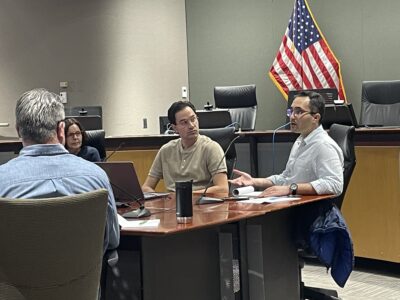
photo by: Sylas May/Journal-World
Mohsen Fatemi, right, discusses his proposal to amend a city sustainability ordinance with the rest of the Environmental Sustainability Advisory Board on Thursday, Feb. 26, 2026 at City Hall. Also pictured, from left, are board members Joe Fearn, Nancy Muma and Patrick Ross.
“Currently, there is not a laid-out strategy that the city has adopted to reach those next goals.”
Those words were spoken by the city-county sustainability director back in 2019 about Lawrence’s plan for reducing greenhouse gas emissions. But they might as well have been said by the Environmental Sustainability Advisory Board just this week in its discussion of what to do with the city’s clean energy ordinance.
“They passed this great law,” said board member Joshua Roundy at the board’s meeting on Thursday. “But they didn’t have any action items to do it or resources to make it happen.”
As the board heard, the city’s conversation about improving its climate policies is a long one, one that’s gone on for decades.
The ordinance at issue right now is called Ordinance 9744, and when it was passed in 2020, it set a goal for 100% renewable energy in all city operations by 2025 and 100% renewable energy citywide – including in private homes and businesses – by 2035. When the end of 2025 arrived, as the Journal-World reported, the city was powering only 3% of its operations with clean energy sources.
At its meeting on Thursday, the board reached a consensus on what it would like the city to do now: amend Ordinance 9744 and make it more focused on concrete, “actionable” steps. The board doesn’t have the power to do that itself, but it can recommend strategies that it would like the City Commission to implement.
“We’ve got to do more than just say we’re going to follow it,” board member Nancy Muma said of Ordinance 9744. “We’ve got to have some teeth.”
The idea of amending the ordinance was proposed by board member Mohsen Fatemi. He preferred that over city staff’s idea to repeal the ordinance entirely and replace it with a goal of being “climate neutral” by 2050. This would basically duplicate something in Douglas County’s “higher-level” climate plan, he said, and it wouldn’t help hold the city accountable.
Fatemi said he thought the city had the right idea in its goal of 100% clean energy; what was missing was the execution.
“I think this is a valuable goal that the city has had and adopted,” he said. “The decision to repeal the policy would mean that we don’t want to pursue this goal.”
•••
Both Fatemi and new board member Patrick Ross said this was an opportunity to revisit Ordinance 9744 and see, after five years, what went wrong.
But they also heard that they may need to look even further back – perhaps 17 years back.
Kay Johnson, a former Sustainability Advisory Board member, spoke to the board on Thursday night and said there was something missing from their conversation – what happened with the city’s old Climate Protection Plan.
That plan was adopted by the City Commission in 2009 and had goals such as reducing the city’s greenhouse gas emissions by 30% by 2020 and 50% by 2030.
As the Journal-World reported, there was some progress toward those goals in the first years. Between the plan’s baseline year of 2005 and 2017, for instance, the city’s emissions had gone down by 27%, approaching the 30% target reduction for 2020. But the sustainability director at the time, Jasmin Moore, said that most of that was due to utilities “changing their energy mix,” that all of the easiest ways for the city itself to cut emissions had already been done, and that the targets would get tougher to hit from there.
Moore was the one who said there wasn’t a strategy back in 2019 – a concern much like Fatemi’s concern now. Like Fatemi, she also wanted the city to “continue to be bold” and set big goals in its climate policy.
The advisory board in 2019 agreed. It sent a memo to then-Mayor Lisa Larsen, the rest of the City Commission and then-City Manager Tom Markus telling them to treat the climate plan as “a top priority in all City functions.”
That memo contains the seeds of the climate ordinance, including the call for 100% renewable energy in all city functions by 2025. But it also proposed stronger accountability mechanisms and dedicated funding.
The board recommended that $100,000 be allocated for research to update the Climate Protection Plan with “actionable steps that can be taken during a ten year horizon.” It wanted regular reviews and reports to the City Commission (something Fatemi’s proposal also includes). And it wanted one or more of its members to be appointed as “stewards of the plan” to work closely with city staff on implementing and monitoring it.
After that, Johnson said, a lot of other things intervened.
One of them was COVID, which shook up the city government’s operations in many ways. But there was also the city’s strategic plan process, in which some of the things the board proposed were “piecemealed” into the broader strategic plan, rather than forming part of a dedicated climate plan. She also said this was around the time that the city and county, which previously had a joint sustainability office, decided to split that office up.
“Long and short of it, some things got lost,” Johnson said. “The city did not develop its own action plan.”
Even more could get lost if the ordinance were completely repealed, Johnson said. It’s referred to in other city planning documents, such as transportation plans that deal with electric buses, for instance.
•••
The Sustainability Advisory Board members agreed Thursday that they were interested in recommending an amendment. But they’ll still have to figure out what exactly that looks like. The City Commission won’t be discussing the sustainability goals until mid-April, said Sustainability Director Kathy Richardson, so there would be time for them to come up with ideas and send them to the commission.
Some members of the board wanted to get commissioners involved in the conversation sooner. Ross suggested bringing in Mayor Brad Finkeldei and City Commissioner Mike Dever to a future meeting to talk about the ordinance with the board. In addition to being Lawrence’s last mayor, Dever was also the mayor in 2008 and launched a Climate Protection Task Force that led to the development of the 2009 plan.
“Let’s get our last mayor and the current mayor talking about climate change and renewable energy and efficiency,” Ross said. “That sounds like a great discussion.”
As for what the “teeth” of the amended ordinance might be, the board members had several suggestions.
Chris Reiner said the ordinance could specify how much money the city had to put toward climate protection, “You have to make a financial commitment to actually pursue this,” he said. Muma suggested there could be someone responsible for seeking out climate grants or calculating cost savings from energy efficiency improvements.
Fatemi, in his sketch of an amended ordinance, also envisioned a dashboard to share data with the public, and Reiner agreed that some kind of “transparency tracker” was needed.
But bigger than all these goals was the goal of bringing accountability to the city’s climate plans, and Johnson urged them to keep working toward that.
“The whole thing is not an easy thing,” she told them. “… It’s not just the will. You may have the will to do it, but you’ve got to have the resources to do it. So the city does have to be held accountable for providing those resources.”
City Government
Lawrence City Commission to weigh whether Costco should be included in STAR bond district
As they approve bikes plan, Lawrence city leaders ask about data collection, Kentucky and Tennessee streets
Lawrence city leaders want to toughen tobacco licensing rules ‘sooner than later’
Algerian government invites Mayor Brad Finkeldei, Lawrence delegation for a visit
Construction on Wakarusa Drive to resume; city manager says KDOT’s secretary has apologized for delay