

City of Lawrence enters negotiations with a city manager candidate; announcement could come next week
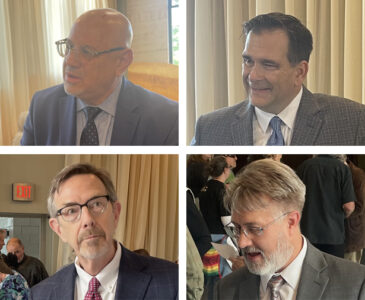
photo by: Sylas May/Journal-World
Clockwise from top left are Lawrence city manager candidates Majed Al-Ghafry, Joe Fivas, Michael Kovacs and Joe Lessard, pictured at a meet-and-greet event on Wednesday, May 20, 2026.
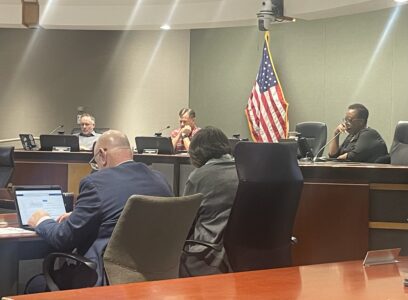
Lawrence city commissioners voted Friday morning to enter contract negotiations with a city manager candidate, but which one won’t be revealed for a few more days yet.
The vote was taken in a special meeting that lasted about a minute; the commission did not name the candidate the city would be negotiating with. Mayor Brad Finkeldei told the Journal-World afterward that another special meeting would likely be called next week to approve a contract and announce the hire.
For about a month, the commission has been evaluating candidates to succeed the previous city manager, Craig Owens. They started with a pool of 60 candidates, which they gradually narrowed down to five; one of them, David Vela, then dropped out of consideration.
This week was dedicated to in-person interactions with the four remaining finalists: Majed Al-Ghafry, Joe Fivas, Michael Kovacs and Joe Lessard. On Wednesday, the finalists took a tour of the city and introduced themselves to residents at a public meet-and-greet, and on Thursday the City Commission met for a daylong closed executive session to conduct in-person interviews with them.
Whichever candidate is chosen, running Lawrence will be a big change from their most recent city management experience. All four finalists’ most recent experience is in cities much smaller than Lawrence, and three of the four are now managing suburban communities within a larger city’s metro area.
Al-Ghafry and Kovacs are both managers of suburbs in the Dallas metro area. Al-Ghafry manages DeSoto, Texas, with a population of around 50,000, and Kovacs manages Fate, Texas, with around 23,000 people. Fivas manages Cleveland, Tennessee, which has about 50,000 people and is about 10 miles outside of Chattanooga, a city roughly twice the size of Lawrence.
Lessard, who currently works as an independent consultant, was most recently city manager of Ashland, Oregon, which has about 20,000 people. It’s not near any major urban areas; the closest city with more than 100,000 people is Eugene, Oregon, which is more than 100 miles away.
Doug Thomas is a consultant from the search firm the city worked with, Strategic Government Relations. In a search for a job like Lawrence’s, city managers with experience leading larger organizations can be difficult to find, he said.
“Part of that is the fact that as you become larger … there’s fewer and fewer city managers that have managed those organizations,” Thomas said. “You often, as you get to 100,000 or 200,000 (population) or larger, the pool of people that have been in management running those types of (complex) organizations are smaller.”
Another big difference is that none of the candidates comes from a city with a major university. However, one of them currently works for a city with multiple smaller higher education institutions, and the others have all been in leadership positions in cities with colleges or universities in the past.
Cleveland, where Fivas is manager, is home to a community college and a private Christian university called Lee University with about 3,800 students. Al-Ghafry was previously the assistant city manager and chief economic development officer of Dallas, which is home to about a dozen higher education institutions, and he’s taught as an adjunct professor of civil engineering at the nearby University of Texas at Arlington. Two of Lessard’s previous stops had colleges or universities — Ashland has Southern Oregon University with about 5,300 students, and Lessard in the 1990s was assistant city manager of Austin, Texas, home to the University of Texas System’s flagship institution. And Kovacs was once the manager of Galveston, Texas, which has the University of Texas Medical Branch campus, a junior college and a branch of Texas A&M University.
Thomas said that as part of the City Commission’s review of candidates, “town-gown relations were certainly a major factor.”
“Most of these candidates have some involvement with universities in previous or current positions,” Thomas said. “They may not be the same scale and scope, but they certainly bring that to the table.”
The search was also looking for someone with economic development experience, Thomas said. Commissioners wanted someone who could help diversify Lawrence’s tax base.
“That’s a major concern,” Thomas said. “I know a good portion of your property taxes are tax-exempt; the college, the hospital, certainly the county operations. And I know economic diversification is a big issue, so that was another component.”
Another priority was finding people who were comfortable with community engagement and collaborating with other government entities, Thomas said. “You do an awful lot with your intergovernmental partners, the county, the school system and the university, and certainly with public-private partnerships with some of the economic development arenas as well.”
Some other considerations in the search process included experience in budgeting, local government finance and capital projects; homelessness issues; and strategic planning. The new city manager will be leading the development of the city’s next strategic plan, which informs many parts of local government operations and sets the city’s goals and performance metrics.
“I know your plan is wrapping up now,” Thomas said of the current strategic plan. “… So the timing of a new manager coming on board is pretty critical.”
City Government
As they approve bikes plan, Lawrence city leaders ask about data collection, Kentucky and Tennessee streets
Lawrence city leaders want to toughen tobacco licensing rules ‘sooner than later’
Algerian government invites Mayor Brad Finkeldei, Lawrence delegation for a visit
Construction on Wakarusa Drive to resume; city manager says KDOT’s secretary has apologized for delay
Evacuation drill planned Tuesday at Lawrence City Hall
