Lawrence city commissioners discuss slight mill levy increase for 2026 budget to restore public safety positions, subsidize rec center fees
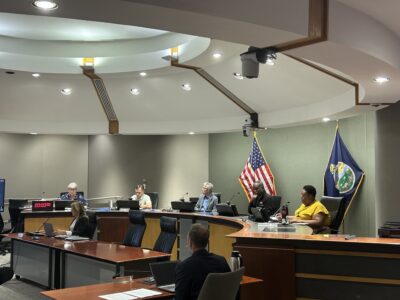
photo by: Bremen Keasey
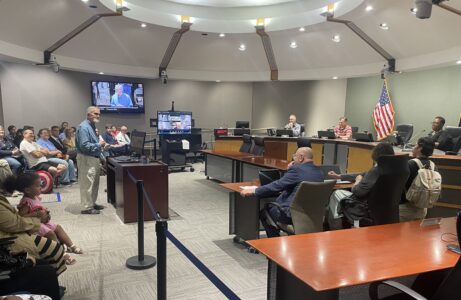
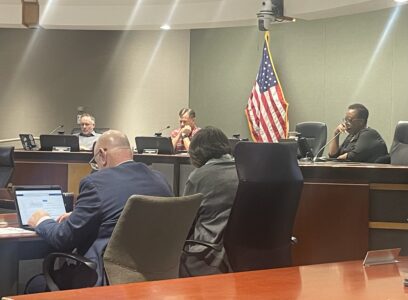
Lawrence City Commissioners held two public hearings about the 2026 budget, which included setting the revenue neutral rate and providing guidance to the city on final changes before the final vote Sept. 16.
To avoid some public safety cuts and waive rec center fees for youth and low-income residents, Lawrence city commissioners on Tuesday discussed setting the mill levy in the 2026 budget slightly above what city staff initially proposed.
On Tuesday, the commission held its public hearings on the 2026 budget, which they are expected to take a final vote on later this month. The city has been working to close a $6.6 million budget shortfall, and commissioners heard updates on — and comments from the public about — two of the big issues in this year’s budget cycle: Lawrence-Douglas County Fire Medical staffing and proposed entry fees at the city’s rec centers.
Budget manager Alley Porter presented the updated budget to commissioners and briefed them on changes in these two areas. In the updated budget, rec center fees would be cut in half from the previous proposal, and the Fire Medical department would be able to reduce its staffing by just one position instead of three.
But the commissioners agreed that they would like to restore more than that, even if it meant a slight mill levy increase. The mill levy, or property tax rate, proposed in City Manager Craig Owens’ recommended budget was originally 33.186 mills. But Commissioner Brad Finkeldei proposed an increase of 0.32 mills over that recommendation, which would put the mill levy at 33.506 mills, and the other commissioners agreed city staff should look into it.
With that increase, the city would be able to add two police officer positions and one firefighter position that were not funded in the updated budget proposal and provide funds to help the Parks, Recreation and Culture Department keep rec center access free for youths and low-income residents. It would still be below what the city set as its maximum possible mill levy in July, 33.986 mills.
Rec center fees
The first proposal for rec center fees was presented to the commission in July, and at that time, they were listed at $25 a month or $250 a year for individual adult residents; $15 a month or $150 a year for residents ages 5 to 17 years old and ages 60 and older; and $40 a month or $400 a year for a family membership.
The commission wanted them to be lower, and the version that city staff came back with on Tuesday showed fees for Lawrence residents of $12 a month or $120 a year for adults, $8 a month or $80 a year for seniors, and $20 a month or $200 a year for families; fees for nonresidents would be higher.
Back in July, the commission also discussed the possibility of free access for youth and low-income residents. But Porter said on Tuesday that waiving these fees would mean about $50,000 less in revenue for the Parks, Recreation and Culture department.
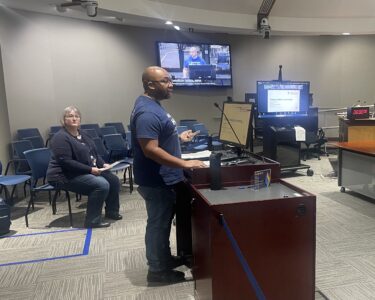
During the public hearing on the budget, more than a dozen residents spoke out against adding membership fees for the rec centers. Many argued the rec centers provided a health benefit to the people who use them, and that the city should not limit access to that. Some commenters also mentioned a petition calling on the city to maintain free access, which they said had gotten about 2,000 signatures.
Fire Medical staffing
For fire and medical, meanwhile, Porter said actions by Douglas County government would mean the cuts wouldn’t need to be as deep as originally proposed.
The initial proposal in July would have changed the minimum daily staffing of the fire and medical department from 39 people to 36, but Porter said Douglas County approved changes that added extra funding for LDCFM, meaning that the minimum staffing would decrease by just one, from 39 to 38.
A handful of people urged the commissioners during public comments to reconsider cuts and especially to prevent any fire engines from being sidelined because of a lack of staff. Seamus Albritton, the president of the union that represents Lawrence firefighters, said this budget would raise the possibility of removing one fire engine, and that would be a departure from past budget decisions.
Shaun Coffey, a former fire chief in Lawrence, said during public comments that the staffing cuts would equate to bringing some of the staffing levels to “1985 levels.” He called the cuts “unacceptable.”
A higher mill levy and the revenue-neutral rate
After the commission heard about these changes, Finkeldei suggested the increase of 0.32 mills from the initially proposed rate. He asked city staff to explore that increase to fund the addition of two police officers, one firefighter and add back in the $50,000 that Parks, Recreation and Culture would forgo by allowing free access for youth and lower-income Lawrence residents.
The other commissioners concurred that city staff should explore those options, but they also suggested exploring the costs for a few other additions. The city set its maximum mill levy in July at 33.986 mills, so it would still be possible for the commission to increase the rate more to fund more budget items.
Commissioners Bart Littlejohn and Amber Sellers asked city staff to explore adding about $25,000 for economic development. Sellers also suggested moving up funding allocated to a permanent site for the Lawrence Farmers Market in the city’s Capital Improvement Plan. And Commissioner Lisa Larsen asked the city to look at restoring around $20,000 in funds that help the neighborhood associations.
The commission did not make any final decisions on the 2026 budget on Tuesday — that final vote is expected to take place on Sept. 16. But the commission did take some procedural steps required under state law, including voting unanimously to exceed its revenue-neutral rate. The revenue-neutral rate is the mill levy required to raise the same amount of property tax revenue as the prior year, using the current year’s assessed valuation amount. That rate would be 31.379 mills, which is lower than what Owens had initially proposed.
The maximum mill levy of 33.986 mills would result in about a $25-a-year property tax increase for the owner of a $269,500 home in Lawrence — the median home value in 2023 — according to calculations by Porter.
• • •
In other business, commissioners unanimously voted to approve a site plan for a development that would build 15 row houses on a vacant downtown Lawrence parking lot at 700 New Hampshire St.
The plans for the row house were first filed in January by local businessman Adam Williams, as the Journal-World reported. The three-story building would be constructed on the parking lot of the former Borders, which closed in 2011. It would include 15 2,353-square-foot units that would have a one-car garage on the ground floor.
The site plan for the project was administratively approved by city staff on July 22. But the commission’s vote was necessary because nearby property owners who have concerns about the project appealed that approval, citing concerns that the site plan does not comply with the code.
Nearly a dozen commenters voiced opposition to the project during public comments. They had concerns on how it could negatively impact the historic nature of the neighborhood, and some said they thought the project was too big.
Paul Werner, an architect representing the developer, said the project would develop an unused site that has been vacant for around 12 years. Additionally, the appeal was based solely on the details of the site plan, not on a historic preservation concern. Werner said the project already was reviewed three times by the Historic Resources Commission, which eventually recommended its approval in May, as the Journal-World reported, and its consideration tonight was solely about the site plan.
“Not liking (the project) doesn’t mean the project is not allowed,” Werner said.
Larsen asked city staff members, including Sandy Day, a city planner, and Randy Larkin, the deputy city attorney, a series of questions about whether the concerns the public brought up meant the site plan did not fit the city’s code. For each answer, the city staff said the site plan still met the code’s requirements, which meant the commission had to approve it. Ahead of the public discussion, Larkin said the City Commission could only base its vote on whether the project met the guidelines, and did not have any discretion on this item.
City Government
Lawrence City Commission to weigh whether Costco should be included in STAR bond district
As they approve bikes plan, Lawrence city leaders ask about data collection, Kentucky and Tennessee streets
Lawrence city leaders want to toughen tobacco licensing rules ‘sooner than later’
Algerian government invites Mayor Brad Finkeldei, Lawrence delegation for a visit
Construction on Wakarusa Drive to resume; city manager says KDOT’s secretary has apologized for delay