Rape victims express dismay with DA’s office, Project for Innocence after rapist’s sentence is drastically reduced without their being notified
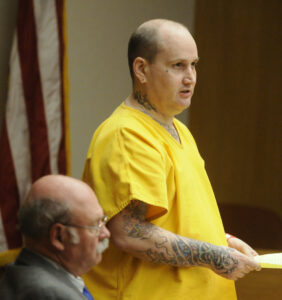
photo by: Journal-World File
Cory Elkins addresses the judge in Douglas County District Court during his sentencing in a rape case in 2008.
Two Lawrence-based entities are facing criticism in connection with a brutal rape case in which the rapist’s sentence was reduced by 30 years and victims contend that they weren’t notified.
The Douglas County District Attorney’s Office and the University of Kansas Law School Project for Innocence and Post Conviction Remedies are both facing questions after the sentence of rapist Cory Elkins, who was convicted of four counts of rape and three counts of aggravated criminal sodomy, was drastically reduced in 2021 by Douglas County District Court Judge Stacey Donovan.
Elkins, now 54, was convicted in 2008 for multiple rapes that occurred in the 1990s and was sentenced to 48 years in prison. He is now slated to serve 18 years instead and could go free in 2025.
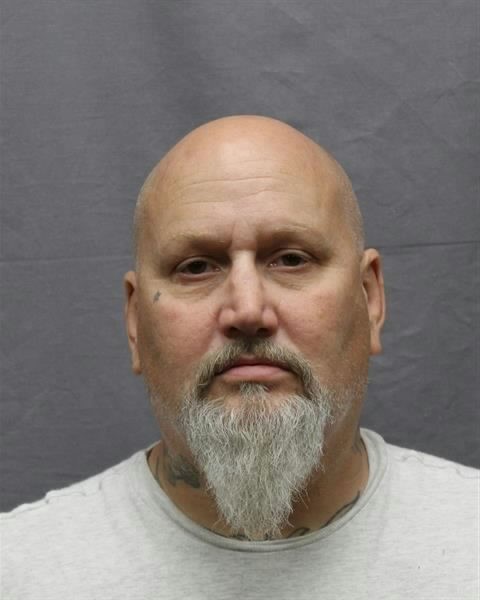
photo by: Kansas Department of Corrections
Cory Elkins in 2022
The women who were raped by Elkins told KMBC 9 News that they were never notified about hearings related to the resentencing or about the much earlier release date. One of the women said she found out only by checking the Kansas Department of Corrections website. The women told KMBC that they were “dumbfounded” and “shocked.”
The sentencing was redone, according to court records, because an earlier conviction for burglary was misclassified, which incorrectly affected the criminal history score that was used in Elkins’ sentencing. The resentencing was pursued by KU’s Project for Innocence — which sparked questions from one rape victim about what the misclassified and unrelated burglary charge had to do with innocence. She told KMBC that she was disillusioned by KU’s choice to take on the case since Elkins’ innocence was not in question in the brutal rapes.
The women said the reason they were given for not being notified by the DA’s office is that the office didn’t want to “open old wounds.”
When contacted by the Journal-World Friday, Cheryl Cadue, the public information officer for the DA’s office, said in an email that the office’s usual practice was “to provide notifications in every case” unless the victims ask not to be notified.
“A victim’s wishes are taken into consideration with each prosecutorial decision made throughout a case,” she said.
In the Elkins resentencing, however, a rare exception was made to the usual practice, she said.
“The victim witness coordinator made an extraordinary exception by recommending that we not provide notifications out of concern that we would be retraumatizing the victims,” Cadue said in an email. “This was an unusual situation where the victim witness coordinator was the only staff member involved in the prosecution 15 years ago. For the now retired and highly regarded coordinator to make this atypical recommendation, we deferred to her judgement. And at resentencing, we successfully argued for the maximum possible sentence.”
Cadue added that the DA’s office had discussed the matter with one of the rape survivors over the past year and had “acknowledged her concerns” and apologized “for the trauma that she has suffered.”
“Listening to our survivors is critical to ensuring that they are not further victimized,” Cadue said.
As the Journal-World reported, a Douglas County jury in May 2008 convicted Elkins on four counts of rape and three counts of aggravated criminal sodomy in attacks on two women. A third woman said Elkins had also attacked her, but prosecutors, then under the direction of District Attorney Charles Branson, could not file charges because the statute of limitations for rape had expired.
A conviction eventually occurred largely due to the efforts of one of the women, who kept the case alive and contacted the state nine years after her rape to lobby for new DNA technology to be used on the evidence — technology she first learned about from an episode of Oprah Winfrey’s talk show. She said that Elkins broke into her Oread Neighborhood home in 1995 and assaulted her as she was sleeping.
Douglas County Judge Michael Malone sentenced Elkins to 48 years, the most severe sentence he could give under the Kansas sentencing guidelines.
Despite its more commonly known name, the Project for Innocence is actually called the Project for Innocence and Post Conviction Remedies.
The second half of that name is important, said Jean Phillips, the project’s director, who told the Journal-World that the project has a broader mission than demonstrating actual innocence.
The project, she said, “provides assistance to incarcerated persons with correcting errors in convictions and sentences. The sentence Mr. Elkins initially received violated state statutes and Kansas Supreme Court case law. Mr. Elkins’ current sentence is the maximum sentence permitted by state statute.”
Phillips explained that Elkins’ sentence was illegal because it classified a nonperson felony — the burglary — as a person felony, which bumped Elkins into a more severe box on the state sentencing grid, which judges use in handing down penalties. The court in 2021 deemed the misclassification illegal and issued a corrected sentence.
“I understand that people are unhappy,” Phillips said, “but our position is that the sentence has to be (one permitted by the law).”
The project didn’t take the case, she added, because it thought “some rapist deserved to get out of prison early.”
The Journal-World was not able to directly contact the victims in the case.
Public Safety
He won big at the K-9 Games, but the biggest thrill for Lawrence police dog Shadow is just doing his job
Frequent public commenter loses another federal lawsuit; county officials did not violate his civil rights, judge rules

Lawrence businessman sentenced to 18 months in prison for selling aviation technology to Russians
Defendant facing felony charge after allegedly bashing man in the head with a thermos outside Lawrence grocery store

Driver accused of killing actor on South Lawrence Trafficway waives preliminary hearing in unrelated DUI case