

More than 400 international students at KU could lose access to program that allows them to work in the U.S.
The share of international student enrollment at the university has declined by 8% this fall
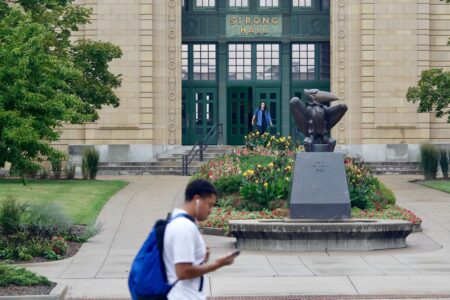
photo by: Dmitry Martirosov/Journal-World
Strong Hall, which houses the University of Kansas office of international affairs, is pictured on Wednesday, Sept. 30, 2026.
More than 400 international students at the University of Kansas could lose access to a longstanding program that allows them to stay in the country and get valuable post-college work experience.
Proposed changes by the Trump administration are threatening the program at KU and at universities across the country.
The Trump administration has noted there is an alternative, however: Universities could choose to pay the $70,000 fee. In the case of KU, that would require roughly $29 million. A KU leader recently told federal officials that is hardly realistic.
“It doesn’t make any sense,” Charli Bankart, KU’s vice provost for international affairs, told the Journal-World in an interview. “No institution is going to do it,” adding that that might be the whole point; the fees are so high that if no university pays them the program would cease to exist, he said.
“They haven’t revoked the regulatory ability to grant OPT,” Bankart said. “They’ve just made it unattainable because it’s no longer practical.”
The program under scrutiny from the Trump Administration is commonly known as Optional Practical Training, or OPT, which lets international students attending U.S. universities work temporarily in the country after the completion of their degrees. As proposed, the $70,000 fee would allow a graduate to work for up to 12 months in the U.S. If an additional $30,000 is paid, the graduate could work for up to a total of three years in the U.S., depending on their degrees.
Universities would be responsible for sending the fees to the federal government, although the Trump administration has said it is up to the universities whether they simply pass those fees along to international students in the form of higher tuition.
At KU, 418 international students are at risk of losing access to the program if the proposal goes through, Bankart said. Simply adding those fees on to their tuition bills isn’t realistic, he said.
International students typically pay full tuition to attend American universities, and most are ineligible for financial aid. Adding $70,000 to their bill would “effectively end” their ability to work in the U.S. after graduation, which would have ripple effects not only at KU, but across the Kansas economy, Bankart said in a comment submitted to the U.S. Department of Homeland Security.
Passing the fees on to KU’s international students is not feasible, Bankart added. If KU were to pay the fees itself for all 418 students who are currently participating in the program, however, that would have a “catastrophic financial impact” on the university, he said.
The fees, which the Department of Homeland Security announced last month, are just the latest in a list of proposals that the Trump administration has been trying to impose on international students as part of its crackdown on immigration. An earlier proposal seeking to limit international students’ stay in the U.S to four years was struck down by a federal district judge earlier this month. International students traditionally have been permitted to stay in the U.S. for as long as it took to complete their degrees.
The Department of Homeland Security said the proposals would help protect domestic jobs and strengthen U.S. immigration laws governing student visas, which it said have been exploited and have created “incentives for fraud and abuse.”
The new policies by the Trump administration have resulted in significant declines among international students attending U.S. universities, including at KU.
International student enrollment at KU declined 8% this fall, adding to last year’s 3% decline. At 1,778 students this fall, KU has its smallest international student population since at least 2017, the last year for which data was available. Then, KU had more than 2,300 international students enrolled.
Nationwide, enrollments have fallen more sharply. The share of new international student enrollment in the U.S. has plummeted by 15%, according to the Institute of International Education, which tracks international student enrollment in the U.S. That’s in addition to last year’s nearly 18% drop, and the 7% drop from the year before.
International student enrollment nationwide has fallen across all levels this fall. Undergraduates saw a 3% decline; graduate students a 15% decline; and students participating in OPT a 6% decline, according to the institute.
“It is not a hospitable immigration environment for international students, or for anyone who has come to the United States, either documented or undocumented,” Bankart said. “It is a hostile environment.”
But Bankart also cautioned against attributing the declines to any one factor.
“I think it’s easy to say that the current immigration policies and processes, the stance of the administration in Washington, D.C., has resulted in international enrollment declines in the United States,” he said. “I think it’s important to be very clear that I think what we have seen is an acceleration of a decline that really started back in 2016 — nationally, but also at KU.”
Among a number of factors that have been impacting international student enrollment at KU, Bankart pointed to recent policy changes in China that have resulted in fewer students from the country enrolling at the university. Chinese students still make up the largest share of international students at KU, but their numbers have declined by more than half over the past decade. Chinese students once comprised half of KU’s entire international student population, Bankart said. Now it’s about one fifth.
Around the same time that the share of students from China has been declining, KU saw an influx of graduate students from India enrolling at the university who were pursuing master’s degrees in computer science and engineering. But that has also been disrupted. This time artificial intelligence is the likely reason, Bankart said. The share of students from India dropped by 25% this fall, adding to last year’s decline of 20%.
Nationally, uncertainty surrounding the visa application process has been the No. 1 reason for international student declines, according to a survey by the Institute of International Education of more than 800 universities. Long wait times and visa denials have led many to opt out for other destinations, the institute found. Other reasons cited in the institute’s annual report were travel restrictions and a feeling of not being welcome in the U.S.
“You can come here, you can devote all of your time, passion, energy, and developing your knowledge and skills, but then you gotta leave, and don’t let the door hit you on your way out,” Bankart said. “It doesn’t make sense. That’s how it feels, I think, to many international students.”
Optional Practical Training is one of the main factors driving international students to attend U.S. universities. The program, which was created during the Bush administration in 1992, allows students to gain work experience in a real world environment, as well as build a professional network that they can then take home with them when their visas expire.
About one third of the more than 1.1 million international students in the U.S. participated in the program last year, according to the institute. Many tend to remain connected to the institutions where they earned their degrees, Bankart said, leading to a global network of professionals.
Bankart pushed back against the Trump administration claim that international students take jobs away from Americans, saying the administration has it in reverse. Hiring someone with expertise who is at the top of their field, in fact, creates jobs, by making businesses and organizations more prosperous, he said.
“The cold, hard data support global engagement in every sector,” Bankart said.
KU
More than 400 international students at KU could lose access to program that allows them to work in the U.S.

KU study examines how states are approaching data center development – and there’s a few things Kansas could learn
From coming up with art project ideas to grading papers, AI is getting used at KU, but not all approve
KU eases high school GPA requirements to remain competitive with other colleges

KU takes big strides in race for AI, announcing new partnership and formation of academic advisory board