

KU students are skeptical of AI, but some see benefits; university signs new partnership and working on new AI degrees
Some students are cognizant of the risks posed by AI and turn away. Others believe adopting it is unavoidable.
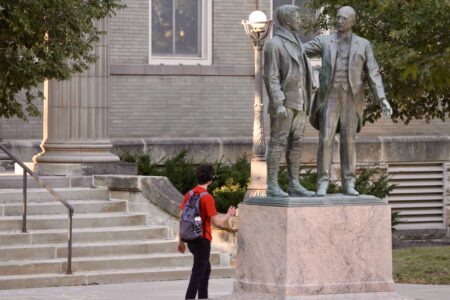
photo by: Dmitry Martirosov/Journal-World
A student walks past Lippincott Hall at the University of Kansas on Wednesday, Oct. 21, 2026.
Shubra Durgavathi doesn’t see the appeal of artificial intelligence. Not even a little bit.
The University of Kansas freshman is going so far as to avoid it that she no longer uses Google as her main search engine. She did so, Durgavathi said, to avoid the AI-generated summary Google started putting at the top of every search results page.
Durgavathi also isn’t thrilled with policies that allow professors to use AI when grading assignments, which she said can cause confusion. And she criticized the often-cited argument that AI eventually will solve the world’s most complex problems, as opposed to addressing more pressing concerns.
“There’s the promises of, ‘We’ll fix this in 10 years,’ and, ‘In 10 years everything will be great,'” Durgavathi said. “But what about right now?”
Durgavathi isn’t the sole objector to the technology that has been upending colleges nationwide. Other students at KU who oppose the use of AI pointed at its degrading qualities on fostering human connections, its diminishing effects on creativity, its impacts on students’ ability to learn deeply, and its disregard for the environment.
Surveys consistently show the use of generative AI among students is rampant. Students use it for school work, including summarizing assignments, generating ideas and drafting essays.
But several students who spoke to the Journal-World voiced opposition to the technology, saying that even though its appeal may be hard to resist, getting their money’s worth before entering the workforce, for instance, is more important.
Brady Nixon, a freshman studying atmospheric science at KU, said he uses generative AI in limited circumstances, such as to help explain complicated concepts. But that’s where he draws the line.
“I think it’s bad when you’re just using it to do the assignments,” he said. “You’re not learning anything. You’re just taking what the AI gives you and putting it in.”
He said many of his teachers encourage the use of AI, but also warn against abusing it. “I know I’m paying for all this … I might as well, you know, get stuff out of it,” he said.
One of the biggest drawbacks of generative AI is that it creates content from existing data rather than producing something original, said Ashley Sharma, a freshman double-majoring in visual arts and biology. This can limit students’ understanding of a topic and cause them to cite unreliable sources, she said.
“In the context of learning, AI just hands you the answer,” Sharma said. “Whereas if I was doing a research paper, then I am specifically searching through all these different sources.”
Like Durgavathi, Sharma isn’t happy with the idea of professors using AI to grade assignments, she said.
“I expect these people who are at the top of their field to actually put effort into grading my work,” she said. “They picked this job. It’s not like anyone forced them into it.”
But Sharma also see the benefits of AI, she said, particularly in areas like medicine and science. “In uses like that, I think AI is really great and helpful,” she said.
KU guidelines around the use of generative AI gives instructors discretion to tailor their own policies around each class.
Among students, AI can be a socially awkward topic of discussion. Polls show that a majority of students use it on a daily or weekly basis, but often report its use among its peers as more widespread than their own. More than 90% of undergraduates at Dartmouth College agree that AI harms writing skills, according to a recent study by the National Bureau of Economic Research. Yet more than 40% of these students use AI to summarize assignments and nearly 20% use it to draft essays, the survey found.
Payton Flory, a freshman studying theatre design, said it’s been discouraging to see some of her classmates using AI to generate project ideas. “Come on, it’s an art class,” she said.
She avoids using AI as much as she can, she said. She doesn’t use it to design, to generate ideas, or to conduct research. “I do all of my drawing myself,” Flory said. She’s been concerned with energy consumption associated with using AI, as well as the potential loss of human connection.
“Even with (AI) sort of breaking down certain topics and making things easier to understand, that’s still taking out the chance of asking another person to help you, or to explain it and making a friend, or getting a better relationship with a professor or a teacher’s assistant,” Flory said. “It’s just taking a human interaction out of your daily life.”
At KU, however, AI doesn’t appear to be slowing down. The university recently announced the formation a new academic advisory committee to “develop strategies for AI in academic settings,” including in teaching and classroom assessments. The school is also considering two bachelor’s degrees in AI, according to recent discussions by university officials, and last week announced a new public-private partnership with a Kansas-based AI firm specializing in cybersecurity. The Kansas Board of Regents, which governs KU and five other public universities, made AI its top priority when adopting its annual goals in September.
Some students don’t mind the heightened focus on AI.
“It’s inevitable,” said Dominick Hayes-Nigro, a finance major. “There’s nothing that we can really do to stop it.”
The freshman, who said he uses AI on a fairly regular basis to help him break down complicated concepts, also said he realizes overreliance on AI ultimately isn’t a good idea.
“I feel like most of the time I need like something to start my brain, you know, get the gears grinding,” said Sam Kirkpatrick, another finance major.
Kirkpatrick said he feels comfortable using AI. But like his peers, he is also aware of the risks of overusing it. He believes adapting to AI is important, not just for college students, but for everyone.
“I think everybody needs to be taught the basics of (AI),” he said.
KU
KU students are skeptical of AI, but some see benefits; university signs new partnership and working on new AI degrees

KU eases high school GPA requirements to remain competitive with other colleges

KU takes big strides in race for AI, announcing new partnership and formation of academic advisory board

Watkins health center to be renovated, not reconstructed
Housing and dining rates at KU may go up again next year to adjust for inflation and maintenance needs