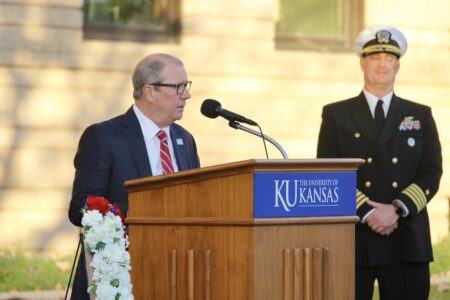

‘We’re on the head of a pencil’: KU’s top financial official highlights rocky path ahead
The university if bracing itself for smaller class sizes that could impact its bottom line
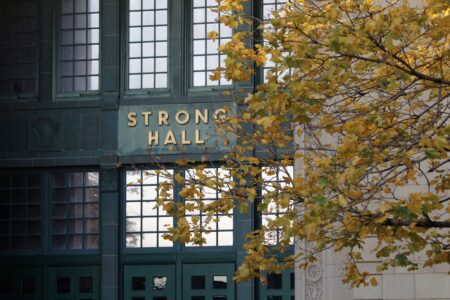
photo by: Dmitry Martirosov/Journal-World
The University of Kansas Strong Hall is seen on Wednesday, Nov. 11, 2026.
The University of Kansas may soon find itself in an $8 million hole if it does nothing to adjust for a 3% pay increase that was approved for eligible employees earlier this month.
That is the worst outcome. The best outcome is to break even, KU’s Chief Financial Officer Jeff DeWitt said. This could become the university’s new financial reality for the next several years, DeWitt added, a result of the many challenges facing higher education that he outlined in a presentation on Tuesday.
In no shortage of detail, DeWitt, who’s been KU’s highest-ranking financial official for the past six years, presented what is rapidly becoming the new normal for many of the nation’s higher education institutions. And if adjustments are not made, he warned, any new investments at KU may come at the expense of existing programs.
“We’re on the head of a pencil,” DeWitt said.
Across the nation, universities both public and private increasingly have been facing a set of challenges in recent years that is becoming all-too-familiar, many of which DeWitt highlighted on Tuesday.
Federal funding has become both unreliable and unpredictable; the so-called “demographic cliff” — or the shrinking population of 18-year-olds — yields fewer freshmen who enroll each year; state funding that is stagnant, or, in some cases, decreased; and a public perception of higher education that is worsening.
All of these affect a university’s bottom line, and KU is no different, DeWitt said.
“We are not in a place where we can handle all these challenges that we have. We need to do something about them,” he said.
Among DeWitt’s concerns is an enrollment projection for first-time freshmen that he said is either going to decline or flatten, depending on how successful KU is at attracting new students. The university has been setting overall enrollment records in recent years, but it’s the new crop of freshmen that arrive each fall that is vital to sustain KU’s revenue projections.
DeWitt on Tuesday revealed that enrollment for first-time freshmen at KU is projected to stagnate through at least the next four years.
“That’s what the forecast assumes,” he said, adding “we are going to have to do things to keep it where it is.”
KU set its enrollment record for first-time freshmen in 2024, when 5,323 students became the newest Jayhawks. In 2025, that number dropped to 5,040, and this fall it slid further to 4,834.
Smaller class sizes mean fewer dollars coming in. It also means more intense competition among universities who are bidding for smaller pools of students.
DeWitt said KU is projecting nearly $10 million less in revenue in the 2028 fiscal year as a result of decreased enrollment among first-time freshmen. The school is projecting that number to increase to more than $20 million in the following fiscal year, and to more than $24 million each in the two fiscal years after that.
Some of that decline is projected to be offset by a more aggressive push toward online enrollment, DeWitt said, which is anticipated to bring in more than $12 million annually by 2031.
“Unless we can get that enrollment back to those record levels, so we don’t have to drop off, that’s a reality,” DeWitt said. “We rode it up, and now we’re gonna ride it down — and hopefully gradually, where we can land it and not have a lot of negative impact.”
DeWitt on Tuesday also revealed that out-of-state students are not coming to KU at the same levels they once were. Universities are fighting to keep their students enrolled in colleges within their states, DeWitt said.
“It’s getting harder and harder,” DeWitt said. “Not only to attract in-state students … but out-of-state students as well.”
KU brings in about $380 million each year in tuition and fees, according to DeWitt. That’s about 19% of its total revenues. The majority of the school’s funding comes from federal grants, about $480 million. State appropriations account for $340 million.
Federal funding, however, has become unreliable, with many top research universities — including KU — unable to predict what projects to fund and how much staff to keep.
A few months ago, DeWitt said, university officials were concerned about taking a 40% hit to its federal grant dollars because they were not seeing money coming in. But toward the end of the fiscal year, he added, KU suddenly started seeing federal grant money coming in again — and in some instances at even higher levels than before.
Just a few months ago, DeWitt noted, KU was trying to figure out how not to lay off some of its researchers.
“It was really, really wild in the last six months,” he said.
KU is also experiencing the impacts of rising inflation — something state officials in Topeka are not being very helpful about, according to DeWitt.
In the 2008 fiscal year — the point at which state funding for KU started to decline — KU received $151 million in state appropriations; in 2027, it received $179 million. That’s an 18% increase, while inflation rose 60% during that same period.
DeWitt said KU officials are not expecting an increase in state appropriations for the next fiscal year either.
“And that’s just the reality we have to deal with,” he said.
KU
‘We’re on the head of a pencil’: KU’s top financial official highlights rocky path ahead
KU scientists awarded $10M grant to make extraction of complex chemicals safer

Dole Institute of Politics to hold post-election conference featuring former Kansas governor

KU Health System announces new CEO for St. Francis Campus in Topeka, other leadership roles

Kansas Public Radio to host Live Day event at Lawrence Public Library