
KU eases high school GPA requirement to remain competitive with other colleges
In one of its admissions pathways, students with a 3.0 GPA will be admitted automatically, down from 3.25
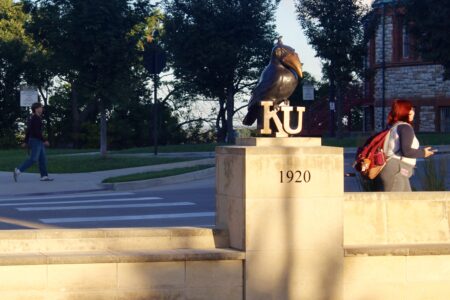
photo by: Dmitry Martirosov/Journal-World
A student walks past Ascher Plaza at the University of Kansas on Tuesday, Sept. 22, 2026.
Incoming freshmen seeking to be admitted to the University of Kansas may soon do so with a lower grade point average than what is currently required after a new set of regulations was approved by the Kansas Board of Regents.
Starting fall 2029, KU will begin offering automatic admissions to high school applicants under 21 years old who have either a 3.0 GPA, or a combination of 2.5 GPA and an ACT score of 24 or higher. Under KU’s existing admissions criteria, incoming freshmen are required to have a 3.25 GPA, or a combination of 2.0 GPA and an ACT score of 21 or higher.
The change, which Regents gave final approval to last week, aims to bring KU in line with other research universities in the Midwest that typically require a 3.0 GPA for automatic admission, according to KU officials. By lowering the GPA from 3.25 to 3.0, the officials explained, KU will become more competitive by enrolling students who may have planned to attend the university but chose another school instead because their GPA meant they weren’t automatically admitted.
That is what KU is hoping to change.
“So really what is happening, we have a small number of students who are kind of getting caught who are from Kansas, who send their application in to KU and (the University of Missouri) and MU immediately sends them a letter back saying ‘You’re admitted,’ and KU doesn’t because it’s not qualified — or automatic — acceptance,” Barbara Bichelmeyer, KU’s former provost, said at a Regents meeting last year.
According to MU’s admissions office, the school doesn’t offer automatic entry to students who have a 3.0 GPA, and instead implements a combination of GPA and test scores. Bichelmeyer used MU as one of several examples to make her case.
Another reason KU is adopting the changes is to offer a second chance to high schoolers who may have struggled early on for a variety of reasons and had their GPA suffer as a result.
“A freshman in high school may not always make the best decisions, or they could have an off-year,” Regent Diana Mendoza said.
Jennifer Bonds-Raacke, the Regents’ president and CEO, said during last week’s meeting that the changes are being adopted to allow KU to be more “timely and competitive” with neighboring states as in-state students are making their decisions.
The changes suggest that KU is taking a more aggressive approach to its enrollment and recruitment efforts in the face of increasing pressures across higher education. The university if expecting a period of stagnant or declined enrollment for first-time freshmen over the next several years, according to Jeff DeWitt, KU’s chief financial officer, an outcome attributed primarily to the declining birth rate in the U.S. The university’s finances are also exceedingly tight, DeWitt said, and if changes are not implemented KU could face a budget shortfall as early as next year.
Not everyone was fully on board with KU’s changes to its admissions criteria during discussions. Regent Neelima Parasker raised the point that lowering KU’s GPA could spike the university’s already high acceptance rate and make the school less appealing to prospective students as a result. If that happens, she said, students may opt to attend other state universities with lower acceptance rates but that are not necessarily offering an education that is superior to KU’s.
“Are we trying to increase (our acceptance rate) or are we trying to find quality students?” Parasker asked during a Regents’ committee meeting last year.
“This is pretty close to my heart,” Parasker said. “Because there are a lot of smart kids going away from Kansas because we have a huge acceptance rate. And I am not saying that we are not attracting really smart, local kids. But they are looking at our acceptance rate and saying ‘You know what, I want to take my education somewhere else.'”
Parasker said she worries that lowering the GPA to 3.0 could attract students who are ill-prepared for a rigorous level of education.
KU’s acceptance rate is in fact higher compared to its peers, hovering at 92% over the past two decades. MU’s is around 80%; University of Arkansas’ is around 75%; and University of Iowa’s is around 82%. KU’s acceptance rate dropped below 90% only three times since 2007 — in 2013, 2022 and 2023 — and this fall reached a new high when 94.3% of all applicants were admitted.
But a high acceptance rate does not reflect the quality of a school or the level of education it offers. Even though its acceptance rate is higher than its peers, KU’s retention rate has only improved over the years, hitting a new high last year with 88% of first-time freshman staying at the university for their sophomore year. The university’s six-year graduation rate has also improved, reaching 70% in fall 2019 — which is above the national average of 61%.
“Our goal is always, we want to be both accessible and excellent,” Nick Stevens, KU’s vice provost for enrollment management, said last year. “Part of this balancing, being an accessible institution and also having excellence, it’s a friction point that we are constantly having to reevaluate and rebalance.”
KU
KU eases high school GPA requirement to remain competitive with other colleges

KU takes big strides in race for AI, announcing new partnership and formation of academic advisory board

Watkins health center to be renovated, not reconstructed
Housing and dining rates at KU may go up again next year to adjust for inflation and maintenance needs

‘We’re on the head of a pencil’: KU’s top financial official highlights rocky path ahead