

KU takes big strides in race for AI, announcing new partnership and formation of academic advisory board
The university is also considering two bachelor's degrees in AI

photo by: Associated Press
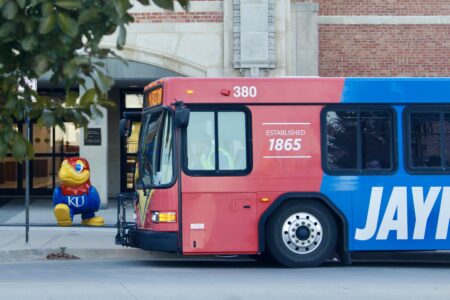
A bus makes its way along Jayhawk Boulevard in front of Strong Hall on the University of Kansas campus in Lawrence, Thursday, Oct. 24, 2019. (AP Photo/Orlin Wagner)
Artificial intelligence has become ubiquitous in Americans’ everyday life — and at the University of Kansas it has become especially pronounced lately.
Several recent developments are taking shape at the Lawrence campus.
The university is considering two bachelor’s degrees in AI — a bachelor of science and a bachelor of arts — according to Ric Steele, KU’s vice provost for academic affairs, who shared the information at a Kansas Board of Regents committee meeting last month.
Provost Arash Mafi announced the creation of a new AI advisory board last week to help the Lawrence and Edwards campuses develop AI strategies in academic settings.
And on Tuesday, the university announced a new private-public partnership with a Kansas-based AI firm specializing in cybersecurity.
The charge for the new Academic AI Advisory Board is to broaden the understanding of AI among students, faculty and staff at the two campuses, including the technology’s capabilities and limitations. The board, which consists of 14 professors from a variety of academic disciplines, is already working on developing AI literacy courses for students.
KU’s partnership with SOFTwarfare, a Prairie Village-based company founded in 2017, will bring the university’s Institute for Information Sciences together with the cybersecurity company to improve security measures and identify threats, among other initiatives. The company has an office in the District of Columbia and has previously partnered with the U.S. Department of Defense.
The announcements are not unique to KU: They are the latest in a spree of new initiatives across the Kansas higher education landscape to integrate AI into university settings.
Eighty miles west, Kansas State University is already making plans to offer a new master’s degree in AI after getting the program approved by the Regents earlier this week. The Manhattan-based school is not being coy about its drive to implement the technology into its classrooms, either: The school is well on its way to getting another program approved. This time, a reduced-credit bachelor’s degree in AI and autonomous systems. The 94-credit program will offer students an even faster route into the workforce.
The push for AI is also not limited to individual schools. The Kansas Board of Regents, which governs KU, K-State and four other public universities, made AI its number one priority when adopting its annual goals in September — above effective governance and cultivating relationships. On Wednesday, Regent Neelima Parasker provided an update on the Regents newly-formed Artificial Intelligence and Postsecondary Innovation task force. Parasker, who serves as president and CEO of a software and technology company in Overland Park and is the chair of the task force, described it as a “think tank with a mandate for action.”
It wasn’t immediately clear whether anything in particular prompted KU to pursue its initiatives. A set of questions the Journal-World sent to a university spokesperson went unanswered on Thursday.
Tinkering with AI has become nearly impossible to avoid in recent years, whether in academia or elsewhere. The share of employees who use AI in the workforce at least once a week grew by 10 percentage points from August 2024 through May of this year, according to a presentation by Donna Ginther, an economist at KU.
But it is in learning settings like universities and high schools where AI use — especially when unauthorized — is most concerning and hardest to prevent. Various surveys show the use of AI among college students is significant, even when institutions explicitly prohibit its use.
A recent Gallup-Lumina Foundation survey of nearly 4,000 students pursuing two- or four-year degrees found that 57% say they use AI for schoolwork on a daily or weekly basis. At the same time, 53% say their school either discourages or prohibits the use of the technology.
At Dartmouth College, a survey of more than 1,200 undergraduates found that more than 43% use AI to summarize reading assignments and about 17% use it to draft essays. About 10% use AI-generated answers to prompts without first understanding the answer. The survey also included results from a sample of 1,000 college students attending universities across the U.S., and found that nearly 40% use AI to summarize reading assignments and nearly a quarter use it to draft essays.
Such trends are not limited to American universities. The Higher Education Policy Institute, a United Kingdom-based independent think tank, found that the share of undergraduates using any AI tool for school assignments has jumped from 66% in 2024 to 92% last year, while those using generative AI tools like ChatGPT jumped from 53% to 88% in the same time period.
KU
KU takes big strides in race for AI, announcing new partnership and formation of academic advisory board
Watkins health center to be renovated, not reconstructed
Housing and dining rates at KU may go up again next year to adjust for inflation and maintenance needs

‘We’re on the head of a pencil’: KU’s top financial official highlights rocky path ahead
KU scientists awarded $10M grant to make extraction of complex chemicals safer