
New post-tenure review data for KU shows no dismissals, few denials
The report is the first to be released after the Kansas Board of Regents approved new rules in January.
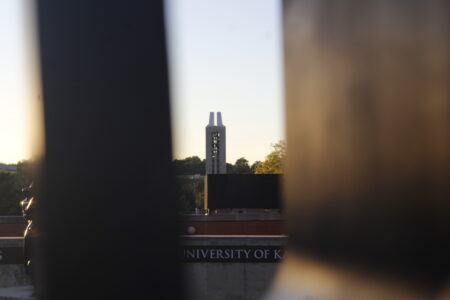
photo by: Dmitry Martirosov/Journal-World
Memorial Campanile at the University of Kansas is pictured on Tuesday, Sept. 22, 2026.
No University of Kansas faculty members were dismissed during the 2025-2026 academic year following a revised tenure policy that was approved in January, a new report shows, but some were denied tenure and one was placed on an improvement plan.
The report reviewed by the Journal-World is part of new data public universities under the purview of the Kansas Board of Regents are now required to submit each year. Under the new rules, the six Regents universities are required to provide information, at a minimum, on the number of faculty members who are subject to a post-tenure review, how many were placed on an improvement plan as a result of a review, and whether any were dismissed.
Regents spent months studying the issue last year before signing off on the changes in January, which create a tougher tenure process for the roughly 1,500 faculty members at KU, as well as the hundreds of others at its peer institutions.
The data, which was released Tuesday by the Regents’ Academic Affairs Standing Committee, shows KU has denied tenure to 1.2% of tenure-track faculty members. The numbers also show KU to be the most selective when awarding tenure, with just 6.2% of tenure-track faculty earning the rank, or 16 members. KU had 258 tenure-track faculty members in the past academic year. Of the 745 tenured faculty members KU had during the 2025-2026 academic year, 44 were subject to a post-tenure review.
Reached for comment, KU’s Erinn Barcomb-Peterson said the university “is confident in our tenure policies and processes that support and uphold the academic and scholarly excellence of KU faculty,” adding that KU is “comfortable sharing the data with the board (of Regents).”
Tenure — a rank that provides job protections and safeguards academic freedom — is not without its critics. Opponents point that tenure turns professors from instructors in a classroom into researchers, and that it grants certain teachers job security they might not deserve. Proponents, on the other hand, say it’s a needed quality check that encourages risk-taking by academics that otherwise wouldn’t have been possible, in addition to providing stability and expertise on an array of topics.
The changes approved by the Regents themselves were spurred by doubtful lawmakers in the Republican-controlled Kansas Legislature who questioned whether there was too much latitude in deciding when a professor is no longer meeting expectations.
Some of the tightening approved in January include shortening the post-tenure review period by two years — from seven to five — and a review process that could, if certain conditions are unmet, lead to dismissal.
Here are the numbers of tenure-track faculty members who were denied tenure at each of the six Regents universities, including percentages, the number of tenured faculty who were placed on an improvement plan, and those who were subject to a post-tenure review.
Tenure-track faculty denied tenure:
• Emporia State: 2 (3.8%)
• Pittsburg State: 1 (1.8%)
• Fort Hays State: 1 (1.4%)
• KU: 3 (1.2%)
• Wichita State: 1 (1.1%)
• Kansas State: 0
Tenured faculty placed on improvement plan:
• KU: 1 (2.3%)
• Kansas State: 1 (1.4%)
• Emporia State: 0
• Fort Hays State: 0
• Pittsburg State: 0
• Wichita State: 0
Tenured faculty subject to post-tenure review:
• Pittsburg State: 18 (10.7%)
• Kansas State: 71 (10.6%)
• Wichita State: 27 (10.2%)
• KU: 44 (5.9%)
• Fort Hays State: 6 (3.6%)
• Emporia State: 1 (1.1%)
KU
New post-tenure review data for KU shows no dismissals, few denials
Excessive power, lack of civility and the economy drove young KU voters in midterm elections

Military helicopters to fly over Lawrence before KU vs. UCF game

Lawrence City Commission OKs up to $100M in bonds for second phase of KU’s Gateway project
KU to raise employee pay by 3% across all campuses